

Quick Summary
Choosing the best material for ready meal packaging depends on how the food is stored, transported, and consumed. Among common options like PP, CPET, PET, bagasse, and aluminum, each material serves a different purpose.
PP (polypropylene) stands out as the most practical choice for most ready meal applications due to its heat resistance, microwave safety, durability, and cost efficiency. It performs especially well for hot, oily, and delivery-based meals.
However, the best results come from matching the right material and structure to your specific product. Working with experienced suppliers like DASHAN ensures your packaging performs reliably in real-world conditions.
Introduction
The global ready meal market is expanding rapidly, driven by changing consumer lifestyles, urbanization, and the rise of food delivery platforms. From supermarket shelves to meal prep services and airline catering, ready meals require packaging that can withstand complex conditions—from production and transportation to reheating and consumption.
In this context, packaging is no longer just a container. It directly impacts:
-
Food safety
-
Shelf life
-
Product quality
-
Customer experience
-
Logistics efficiency
For food brands, importers, and distributors, one key question remains:
What is the best material for ready meal packaging?
The answer is not as simple as choosing a single material. Instead, it requires understanding how different materials perform under real-world conditions—and selecting the one that best fits your specific application.
What Defines the “Best” Packaging Material?
Before comparing materials, it’s critical to define what “best” actually means in a ready meal context.
Core Evaluation Criteria
| Criteria | Why It Matters |
|---|---|
| Heat resistance | Prevents deformation during reheating |
| Microwave/oven compatibility | Determines usability |
| Oil & moisture resistance | Prevents leakage and contamination |
| Structural strength | Ensures safe transport and stacking |
| Barrier performance | Affects shelf life |
| Cost efficiency | Impacts profitability |
| Sustainability | Meets regulatory and consumer expectations |
| Consumer experience | Influences purchase decisions |
A material that performs well across most of these categories is typically the most practical choice—not necessarily the most advanced one.
Common Materials Used in Ready Meal Packaging
Different materials serve different purposes. Understanding their strengths and limitations is essential for making informed decisions.
1. PP (Polypropylene)
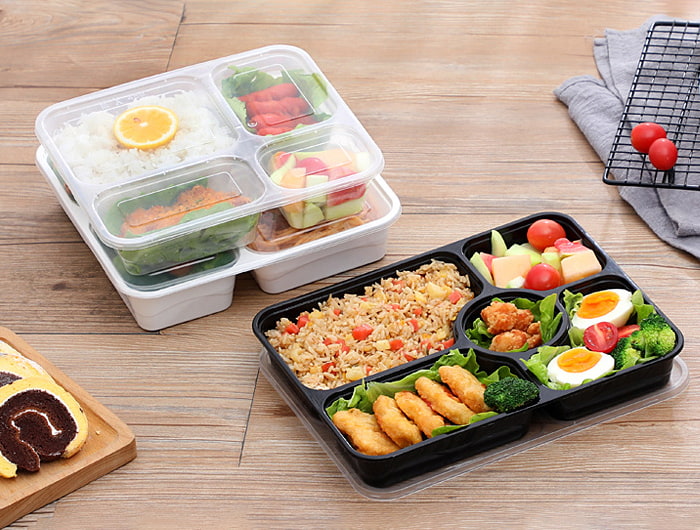
PP is one of the most widely used materials in ready meal packaging worldwide.
Key Advantages:
-
Microwave-safe
-
Heat resistant (up to 120–130°C)
-
Excellent resistance to oils and sauces
-
Lightweight and cost-effective
-
Durable for delivery and stacking
Limitations:
-
Lower transparency compared to PET
-
Not suitable for oven use
👉 Best for:
-
Microwaveable ready meals
-
Takeaway and delivery
-
Meal prep containers
2. CPET (Crystallized PET)
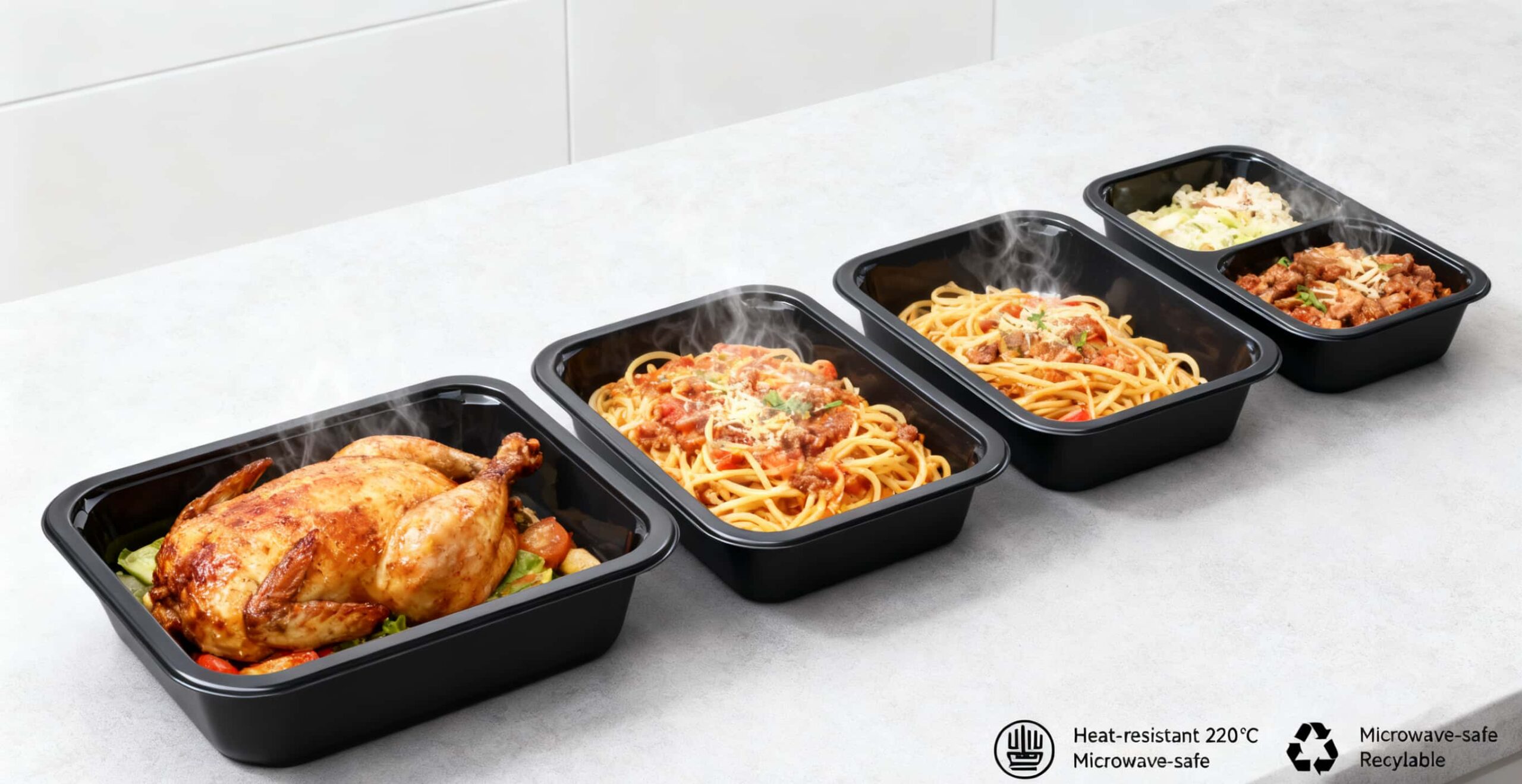
CPET is designed for high-temperature applications.
Key Advantages:
-
Oven-safe (up to 200°C)
-
High rigidity
-
Suitable for premium packaging
Limitations:
-
Higher cost
-
Less flexible design options
👉 Best for:
-
Airline meals
-
Oven-ready meals
-
High-end retail products
3. PET (Polyethylene Terephthalate)
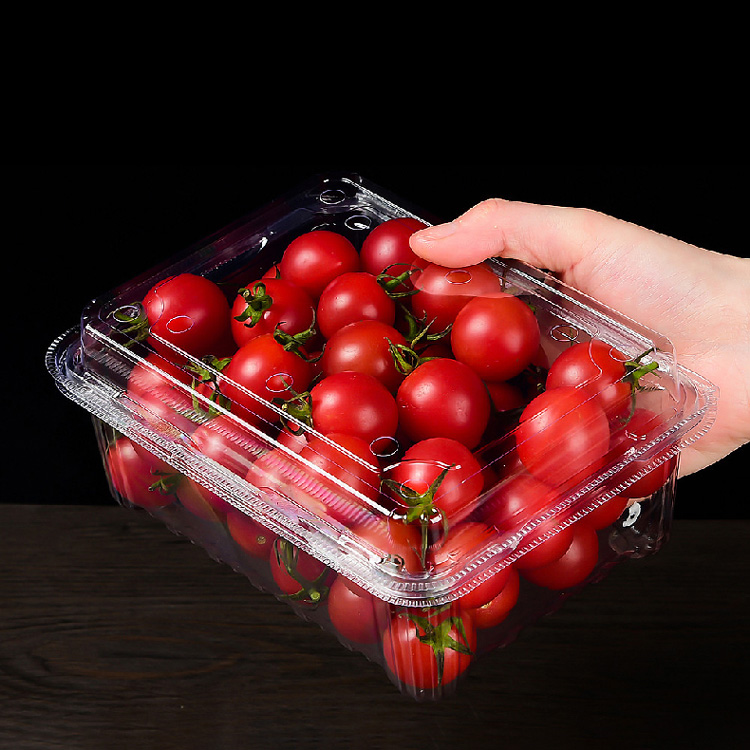
PET is known for its clarity and visual appeal.
Key Advantages:
-
High transparency
-
Good rigidity
-
Strong shelf presentation
Limitations:
-
Not microwave-safe
-
Lower heat resistance
👉 Best for:
-
Cold meals
-
Salads and fresh food
-
Display-focused packaging
4. Bagasse (Sugarcane Fiber)
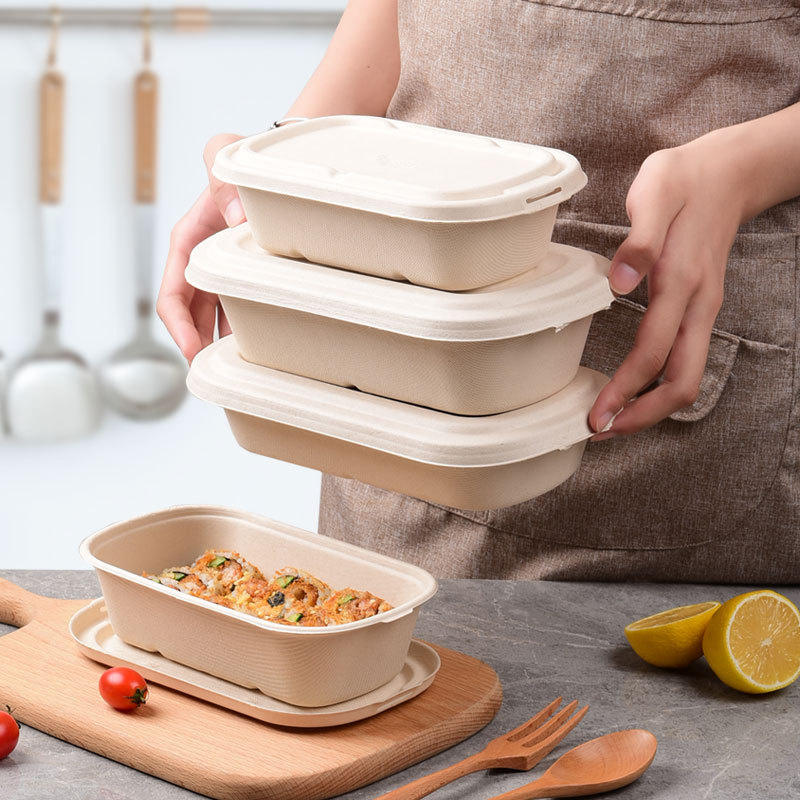
Bagasse is a biodegradable material derived from sugarcane pulp.
Key Advantages:
-
Compostable
-
Eco-friendly branding
-
Plastic-free perception
Limitations:
-
Weak oil resistance
-
Lower structural strength
-
Limited durability in delivery
👉 Best for:
-
Eco-focused takeaway
-
Light, dry foods
5. Aluminum Foil
Aluminum is commonly used for oven-ready packaging.
Key Advantages:
-
Excellent heat conductivity
-
Oven-safe
-
Strong barrier properties
Limitations:
-
Not microwave-safe
-
Higher cost
-
Less sustainable perception
👉 Best for:
-
Oven meals
-
Baked dishes
Material Comparison: A Practical Overview
This comparison helps buyers quickly evaluate which material fits their needs.
| Material | Heat Resistance | Microwave | Oil Resistance | Cost | Sustainability | Best Use Case |
|---|---|---|---|---|---|---|
| PP | ⭐⭐⭐⭐ | Yes | Excellent | Low | Recyclable | Hot meals |
| CPET | ⭐⭐⭐⭐⭐ | Yes | Excellent | High | Recyclable | Oven meals |
| PET | ⭐⭐ | No | Moderate | Low | Recyclable | Cold food |
| Bagasse | ⭐⭐⭐ | Limited | Weak | Medium | Compostable | Eco takeaway |
| Aluminum | ⭐⭐⭐⭐⭐ | No | Excellent | High | Recyclable | Oven food |
Which Material Is Best for Different Ready Meal Scenarios?
Instead of asking “which material is best,” a more practical approach is:
Which material is best for your specific use case?
Microwaveable Ready Meals
Best choice: PP
PP provides:
-
Stable performance under heat
-
Safe microwave use
-
Strong resistance to oil and sauces
Oven-Ready Meals
Best choice: CPET or Aluminum
These materials:
-
Withstand high temperatures
-
Maintain structure in ovens
Cold & Fresh Meals
Best choice: PET
PET offers:
-
Clear visibility
-
Strong shelf appeal
Eco-Focused Brands
Best choice: Bagasse (with limitations)
Good for:
-
Sustainability branding
But requires careful use:
-
Not ideal for oily or long-distance delivery
Delivery & Takeaway Meals
Best choice: PP
Because it balances:
-
Durability
-
Leak resistance
-
Cost efficiency
Why PP Is Often the Most Practical Choice
While no material is perfect, PP stands out for its balanced performance.
Key Reasons:
-
Works across multiple scenarios
-
Handles heat, oil, and transport stress
-
Cost-effective for large-scale operations
-
Compatible with microwave usage
PP is not the most extreme performer—but it is often the most practical solution.
For most ready meal businesses, especially those focused on takeaway and delivery, PP provides the best overall value.
Common Mistakes Buyers Make
Many packaging failures are not caused by material quality—but by incorrect selection.
Frequent Mistakes:
-
Choosing based on price alone
-
Ignoring food characteristics (oil, moisture)
-
Overlooking transportation conditions
-
Assuming eco-materials perform equally
-
Skipping real-world testing
These mistakes can lead to:
-
Leakage
-
Deformation
-
Customer complaints
-
Brand damage
How DASHAN Supports Ready Meal Packaging Solutions
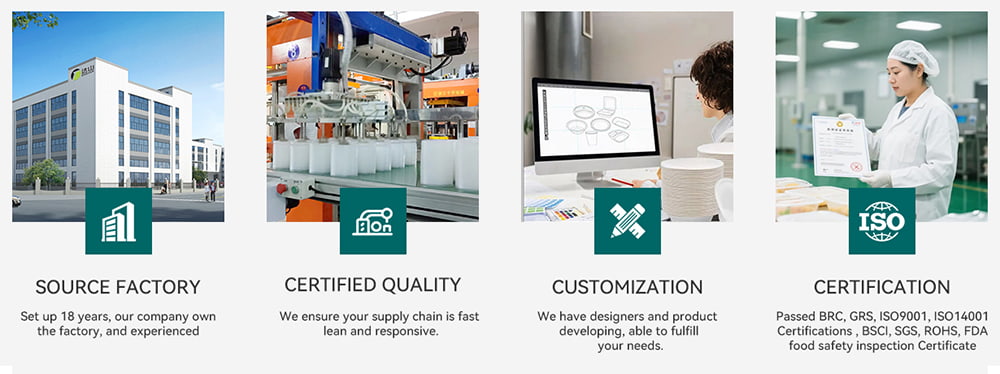
Choosing the right material is only part of the equation. The real challenge is applying it correctly.
This is where DASHAN provides value.
DASHAN’s Approach:
Instead of offering generic products, DASHAN focuses on:
-
Application-based material selection
-
Custom PP and multi-material solutions
-
Structural design optimization (anti-leak, stackability)
-
Cost-performance balance
Typical Solutions:
-
Microwaveable PP meal trays
-
Multi-compartment takeaway containers
-
High-strength delivery packaging
-
Custom designs for meal prep brands
Why It Matters:
For buyers, especially importers and food brands:
-
Incorrect packaging = hidden costs
-
Correct design = long-term efficiency
DASHAN helps bridge the gap between material theory and real-world application.
Future Trends in Ready Meal Packaging
The industry is evolving, but performance remains critical.
Key Trends:
1. Mono-Material Packaging
More focus on recyclable PP systems
2. Lightweighting
Reducing material use without sacrificing strength
3. Hybrid Solutions
Combining:
-
Performance
-
Sustainability
-
Cost efficiency
4. Growth of Microwave-Ready Packaging
Driven by convenience-driven consumers
FAQ
1. What is the best material for ready meal packaging?
There is no single best material for all situations. PP is often the most practical choice for hot and microwaveable meals, while CPET is better for oven use, PET for cold meals, and bagasse for eco-focused applications.
2. Why is PP widely used for ready meals?
PP is popular because it offers a strong balance of heat resistance, microwave safety, oil resistance, and cost efficiency. It performs well in takeaway, delivery, and meal prep scenarios.
3. Is PP safe for microwave use?
Yes, PP is considered microwave-safe and can typically withstand temperatures up to 120–130°C, making it suitable for reheating ready meals.
4. When should I choose CPET instead of PP?
CPET is a better choice when your product requires oven heating. It can withstand much higher temperatures (up to 200°C), making it ideal for airline meals and premium ready meals.
5. Are eco-friendly materials like bagasse better than plastic?
Bagasse is more sustainable in terms of compostability, but it may not perform as well as PP in terms of oil resistance, durability, and leak prevention. The best choice depends on your priorities.
6. How do I choose the right packaging for my ready meals?
You should evaluate:
-
Food type (hot, cold, oily)
-
Heating method (microwave or oven)
-
Delivery conditions
-
Cost and branding requirements
Working with suppliers like DASHAN can help ensure the packaging design and material match your real application.
7. What are the most common packaging problems in ready meals?
Typical issues include:
-
Leakage from oily foods
-
Deformation under heat
-
Weak structure during delivery
These problems are often caused by incorrect material or design selection.
8. Why do buyers choose DASHAN for ready meal packaging?
DASHAN provides application-based packaging solutions, including customized PP trays and containers. They focus on real-world performance, helping businesses optimize packaging for heat, oil resistance, and delivery conditions while maintaining cost efficiency.
Conclusion
There is no universal “best” material for ready meal packaging.
The right choice depends on:
-
Food type
-
Heating method
-
Delivery conditions
-
Cost constraints
-
Brand positioning
However, in most real-world scenarios:
PP remains the most balanced and scalable solution for ready meal packaging—especially when properly designed and customized.
For businesses looking to optimize both performance and cost, the key is not just choosing a material, but choosing the right packaging solution for the right application.
References
-
U.S. Food & Drug Administration (FDA) – Food Contact Substances
https://www.fda.gov/food/food-ingredients-packaging/food-contact-substances-fcs -
European Food Safety Authority (EFSA) – Food Contact Materials
https://www.efsa.europa.eu/en/topics/topic/food-contact-materials -
European Commission – Plastic Food Contact Materials Regulation (EU) No 10/2011
https://food.ec.europa.eu/safety/chemical-safety/food-contact-materials/plastic-materials_en -
American Chemistry Council – Polypropylene (PP)
https://plastics.americanchemistry.com/plastics-market-data/market-resin/polypropylene/ -
British Plastics Federation – Polypropylene Applications
https://www.bpf.co.uk/plastipedia/polymers/PP.aspx -
ScienceDirect – Polypropylene in Food Packaging
https://www.sciencedirect.com/topics/materials-science/polypropylene -
OECD – Global Plastics Outlook
https://www.oecd.org/environment/plastics/
Copyright Statement
© 2026 Dashan Packing. All rights reserved.
This article is an original work created by the Dashan Packing editorial team.
All text, data, and images are the result of our independent research, industry experience,
and product development insights. Reproduction or redistribution of any part of this content
without written permission is strictly prohibited.
Dashan Packing is committed to providing accurate, evidence-based information and
to upholding transparency, originality, and compliance with global intellectual property standards.