

Quick Summary
Choosing between single-material and multi-material packaging suppliers is not just a purchasing decision—it is a strategic choice that affects performance, cost, and scalability.
Single-material suppliers offer specialization and may reduce unit costs, but they often struggle to support complex food applications involving different temperatures, oil content, and packaging formats. This leads to increased coordination, inconsistent quality, and higher operational risks.
Multi-material suppliers, on the other hand, provide application-based solutions by combining materials such as PP, PLA, and bagasse. This allows businesses to match packaging to real usage scenarios—hot meals, cold foods, and delivery conditions—while simplifying supply chain management.
For growing food businesses, the goal is not to choose one material, but to build a flexible packaging strategy. Working with a multi-material supplier like DASHAN helps reduce total cost, improve consistency, and adapt to changing market demands.
Introduction: Why Supplier Choice Matters More Than Material
When sourcing food packaging, most buyers focus heavily on materials—PP, PLA, bagasse, PET.
But in real business operations, the material itself is only one part of the equation.
What actually determines your packaging performance, cost efficiency, and long-term scalability is:
The type of supplier you choose.
Many businesses only realize this after facing issues such as:
- Packaging mismatch across product lines
- Inconsistent quality between suppliers
- Increasing operational complexity
This leads to a critical question:
Should you work with a single-material supplier or a multi-material packaging partner?
What Is a Single Material Supplier?
A single material supplier specializes in one category of material—for example:
- Only PP containers
- Only PLA cups
- Only bagasse tableware
Advantages
- Deep expertise in one material
- Potentially lower unit cost due to specialization
- Streamlined production processes
Limitations
However, these advantages come with clear constraints:
- Limited product range
- Inability to adapt to different food applications
- Need to coordinate multiple suppliers for different needs
👉 In practice, this means:
Single-material suppliers work well for simple, standardized requirements—but become restrictive as your business grows.
What Is a Multi-Material Supplier?

A multi-material supplier offers a range of materials and packaging solutions, such as:
- PP (for hot food and durability)
- PLA (for cold food and eco positioning)
- Bagasse (for fiber-based alternatives)
Core Capabilities
- Application-based material selection
- Integrated product portfolio
- Custom design and engineering
Key Value
Instead of forcing your business to adapt to one material, a multi-material supplier allows:
- Flexibility across different food types
- Consistency across product lines
- Simplified procurement processes
Key Differences: Single vs Multi-Material Suppliers
| Factor | Single Material Supplier | Multi-Material Supplier |
|---|---|---|
| Flexibility | Low | High |
| Product Range | Limited | Wide |
| Application Matching | Weak | Strong |
| Supply Chain Complexity | High | Low |
| Customization | Limited | Advanced |
| Risk Control | Lower | Better |
| Cost Structure | Lower unit cost | Optimized total cost |
👉 Key insight:
The difference is not just about materials—it’s about operational efficiency, risk management, and scalability.
Real Business Scenarios: When Single Material Suppliers Fall Short

Scenario 1: Mixed Menu (Hot + Cold)
A takeaway business offering:
- Hot meals
- Cold desserts
- Beverages
Requires:
- PP for hot food
- PLA or PET for cold items
👉 A single-material supplier cannot fully support this.
Scenario 2: Oil and Sauce-Heavy Food
Certain cuisines involve:
- High oil content
- Liquid sauces
These require:
- Strong leak resistance
- Heat stability
👉 Not all materials perform equally, and choosing the wrong one leads to failures.
Scenario 3: Expanding Product Lines
As businesses grow, they often need:
- Multiple packaging formats
- Custom branding
- Different specifications
Managing multiple suppliers leads to:
- Increased coordination
- Inconsistent quality
- Higher operational risk
👉 Conclusion:
The more complex your business becomes, the less efficient a single-material supplier is.
The Hidden Costs of Using Multiple Single-Material Suppliers
At first glance, working with specialized suppliers may seem cost-effective.
But in reality, businesses often underestimate the hidden costs:
1. Communication Overhead
- Multiple contacts
- Repeated specifications
- Increased management time
2. Inconsistent Quality
- Different production standards
- Variation in product performance
3. Supply Chain Misalignment
- Different lead times
- Inventory imbalance
4. Logistics Complexity
- Multiple shipments
- Higher freight costs
👉 Critical insight:
Buyers often focus on unit price, but overlook total operational cost.
Why More Buyers Are Switching to Multi-Material Suppliers
The shift toward multi-material suppliers is driven by real operational needs.
Key Reasons:
- Simplified supply chain management
- Better consistency across products
- Faster response to market changes
- Reduced risk of packaging failure
In markets like Europe, buyers are increasingly prioritizing:
- Reliability over lowest price
- Integrated solutions over fragmented sourcing
When a Single Material Supplier Still Makes Sense
To be objective, single-material suppliers are still suitable in certain cases:
- Highly standardized products
- Large volume of a single SKU
- Minimal variation in application
👉 For these businesses, specialization can be efficient.
How to Choose the Right Supplier for Your Business
Instead of focusing only on material, buyers should evaluate:
Key Questions:
- Do you handle both hot and cold food?
- Do your products involve oil or liquids?
- Do you require multiple packaging types?
- Are you scaling your business or entering new markets?
👉 Decision logic:
- Simple needs → Single material supplier
- Complex needs → Multi-material supplier
How DASHAN Supports Multi-Material Packaging Solutions
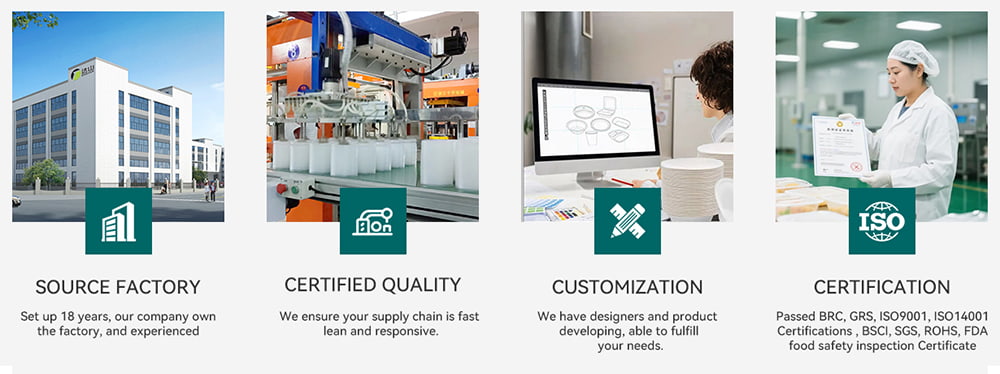
For businesses dealing with diverse food applications, choosing the right supplier is not just about product availability—it is about solution capability.
DASHAN’s Multi-Material Approach
DASHAN provides an integrated range of packaging solutions, including:
- PP containers for hot, oily, and delivery-focused applications
- PLA packaging for cold food and sustainability-driven use cases
- Bagasse products for fiber-based, eco-conscious positioning
Beyond Materials: Engineering-Based Solutions
What differentiates DASHAN is not just material variety, but how materials are applied:
- Structural design to improve leak resistance
- Thickness optimization to balance cost and strength
- Custom mold development for specific food applications
Real Benefits for Buyers
By working with a multi-material supplier like DASHAN, businesses can:
- Reduce the number of suppliers they manage
- Achieve more consistent product quality
- Lower total operational costs
- Adapt more quickly to market and regulatory changes
Instead of choosing between PP, PLA, or bagasse, DASHAN helps you choose the right solution for each application.
FAQ
1. What is the difference between single-material and multi-material suppliers?
Single-material suppliers focus on one type of material, while multi-material suppliers offer a range of materials and solutions tailored to different food applications.
2. Are single-material suppliers cheaper?
They may offer lower unit prices, but working with multiple suppliers often increases total operational costs due to logistics, communication, and inconsistency.
3. Why do businesses switch to multi-material suppliers?
Businesses switch to reduce supply chain complexity, improve product consistency, and better match packaging to different food scenarios.
4. When should I choose a single-material supplier?
If your business has a highly standardized product and requires only one type of packaging, a single-material supplier can be efficient.
5. What are the risks of using multiple single-material suppliers?
Common risks include:
- Inconsistent quality
- Higher logistics costs
- Longer lead times
- Increased coordination effort
6. What should I look for in a packaging supplier?
You should evaluate:
- Material matching capability
- Structural design expertise
- Customization flexibility
- Supply consistency
7. Can one supplier handle PP, PLA, and bagasse packaging?
Yes, multi-material suppliers like DASHAN can provide integrated solutions using different materials based on application needs.
8. How does a multi-material supplier reduce costs?
By simplifying procurement, reducing logistics complexity, and minimizing packaging failure risks, they help lower total cost rather than just unit price.
Conclusion: It’s Not About Materials—It’s About Strategy
The choice between single-material and multi-material suppliers is not just a technical decision—it is a strategic one.
- Single-material suppliers offer focus
- Multi-material suppliers offer flexibility
As your business grows in complexity, flexibility becomes increasingly valuable.
The goal is not to choose the “best material,” but to build a packaging strategy that works across all scenarios.
Final Thought
For businesses handling multiple food types, delivery conditions, and evolving customer expectations:
Working with a multi-material supplier like DASHAN provides a more scalable, efficient, and future-ready solution.
References
Authoritative Sources
- European Commission – Food Contact Materials
https://food.ec.europa.eu/safety/chemical-safety/food-contact-materials_en - European Commission – Packaging and Packaging Waste
https://environment.ec.europa.eu/topics/waste-and-recycling/packaging-waste_en - OECD – Global Plastics Outlook
https://www.oecd.org/environment/plastics/ - Ellen MacArthur Foundation – Circular Economy in Packaging
https://ellenmacarthurfoundation.org/topics/plastics/overview - European Environment Agency – Packaging Waste Trends
https://www.eea.europa.eu/themes/waste/packaging
Copyright Statement
© 2026 Dashan Packing. All rights reserved.
This article is an original work created by the Dashan Packing editorial team.
All text, data, and images are the result of our independent research, industry experience, and product development insights. Reproduction or redistribution of any part of this content without written permission is strictly prohibited.
Dashan Packing is committed to providing accurate, evidence-based information and to upholding transparency, originality, and compliance with global intellectual property standards.