

Quick Summary
CPET was developed because standard PET fails under sustained high heat. This article explains why CPET can handle oven and airline meal temperatures while PET cannot, clarifies their real performance boundaries, and helps buyers choose the correct material based on heat, food type, and usage scenario.
Food packaging rarely fails because a material is “bad.”
It fails because the conditions it faces quietly exceed what the material was designed to handle.
Among all stress factors in food packaging, heat is the most disruptive. Not because it is extreme, but because it is often combined with time, weight, moisture, and reheating. As foodservice evolved—from fresh meals to prepared foods, central kitchens, airline catering, and oven-ready products—traditional packaging materials began to show their limits.
CPET exists precisely because of this shift.
It was not created to replace PET, nor to compete with it. CPET was developed to extend PET into a thermal environment where standard PET can no longer remain structurally reliable. Understanding why CPET exists requires understanding how heat fundamentally changes the behavior of packaging materials—and why surface-level specifications often hide deeper risks.
1. When Heat Became the Real Packaging Challenge
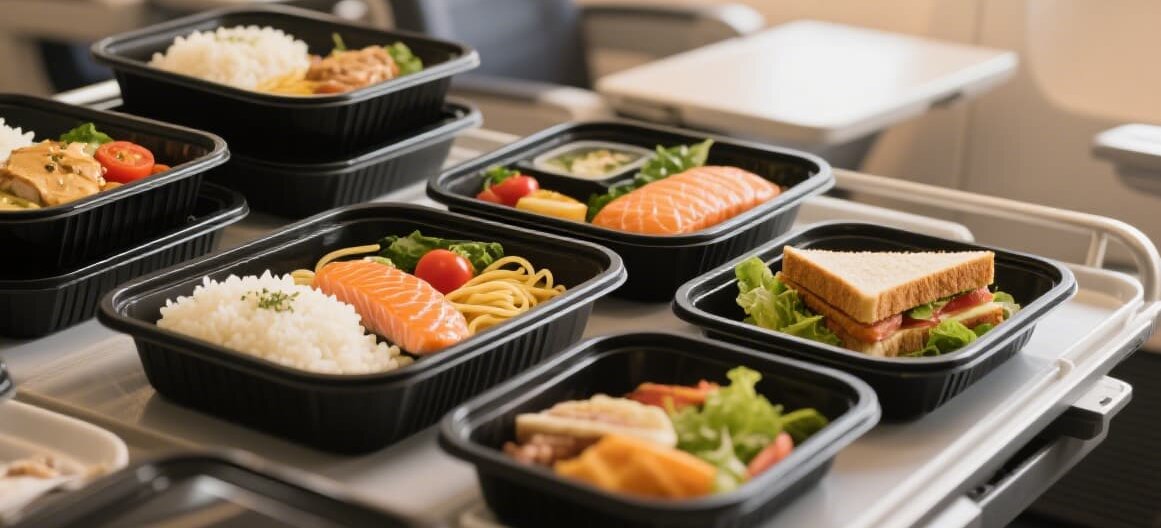
For many years, food packaging focused on protection, hygiene, and presentation. Temperature exposure was relatively predictable: food was packed, consumed shortly after, and rarely reheated inside the container.
That model no longer reflects reality.
Modern food packaging must survive:
-
Hot filling followed by sealing
-
Steam release after closure
-
Holding times of 30–90 minutes
-
Transport and stacking while hot
-
Microwave or oven reheating by the end consumer
In this environment, heat is not a moment—it is a process. Materials are stressed gradually, not instantly, and the failure is often delayed until the container is already in use.
2. What High-Heat Food Packaging Actually Demands
2.1 Temperature Is Only One Variable
Many buyers evaluate heat resistance using a single number: maximum temperature. This approach is misleading.
High-heat food packaging must handle:
-
Sustained exposure rather than short bursts
-
Combined thermal and mechanical stress
-
Load-bearing performance while softened
-
Dimensional stability over time
A container that survives brief heat exposure may still deform under weight, leading to seal failure or tray collapse.
2.2 Why Deformation Is the Real Risk
In most cases, packaging does not melt.
It softens just enough to lose structural integrity.
This leads to:
-
Warping that breaks lid seals
-
Tray sagging under food weight
-
Stacking instability during transport
These failures are subtle, progressive, and expensive.
3. Understanding Standard PET in Food Packaging
Before explaining CPET, it is important to clarify what standard PET does well—and why it remains essential in food packaging.
3.1 Where PET Excels
PET is widely used because it offers:
-
High clarity and gloss
-
Precise thermoforming
-
Good barrier properties
-
Reliable performance for cold and ambient foods
For salads, desserts, bakery items, and chilled meals, PET remains an excellent choice.
3.2 What Changes Under Heat
PET is an amorphous polymer in most food packaging applications. As temperature approaches its glass transition range, PET begins to soften.
This does not indicate poor quality.
It reflects material physics.
Under high heat:
-
Molecular mobility increases
-
Structural rigidity decreases
-
Load-bearing capacity drops
In applications involving reheating or prolonged heat exposure, this behavior becomes a limiting factor.
4. Why CPET Was Developed
CPET—Crystallized Polyethylene Terephthalate—was developed to address these thermal limitations without abandoning PET’s core advantages.
4.1 The Role of Crystallization
The key difference between PET and CPET is controlled crystallization.
Crystallization:
-
Restricts molecular movement
-
Increases heat deflection temperature
-
Improves dimensional stability under load
Rather than softening rapidly, CPET maintains shape and strength at temperatures where standard PET would deform.
4.2 Structural Stability at Elevated Temperatures
CPET trays are designed to:
-
Withstand oven temperatures
-
Maintain rigidity during microwave reheating
-
Support food weight without sagging
This makes CPET suitable for applications where packaging must remain functional throughout heating, holding, and serving.
5. What CPET Enables in Real Food Applications
CPET does not simply “handle more heat.”
It enables entire categories of food packaging that would otherwise be unreliable.
5.1 Oven-Ready Meals
Prepared meals designed for oven heating require:
-
Shape retention
-
Stable tray geometry
-
Reliable sealing throughout heating
CPET allows food to be cooked or reheated directly in the container.
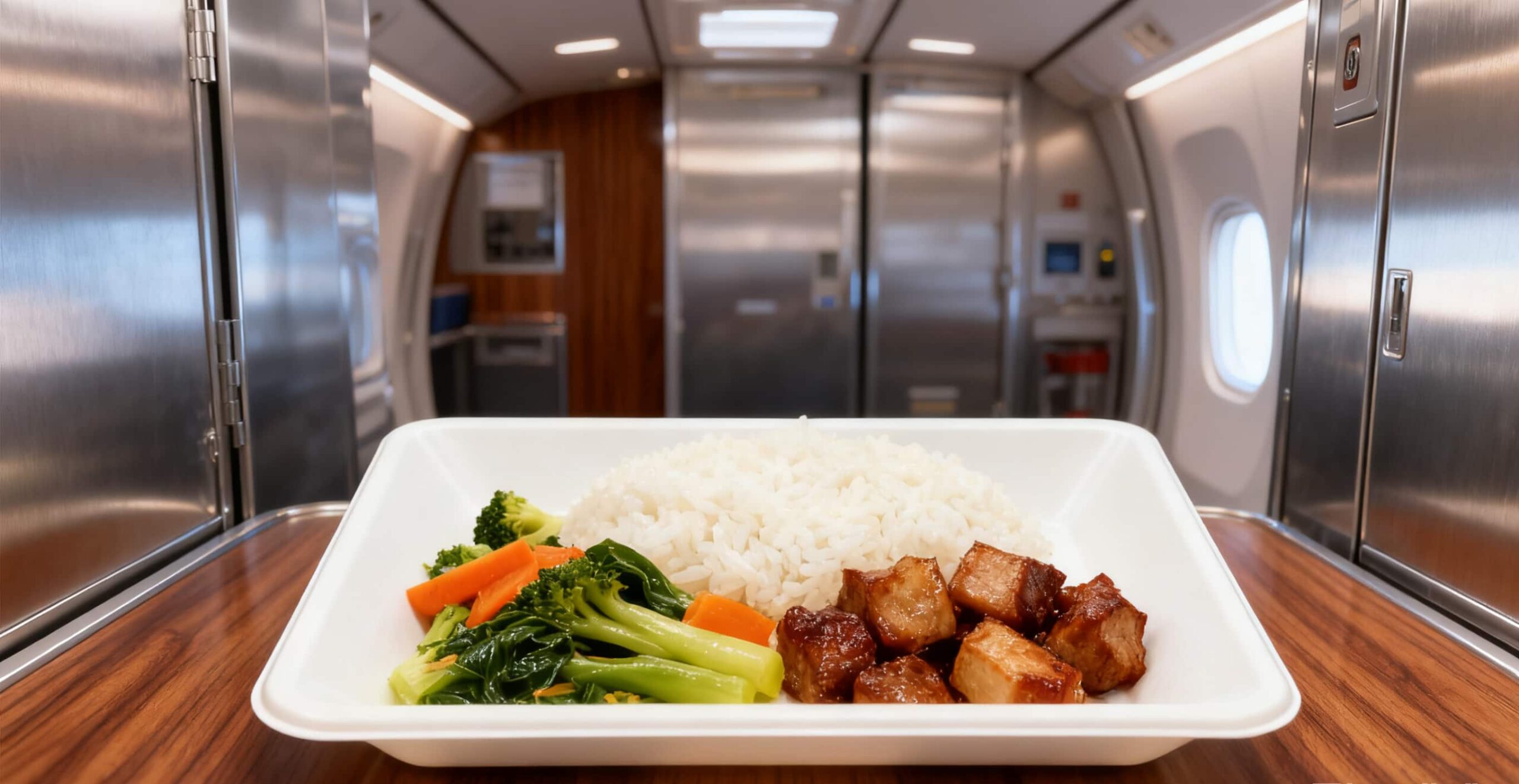
5.2 Airline and Institutional Catering
In airline catering and large-scale foodservice:
-
Meals are heated in bulk
-
Trays are stacked under load
-
Timing is tightly controlled
CPET provides the predictability required in these environments.
5.3 Central Kitchen Operations
Central kitchens depend on standardized processes. Packaging failure disrupts logistics and food safety.
CPET reduces variability by maintaining structural integrity across repeated heating cycles.
6. PET vs CPET: Understanding the Usage Boundary
 |
 |
At this point in the article, it is useful to clarify where PET ends and CPET begins, not as competitors, but as complementary solutions.
📊 PET vs CPET Usage Boundary Comparison
(Recommended placement: immediately after Section 6 on your website)
| Criteria | PET | CPET |
|---|---|---|
| Typical Use Temperature | Cold to warm | High heat |
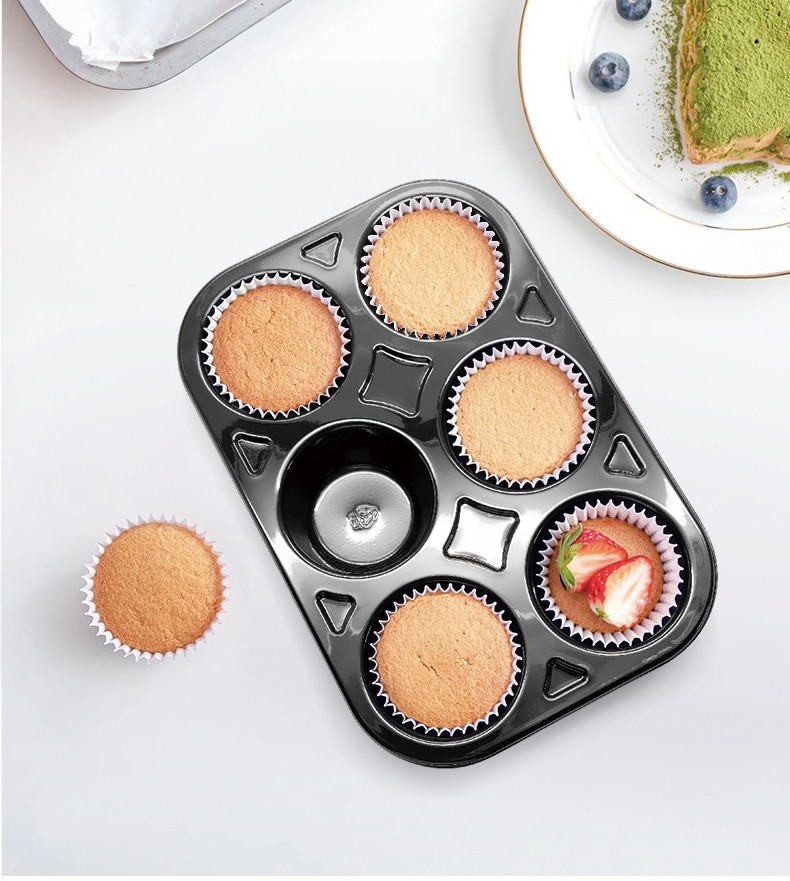
| Oven Compatibility | Not suitable | Oven-ready |
| Microwave Reheating | Limited | Designed for reheating |
| Structural Stability Under Heat | Decreases | Maintains shape |
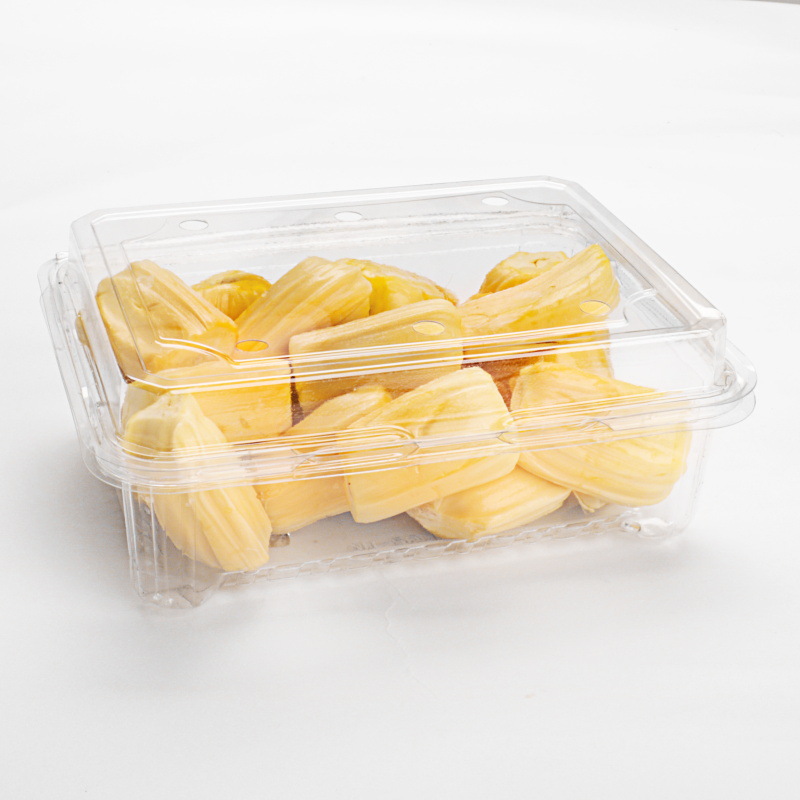
| Clarity | High transparency | Opaque |
| Common Applications | Salads, desserts, cold meals | Ready meals, airline trays |
| Design Goal | Presentation & efficiency | Thermal reliability |
Key takeaway:
PET and CPET serve different thermal zones, not different quality levels.
7. CPET Is an Extension of PET, Not a Replacement
One of the most common misunderstandings in material selection is the belief that newer or more specialized materials should replace older ones entirely.
This thinking leads to:
-
Overengineering low-risk applications
-
Unnecessary cost increases
-
Misaligned sustainability claims
CPET exists because PET performs exceptionally well within its intended range. When heat pushes beyond that range, CPET takes over.
8. When CPET Is the Right Choice
CPET should be considered when:
-
Food is reheated in the container
-
Heat exposure is prolonged
-
Structural stability is critical
-
Failure risk carries high downstream cost
In these scenarios, material predictability outweighs aesthetics.
9. When CPET Is Not Necessary
CPET is not always the optimal solution.
It may be unnecessary for:
-
Cold or chilled foods
-
Short-use takeaway items
-
Display-driven retail packaging
Using CPET in these cases adds cost without adding functional value.
10. How Experienced Manufacturers Apply PET and CPET Strategically
Experienced packaging suppliers rarely promote a single material across all applications.
At DASHAN, PET and CPET are positioned as problem-solving tools, selected based on:
-
Food temperature profile
-
Heating method
-
Holding time
-
Distribution conditions
This material-neutral approach helps customers avoid failures caused by mismatched expectations.
11. Sustainability Considerations in High-Heat Packaging
Sustainability discussions often focus on material type rather than system performance.
In high-heat applications:
-
Packaging failure leads to food waste
-
Food waste carries a higher environmental footprint than packaging
CPET can reduce overall environmental impact by preventing failure in scenarios where other materials cannot perform reliably.
FAQ
1. Why can CPET withstand high temperatures while PET cannot?
Because CPET is crystallized PET. The crystallization process changes the polymer structure, raising its heat resistance from ~60°C (PET) to 200–220°C, making it suitable for ovens and reheating.
2. Can PET be modified to replace CPET for hot food?
Not reliably. Additives or thicker PET may delay deformation, but PET still softens under sustained heat and cannot meet oven or airline meal requirements the way CPET does.
3. Is CPET safe for airline and oven use?
Yes. CPET is widely approved for airline meals, ready meals, and institutional catering because it maintains structural stability and food safety at high temperatures.
4. Why does CPET look black or opaque instead of clear?
Crystallization reduces transparency. Most CPET trays are black or dual-color to ensure uniform heating and prevent visual defects caused by crystallization.
5. Is CPET recyclable?
Yes. CPET is recyclable within PET recycling streams, although sorting infrastructure and color (especially black CPET) can affect recycling efficiency in some regions.
6. When is PET still the better choice?
PET is ideal for cold food, fresh display, salads, desserts, and chilled meals where clarity, appearance, and cost matter more than heat resistance.
Conclusion: CPET Exists Because Heat Changes the Rules
CPET was not created to improve PET—it was created to adapt PET to a harsher reality.
When food packaging enters high-temperature territory, assumptions based on cold or ambient use no longer apply. Structural stability, load-bearing capacity, and thermal predictability become essential.
Understanding why CPET exists is not about choosing the “better” material.
It is about choosing the right material for the conditions food actually experiences.
References
-
What Material Is CPET? — Material Properties and Suitability for High-Heat Food Packaging
Explains CPET’s crystallized structure, superior heat resistance from freezing to ovens, and why it maintains shape under extreme temperatures. What Material Is CPET? (JWELL) -
CPET/RPET Packaging Solutions — High Heat and Cold Performance
Summarizes CPET’s ability to withstand temperatures up to about 220°C and as low as −40°C, its food safety suitability, durability, and recyclability. CPET/RPET Packaging Solutions Overview (Euralpack) -
CPET: High-Performance Material for Diverse Applications
Describes CPET’s thermal stability up to 220°C, cold resistance down to −40°C, and suitability for food packaging that requires both heating and freezing performance. CPET High‑Performance Material for Packaging (SDZL Plastic) -
ScienceDirect — Semi-Crystalline PET (CPET) Material Properties
https://www.sciencedirect.com/science/article/pii/S2666086524000341 -
Packaging Technology Review — CPET Trays: High-Temperature Food Packaging Solution
https://www.hengmaster.com/application/cpet-packaging
Copyright Statement
© 2026 Dashan Packing. All rights reserved.
This article is an original work created by the Dashan Packing editorial team.
All text, data, and images are the result of our independent research, industry experience,
and product development insights. Reproduction or redistribution of any part of this content
without written permission is strictly prohibited.
Dashan Packing is committed to providing accurate, evidence-based information and
to upholding transparency, originality, and compliance with global intellectual property standards.