

Introduction: The Problem with the “Corn Starch” Label
In recent years, corn starch cups and cutlery have become synonymous with “eco-friendly” disposable food packaging. To many buyers, the term corn starch suggests a simple idea: products made directly from natural plant starch, molded into cups, forks, and spoons, and then safely returned to nature after use.
However, this perception is fundamentally flawed.
In reality, no commercially viable corn starch cup or cutlery product is made from pure corn starch alone. What the market commonly labels as “corn starch products” are, in fact, engineered composite materials, designed to behave like plastics under industrial processing and real food-use conditions.
This article explains why “pure corn starch” is not a functional material for disposable cups and utensils, what these products are actually made of, and why performance varies so dramatically between suppliers—even when products appear identical on the surface.
Understanding this distinction is critical for buyers who want to avoid breakage, deformation, customer complaints, and costly material mismatches.
1. What People Imagine vs. What Corn Starch Really Is
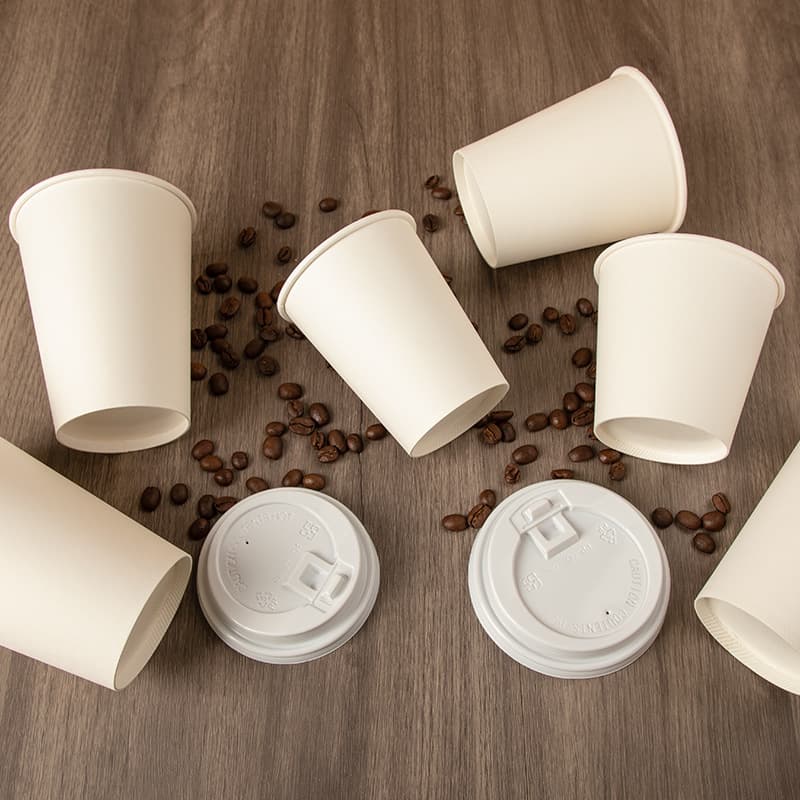
1.1 The Idealized Image of “Pure Corn Starch”
When buyers hear “corn starch,” they often imagine a natural powder extracted from corn kernels, pressed or molded into solid shapes. In theory, this sounds appealing: renewable, biodegradable, and plastic-free.
But corn starch, in its natural form, is not a structural material. It is a carbohydrate polymer designed by nature to store energy—not to bear loads, resist heat, or survive contact with liquids.
Pure corn starch has several inherent limitations:
-
Strong hydrophilicity (it readily absorbs water)
-
Low thermal stability
-
Poor mechanical strength
-
No inherent thermoplastic behavior
These characteristics make pure corn starch unsuitable for manufacturing rigid or semi-rigid food-contact products at scale.
1.2 Why “100% Pure Corn Starch” Cannot Exist in Practice
If one were to attempt producing cups or cutlery from pure starch:
-
The material would soften or dissolve upon contact with liquids
-
It would deform at low temperatures, far below hot beverage conditions
-
It could not be injection molded using standard industrial equipment
-
The resulting product would crack, crumble, or warp during normal use
In short, pure corn starch cannot meet even the most basic functional requirements of disposable food packaging.
2. Why Corn Starch Must Be Engineered to Behave Like a Material
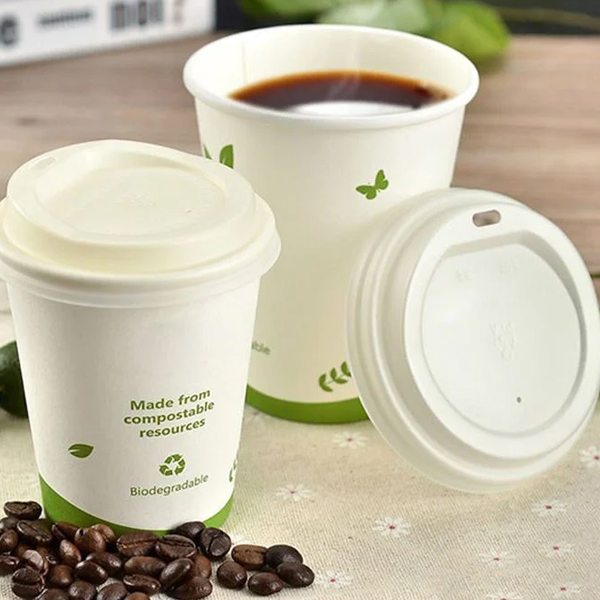
To transform corn starch from a food ingredient into a usable packaging material, it must undergo extensive modification.
2.1 Modified Starch: From Powder to Processable Substance
Modified starch is chemically or physically altered to improve:
-
Thermal behavior
-
Processability
-
Compatibility with other polymers
This modification allows starch-based materials to flow under heat and pressure—an essential requirement for injection molding and thermoforming.
However, even modified starch alone remains insufficient for most real-world applications.
2.2 Polymer Blending: The Unavoidable Reality
To achieve usable strength, flexibility, and dimensional stability, starch must be blended with polymers, most commonly:
-
PLA (polylactic acid)
-
PBAT
-
Other biodegradable or semi-synthetic polymers
These polymers provide what starch cannot:
-
Structural integrity
-
Controlled deformation
-
Resistance to short-term heat exposure
-
Improved molding consistency
At this point, the product is no longer “corn starch” in a material-science sense—it is a starch–polymer composite.
3. Additives: The Hidden Components That Define Performance
Beyond starch and polymers, corn starch cups and cutlery rely heavily on additives that rarely appear in marketing descriptions.
3.1 Plasticizers
Plasticizers increase flexibility and reduce brittleness. Without them, starch-based products would fracture easily under stress.
However, plasticizers also:
-
Reduce heat resistance
-
Increase sensitivity to moisture
-
Affect long-term stability
3.2 Processing Aids and Stabilizers
These additives improve:
-
Flow during molding
-
Surface finish
-
Short-term dimensional consistency
Their presence further distances the final product from the idea of “pure starch.”
3.3 Why Labels Rarely Reflect Reality
Most buyers see a single label—corn starch—but that label masks a complex formulation. Two products with identical labels may behave completely differently due to variations in polymer ratios, plasticizers, and additives.
4. Why Corn Starch Cups and Cutlery Are Fundamentally Different Problems
One of the most common misconceptions is that cups and cutlery can share the same formulation. In reality, they face entirely different mechanical and environmental stresses.
4.1 Corn Starch Cups: Long-Term Load + Heat + Liquid
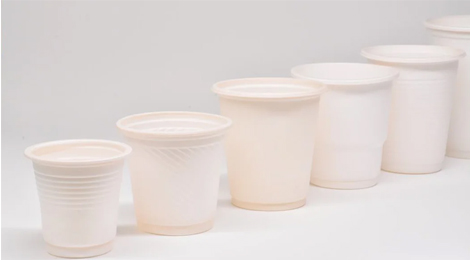
Cups must withstand:
-
Continuous liquid contact
-
Internal pressure from filled beverages
-
Elevated temperatures (hot water, tea, coffee)
-
Time-dependent softening
Starch-based materials absorb moisture over time, leading to:
-
Loss of stiffness
-
Wall deformation
-
Structural collapse under load
Even when a corn starch cup performs acceptably for cold drinks, its behavior can change dramatically with hot or acidic beverages.
4.2 Corn Starch Cutlery: Short Use, Extreme Stress
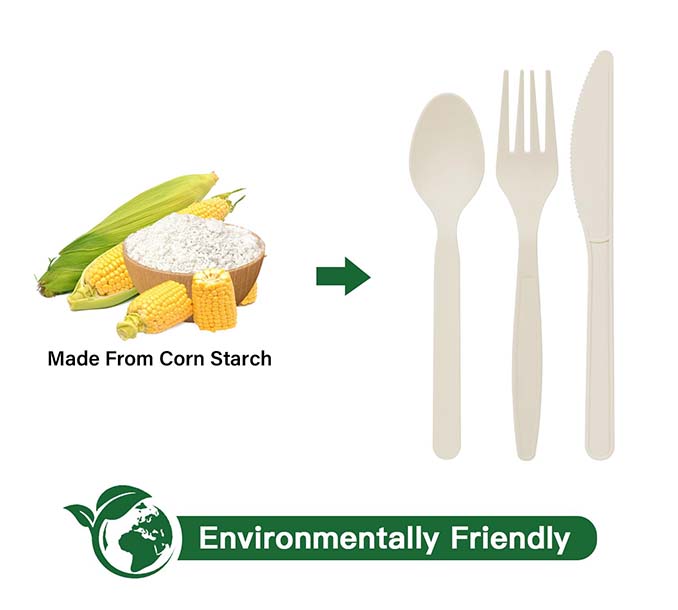
Cutlery faces a different challenge:
-
High bending stress during use
-
Concentrated forces at thin sections
-
Cutting and prying motions
-
Occasional biting pressure
These forces act quickly and locally, exploiting weaknesses in the material’s internal structure.
4.3 Why One Formula Cannot Serve Both
A formulation optimized for cups (higher stiffness, lower plasticizer content) will often be too brittle for cutlery. Conversely, a cutlery formulation with higher flexibility may be too soft for cups.
Attempts to use one universal formula inevitably result in compromise—and performance complaints.
5. Why Thickness Does Not Solve Corn Starch Product Failures
A common buyer assumption is that increasing thickness improves strength. For starch-based materials, this logic is misleading.
5.1 Material Behavior vs. Geometry
Thickness increases mass, but it does not change:
-
Moisture absorption behavior
-
Glass transition temperature
-
Polymer–starch interaction
As a result, thicker products may:
-
Bend more slowly—but still bend
-
Fail later—but still fail
-
Create false confidence during short tests
5.2 Why Failures Appear in Real Use, Not Sampling
Short-term sample testing often misses:
-
Time-dependent softening
-
Repeated stress cycles
-
Environmental humidity effects
This explains why products that “passed samples” fail after mass deployment.
6. Processing Matters as Much as Formulation
Even with the same formulation, performance can vary significantly between factories.
6.1 Injection Molding Effects
Processing parameters influence:
-
Molecular orientation
-
Internal stress distribution
-
Weak points along flow lines
Poorly controlled molding can create invisible fracture paths that only appear under real use.
6.2 Why Batch Consistency Is Difficult
Starch-based composites are more sensitive to:
-
Moisture content
-
Temperature fluctuation
-
Processing speed
This sensitivity makes consistent mass production far more challenging than with conventional plastics.
7. Compostable Does Not Mean Universally Usable
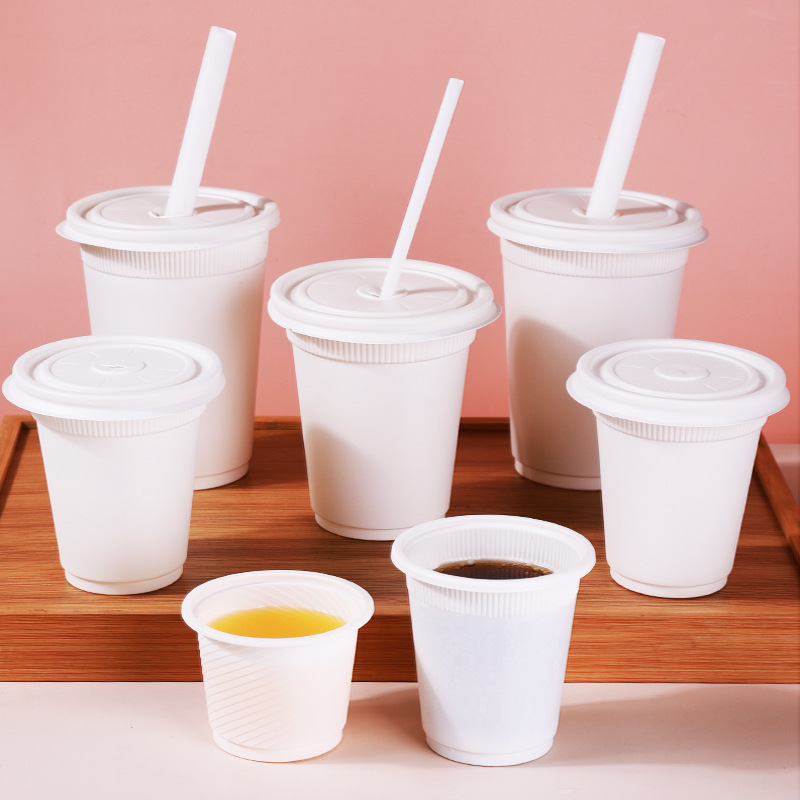
Corn starch products are often marketed as compostable—but compostability describes end-of-life behavior, not performance during use.
7.1 Functional Performance vs. Environmental Claims
A material can be:
-
Fully compostable
-
Fully compliant
-
Fully unsuitable for a given food application
These realities are not contradictory—they reflect different evaluation criteria.
7.2 The Trade-Off Triangle
For starch-based products, manufacturers must balance:
-
Strength
-
Heat resistance
-
Biodegradability
Improving one often weakens another. There is no formulation that maximizes all three simultaneously.
8. Why Corn Starch Products Pass Tests but Fail in the Market
Laboratory tests are typically:
-
Short-duration
-
Static
-
Conducted under controlled conditions
Real food use is:
-
Dynamic
-
Repetitive
-
Variable in temperature and humidity
This gap explains why certification alone cannot guarantee customer satisfaction.
9. How Buyers Should Evaluate Corn Starch Cups and Cutlery
9.1 Questions Buyers Should Ask
Instead of asking “Is this corn starch?” buyers should ask:
-
What polymers are blended with the starch?
-
What is the recommended temperature and time limit?
-
Are cups and cutlery made from different formulations?
-
What real-use scenarios were tested?
9.2 Matching Material to Application
Corn starch products are best suited for:
-
Cold or room-temperature foods
-
Short-duration use
-
Low mechanical stress scenarios
They are poorly suited for:
-
Hot beverages
-
Long holding times
-
Heavy or forceful utensil use
FAQ
1. Are corn starch cups and cutlery made from 100% corn starch?
No. Pure corn starch cannot be molded into functional cups or cutlery. Commercial products always contain modified starch, polymers (such as PLA or PBAT), and additives to achieve usable strength and processability.
2. Why can’t pure corn starch be used alone for food packaging?
Pure corn starch is highly sensitive to moisture, has low heat resistance, and lacks mechanical strength. It softens, deforms, or dissolves under conditions that are normal for food and beverage use.
3. Why do corn starch cutlery products bend or break so easily?
Cutlery experiences high bending and localized stress. Starch-based materials absorb moisture and relax under load, which reduces stiffness and leads to bending or fracture—especially when formulations are not optimized for mechanical stress.
4. Can the same corn starch formulation be used for both cups and cutlery?
In practice, no. Cups require resistance to long-term liquid contact and heat, while cutlery must handle short-term but high mechanical stress. A single formulation inevitably compromises performance in one of these uses.
5. Does increasing thickness improve the strength of corn starch products?
Thickness alone does not change the material’s fundamental behavior. It may delay failure, but it cannot prevent softening, moisture absorption, or structural collapse over time.
6. Why do some corn starch products pass tests but fail in real use?
Most tests are short-term and static, while real use involves time, repeated stress, temperature changes, and humidity. Starch-based composites are especially sensitive to these real-world variables.
7. What applications are corn starch cups and cutlery best suited for?
They perform best in cold or room-temperature food and beverage applications, short-duration use, and low mechanical stress scenarios. They are not ideal for hot drinks or heavy-duty utensil use.
Conclusion: Corn Starch Is a Category, Not a Material
Corn starch cups and cutlery are not—and cannot be—pure corn starch products. They are engineered composites, designed to balance environmental goals with limited functional requirements.
Understanding this reality allows buyers to:
-
Set realistic expectations
-
Choose appropriate use scenarios
-
Avoid costly performance failures
In food packaging, material names are not specifications. Performance is defined by formulation, processing, and use conditions—not by labels.
Recognizing corn starch as a category, rather than a single material, is the first step toward making better, safer, and more informed packaging decisions.
References
-
Avérous, L.
Biodegradable multiphase systems based on plasticized starch: A review.
Journal of Macromolecular Science, Polymer Reviews.
https://doi.org/10.1081/MC-200020767 -
Shen, L., Worrell, E., Patel, M.
Present and future development in plastics from biomass.
Biofuels, Bioproducts and Biorefining.
https://doi.org/10.1002/bbb.50 -
Siracusa, V., Rocculi, P., Romani, S., Dalla Rosa, M.
Biodegradable polymers for food packaging: A review.
Trends in Food Science & Technology.
https://doi.org/10.1016/j.tifs.2008.07.003 -
Song, J. H., Murphy, R. J., Narayan, R., Davies, G. B. H.
Biodegradable and compostable alternatives to conventional plastics.
Philosophical Transactions of the Royal Society B.
https://doi.org/10.1098/rstb.2008.0289 -
Niaounakis, M.
Biopolymers: Processing and Products.
William Andrew Publishing (Elsevier).
https://www.sciencedirect.com/book/9781455731459/biopolymers -
European Bioplastics
Material fact sheets – Starch blends, PLA, PBAT.
https://www.european-bioplastics.org/bioplastics/materials/ -
ASTM International
ASTM D6400 – Standard Specification for Labeling of Plastics Designed to Be Aerobically Composted.
https://www.astm.org/d6400 -
European Committee for Standardization (CEN)
EN 13432: Requirements for packaging recoverable through composting and biodegradation.
https://standards.cencenelec.eu/dyn/www/f?p=205:110:0::::FSP_LANG_ID:25 -
U.S. Food and Drug Administration (FDA)
Indirect Food Additives: Polymers – Food Contact Materials.
https://www.fda.gov/food/food-ingredients-packaging/food-contact-materials -
European Commission
Regulation (EC) No 1935/2004 on food contact materials.
https://food.ec.europa.eu/safety/chemical-safety/food-contact-materials/legislation_en -
PlasticsEurope
Bioplastics: Facts and figures.
https://plasticseurope.org/knowledge-hub/bioplastics/ -
Raquez, J. M., et al.
Thermoplastic starch-based materials: A review.
Progress in Polymer Science.
https://doi.org/10.1016/j.progpolymsci.2013.05.014
Copyright Statement
© 2026 Dashan Packing. All rights reserved.
This article is an original work created by the Dashan Packing editorial team.
All text, data, and images are the result of our independent research, industry experience,
and product development insights. Reproduction or redistribution of any part of this content
without written permission is strictly prohibited.
Dashan Packing is committed to providing accurate, evidence-based information and
to upholding transparency, originality, and compliance with global intellectual property standards.