

Quick Answer: The Cost & Compliance Reality
In terms of physical performance, clarity, and food safety, strictly certified RPET (Recycled Polyethylene Terephthalate) and Virgin PET (New, petroleum-based PET) are completely identical. However, RPET commands a price premium due to the highly complex, energy-intensive decontamination and rebuilding processes required to transform post-consumer waste back into food-grade material. For European and UK buyers, this upfront material premium is not a penalty; it is a vital investment. Purchasing certified RPET is the only legally compliant way to bypass massive national “Plastic Taxes” and secure lucrative contracts with major retail chains governed by strict ESG (Environmental, Social, and Governance) mandates.
1. Why the Price Gap? The “Garbage” Paradox Explained
The most common question our export team receives from procurement managers is a logical one: “If RPET is made from recycled garbage, why does it cost 15% to 30% more than virgin plastic extracted from newly refined oil?”
This question stems from a misunderstanding of the modern recycling supply chain. To understand the price gap, you must understand the engineering required to achieve food-grade safety.
Virgin PET production is a hyper-optimized, 70-year-old linear process. Petrochemicals are polymerized in massive, highly efficient continuous-flow reactors. The cost is dictated primarily by global crude oil prices.
RPET, conversely, is a highly complex, multi-stage circular engineering challenge. To turn a dirty, discarded water bottle into a pristine, FDA/EFSA-approved [RPET containers], the material must go through a grueling, capital-intensive decontamination process:
The 5-Stage High-Cost RPET Engineering Process:
-
Collection & Baling Logistics: Unlike oil pumped through a pipe, post-consumer waste must be physically collected from municipal bins, sorted, baled, and transported to a recycling facility. This reverse logistics network is highly labor and transport-intensive.
-
Infrared (NIR) Sorting: The bales contain a mix of materials. Facilities must use multi-million-dollar Near-Infrared (NIR) optical sorting machines to separate PET from PVC, PP, and non-plastics at lightning speed. A single piece of PVC can ruin an entire batch of PET.
-
Hot Washing & Flaking: The sorted bottles are shredded into flakes and subjected to aggressive caustic hot washes to remove glues, labels, syrup residue, and dirt. This requires massive amounts of heated water and chemical detergents.
-
Extrusion & Melt Filtration: The clean flakes are melted down. At this stage, microscopic laser filters (often as fine as 50 microns) push the molten plastic through screens to remove any remaining microscopic impurities, such as aluminum dust or unmelted polymers.
-
Solid State Polycondensation (SSP) – The Ultimate Cost Driver: This is the most critical and expensive step. Melting plastic degrades its molecular structure, making it weak. Furthermore, the material must be completely stripped of any volatile organic compounds (VOCs) that could migrate into food. In the SSP process, the recycled pellets are placed in a massive vacuum reactor and heated to just below their melting point for 12 to 24 hours. This intense environment rebuilds the polymer chains (restoring its original strength) and vaporizes any remaining microscopic contaminants.
The Bottom Line: You are not paying for “garbage.” You are paying for the most advanced mechanical and chemical purification technology on the planet. The premium on RPET is the cost of operating multi-million-dollar SSP reactors to guarantee absolute food safety.

2. The Tax Factor: The European Market’s “Get Out of Jail Free” Card
If RPET is more expensive per kilogram, why is every major European buyer demanding it? Because the regulatory landscape in the UK and the European Union has shifted from encouraging sustainability to financially punishing virgin plastic use.
If you are a food distributor or a brand importing packaging into Europe, paying the RPET premium is no longer an ethical choice; it is a hardcore financial calculation designed to protect your bottom line from government levies.
The UK Plastic Packaging Tax (PPT)
Implemented aggressively and updated annually, the UK Plastic Packaging Tax applies to plastic packaging manufactured in, or imported into, the UK that does not contain at least 30% recycled plastic.
-
The Penalty: As of the latest fiscal updates, the tax stands at approximately £217.85 per tonne of non-compliant plastic packaging.
-
The Exemption: If you can prove, via a secure chain of custody, that your packaging contains 30% or more Post-Consumer Recycled (PCR) content, you are entirely exempt from this tax.
The EU Plastics Own Resource (The €0.80 Levy)
The European Union has introduced a contribution based on the amount of non-recycled plastic packaging waste produced by member states, calculated at €0.80 per kilogram (€800 per tonne). While this is technically levied at the national level, member states are aggressively passing this cost down the supply chain to importers and brands through extended producer responsibility (EPR) schemes and direct packaging taxes (such as Spain’s and Italy’s specific plastic taxes).
The Procurement Math: An “If-Then” Scenario
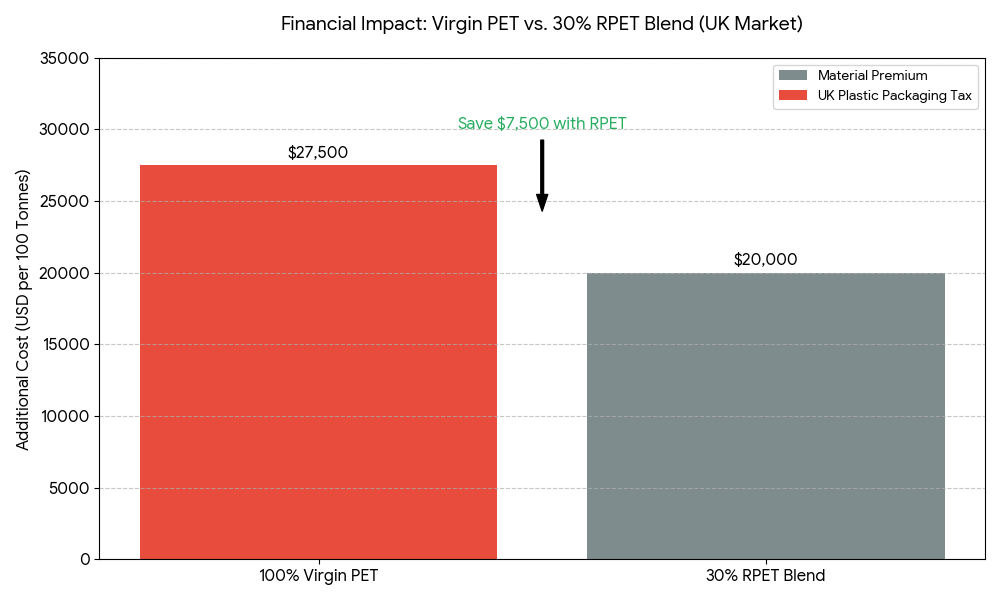
Let’s conduct a risk assessment for a buyer importing 100 tonnes of thermoformed salad bowls into the UK:
-
Scenario A (100% Virgin PET): You save $200 per tonne on the initial purchase price from China. Total saving = $20,000. However, upon clearing UK customs, you are hit with the £217.85/tonne tax (approx. $275 USD). Total Tax = $27,500. Net Loss: $7,500.
-
Scenario B (30% RPET Blend): You pay a $20,000 premium to the factory for certified RPET. You pay $0 in UK Plastic Packaging Tax.
Beyond the direct tax math, there is the ESG Chokehold. Major European retail chains (like Tesco, Carrefour, and Aldi) have strict corporate ESG commitments. If your packaging does not contain verifiable RPET, then you cannot even get a meeting with their procurement buyers. Using RPET is the mandatory entry ticket to securing high-volume retail contracts.
3. The GRS Verification: Spotting Fake RPET in the Supply Chain
Because of the immense financial benefits of claiming RPET status in Europe, a dangerous black market of “fake RPET” has emerged. Unscrupulous factories will simply blend cheaper virgin PET or uncertified industrial scrap and label it “30% PCR” to win your business.
If European customs authorities audit your shipment and find your eco-claims to be fraudulent, you face devastating fines, back-taxes, and immediate blacklisting. To survive in B2B procurement, you must learn how to independently audit your supplier’s certifications.
The global gold standard for verifying recycled content is the Global Recycled Standard (GRS). However, simply asking a factory, “Do you have a GRS certificate?” is a rookie mistake. Here is the professional buyer’s verification guide:
1. Post-Consumer (PCR) vs. Post-Industrial (PIR)
European taxes specifically require Post-Consumer Recycled (PCR) material—meaning it was used by a consumer and diverted from a landfill. Some factories use Post-Industrial Recycled (PIR) material—which is just clean factory scrap swept off their own floor—and try to pass it off as PCR. A valid GRS audit will explicitly state the percentage of PCR vs. PIR.
2. The Facility Certificate (Scope Certificate – SC)
The Scope Certificate proves that the factory has been audited by a third party (like Control Union or Intertek) and possesses the infrastructure, social compliance, and environmental management systems to legally handle and trace recycled materials. You must verify that the SC is currently valid and that the company name exactly matches the factory you are paying.
3. The Transaction Certificate (TC) – Your Ultimate Protection
This is where most buyers fail. A Scope Certificate only proves the factory can make RPET; it does not prove they used RPET for your specific order. To satisfy European tax authorities, you must request a Transaction Certificate (TC) for your specific shipment. A TC is a highly secure document issued by the auditing body that tracks the exact mass balance of the material. It proves that the factory bought X tonnes of certified recycled raw material and used it to produce Y tonnes of your finished packaging. No TC = No tax exemption.
4. Performance & Engineering: Does RPET Compromise Quality?
A common lingering doubt among food distributors is whether integrating 30%, 50%, or even 100% RPET will compromise the structural integrity or visual clarity of the packaging.
The answer is an absolute no, provided the material has been processed through the SSP (Solid State Polycondensation) phase discussed in Section 1.
-
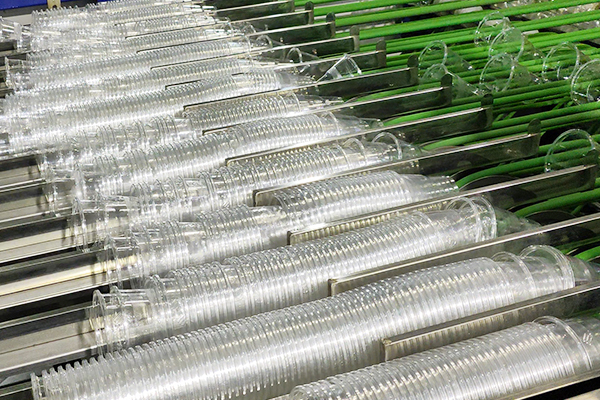
Thermoforming Tolerances: Premium RPET roll stock behaves identically to virgin PET on high-speed thermoforming lines. It maintains the same exceptional tensile strength, allowing for precise wall thickness and the micro-millimeter tolerances required for leak-proof snap-fit lids.
-
Optical Clarity: Advanced melt filtration ensures that high-grade RPET maintains a pristine, glass-like transparency, crucial for visual merchandising in supermarket refrigerated aisles.
-
Food Contact Compliance: Whether it is 30% or 100% recycled, the material must still pass the exact same Overall Migration Limit (OML) and Specific Migration Limit (SML) tests required by EU Regulation 10/2011. Certified RPET is guaranteed to be free from BPA, phthalates, and heavy metals.
5. Conclusion: Secure Your European Market Entry
In the European B2B packaging landscape, trying to save pennies on raw materials will cost you millions in taxes and lost retail opportunities. Sourcing RPET is not a generic commodity purchase; it is a highly regulated compliance strategy.
You need a manufacturing partner who does not just manufacture plastic, but who meticulously manages the chain of custody required by European customs.
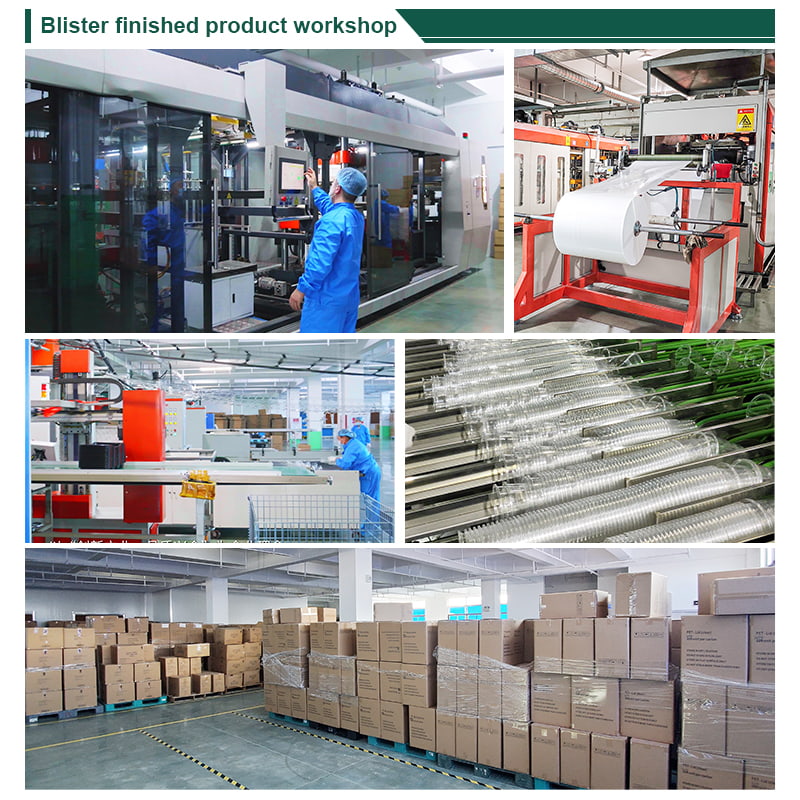
At Dashan Packing, we provide absolute traceability. We operate fully transparent production lines and maintain rigorous GRS certifications. When you order RPET containers from us, you are not just buying packaging; you are buying a legally bulletproof compliance dossier. We provide the Scope Certificates, the batch-specific Transaction Certificates (TC), and the laboratory migration test reports you need to legally bypass European plastic taxes.
Stop gambling with unverified trading companies. Partner with a source factory that guarantees audit-ready compliance.
👉 [Contact us] today to speak with our European export specialists and request to download Dashan’s complete “RPET GRS Certification Pack.” (Want to see our manufacturing facility and laboratory setup? Visit our [About us] page for a deep dive into our quality control infrastructure.)
FAQ: RPET Pricing and Compliance
1. Is 100% RPET packaging safe for direct food contact? Yes. When processed through certified EFSA (European Food Safety Authority) or FDA-approved “super-cleaning” technologies (like Solid State Polycondensation), 100% RPET is stripped of all contaminants and volatile compounds. It is structurally and chemically identical to virgin PET and is completely safe for direct food contact.
2. Why do some RPET containers look slightly yellow or grey? This depends on the grade of recycled flakes used. Premium food-grade RPET requires highly sorted, pure clear bottle flakes, which maintain excellent clarity. If a manufacturer uses lower-grade, mixed-color bales to cut costs, the resulting RPET can have a slight yellowish or greyish tint. Dashan Packing uses only top-tier, optically sorted clear flakes to ensure glass-like transparency.
3. Does the UK Plastic Packaging Tax apply to imported filled goods? Yes. The tax applies not only to empty packaging imported for use in the UK but also to the plastic packaging surrounding goods imported into the UK (e.g., a plastic tray containing imported sushi). The importer of record is responsible for proving the 30% recycled content to avoid the tax.
4. What is the difference between GRS and RCS certifications? The Recycled Claim Standard (RCS) only verifies the presence and amount of recycled material in a final product. The Global Recycled Standard (GRS) is much stricter; it verifies the recycled content but also includes rigorous audits of the factory’s environmental processing, chemical restrictions, and social/labor practices. GRS is the preferred standard for European ESG compliance.
5. Can an RPET container be recycled again? Yes. PET is a highly circular polymer. An RPET food container can be disposed of in standard municipal recycling bins, collected, washed, and melted down to become RPET once again. This closed-loop lifecycle is why European regulators heavily favor PET over alternative plastics.
References & Authoritative Industry Data
To provide procurement teams with legally sound and financially accurate supply chain strategies, Dashan Packing bases its tax calculations and material science data on the following global authorities:
-
HM Revenue & Customs (UK Government): Plastic Packaging Tax Guidelines (The official legislative framework outlining the exact tax rates per tonne, the 30% recycled content threshold, and the rigorous documentation required for exemptions).
-
European Food Safety Authority (EFSA): Safety Evaluation of Mechanical Recycling Processes for PET (The definitive scientific guidelines validating the safety of super-cleaning technologies, such as SSP, for creating food-contact compliant post-consumer RPET).
-
Textile Exchange (Governing Body of GRS): Global Recycled Standard 4.0 (The international standard outlining the strict chain of custody, mass balance requirements, and Transaction Certificate (TC) protocols necessary to authenticate PCR claims).
-
European Commission: Plastics Own Resource (The official policy framework detailing the €0.80 per kilogram national contribution based on non-recycled plastic packaging waste).
Copyright & Legal Disclaimer
© 2026 Dashan Packing. All rights reserved.
This RPET Pricing and Compliance Guide is an original work created by the Dashan Packing export compliance and technical engineering teams. All tax rate calculations, regulatory interpretations (including UK PPT and EU levies), and chemical engineering explanations (such as SSP processing) are the result of our independent industry research and B2B manufacturing expertise. Reproduction, redistribution, or unauthorized use of any part of this content without explicit written permission from Dashan Packing is strictly prohibited. Dashan Packing provides this information for educational and strategic procurement purposes only. We strongly advise consulting with a licensed European customs broker or tax professional to verify current legislative updates and specific tax liabilities prior to import.