

Quick Summary
This article explains what performance claims such as “leak-proof,” “microwave-safe,” and “grease-resistant” really mean in practical sourcing scenarios. Instead of relying on marketing labels, buyers should evaluate packaging through application-based testing, food-contact safety, lid fit, heat performance, and total logistics risk. Using molded fiber (bagasse) as an example, the article clarifies realistic expectations, common misunderstandings, and how professional testing prevents costly failures during delivery and reheating.
In today’s global foodservice market, packaging comes with a long list of performance claims. Browse any catalog and you will immediately see terms like:
-
“Leak-proof”
-
“Microwave-safe”
-
“Grease-resistant”
-
“Eco-friendly”
-
“Compostable”
-
“Heavy-duty”
-
“Premium quality”
These labels sound reassuring. They make packaging appear more advanced, safer, and worth the price.
But here is the challenge:
Most buyers have to make sourcing decisions without fully understanding what these claims actually mean in practice — or how they are tested.
As a result, problems emerge later, not during quotation:
-
lids pop open during delivery
-
soup leaks through seams or corners
-
containers collapse when stacked
-
fibers weaken after reheating
-
“microwave-safe” packaging warps or softens
-
grease spots appear on tables and bags
-
customers complain and brands take the blame
This article is designed to clarify what truly matters when assessing packaging performance — especially for molded fiber products such as bagasse.
We will walk through each claim in a practical, technical way:
-
what the term should mean
-
what actually determines performance
-
what expectations are realistic
-
and what questions professional buyers should ask suppliers
The goal is simple: fewer surprises after ordering, fewer risks, and better decision-making.
1. Performance Depends on the Use Case — Not the Label
One of the biggest mistakes in packaging sourcing is assuming that a single product will perform well in every scenario.
That has never been true.
Packaging performance is influenced by multiple variables at the same time:
Food type
-
dry bread, pastries, and snacks
-
greasy fried foods
-
high-oil dishes like curries
-
soups, sauces, and noodles
-
frozen or chilled items
-
reheated takeaway meals
Each of these applications places different stresses on material, seams, and coatings.
Operating temperature
-
refrigeration
-
room temperature storage
-
hot filling
-
microwave reheating
-
extended heat exposure
Heat changes material strength, flexibility, and chemical stability. Claims about “microwave-safe” or “heat-resistant” must therefore be contextual, not absolute.
Logistics and delivery conditions
-
long delivery distances
-
stacking multiple layers
-
vibration and shaking in couriers’ bags
-
pressure during transportation
-
condensation due to temperature differences
Good design must anticipate movement. A container that works on a restaurant table may fail completely inside a delivery backpack.
Time factor
Packaging often has to maintain performance not only for 30 minutes, but for hours.
Oil gradually penetrates.
Steam softens fibers.
Condensation creates water.
All of this matters.
Conclusion:
There is no universal “best” packaging. There is only the right solution for the right scenario.
Professional sourcing decisions must start from application — not marketing language.
2. What “Leak-Proof” Really Means
“Leak-proof” is the most misunderstood promise in food packaging.
Buyers often assume it means:
No liquid will escape, under any condition.
In reality, packaging engineers distinguish among several different leakage types:
2.1 Types of leakage
-
Seepage through fiber
Liquid slowly penetrates over time.
This is common when packaging is exposed to soups, sauces, or high-oil foods. -
Leakage through gaps
The rim and lid do not seal tightly, allowing liquid to escape under pressure. -
Structural failure
Cracking, bending, or collapsing causes a spill. -
Condensation leakage
Steam converts to water droplets, which escape through edges.
Each failure mode has a different technical root cause — and different solutions.
2.2 How leak resistance is built
Leak resistance is not a coating. It is a system:
-
Structural design
Deep rims, sealing channels, and precise geometry reduce leak paths. -
Material rigidity
Rigid molded fiber holds shape under weight. Thin, flexible packaging does not. -
Lid compatibility
Each container-lid combination has tolerance ranges. Even a 0.5 mm error matters. -
Coatings or barriers (if used)
Some products use food-safe water-based or bio-coatings to slow penetration.
Professional manufacturers test combinations, not individual items.
2.3 Realistic expectations
Leak-resistant and 100% leak-proof are different things.
Bagasse containers perform very well for:
-
rice and noodles
-
grilled meals
-
burgers and sandwiches
-
salads
-
bakery items
-
many takeaway dishes
However, for high-liquid applications — such as noodle soups, broths, and stews — a film-sealed bowl or special sealing lid is usually needed.
A professional buyer asks not:
“Is it leak-proof?”
but instead:
“Under what conditions has it been tested, and for how long?”
3. Microwave-Safe: Often Used, Rarely Understood
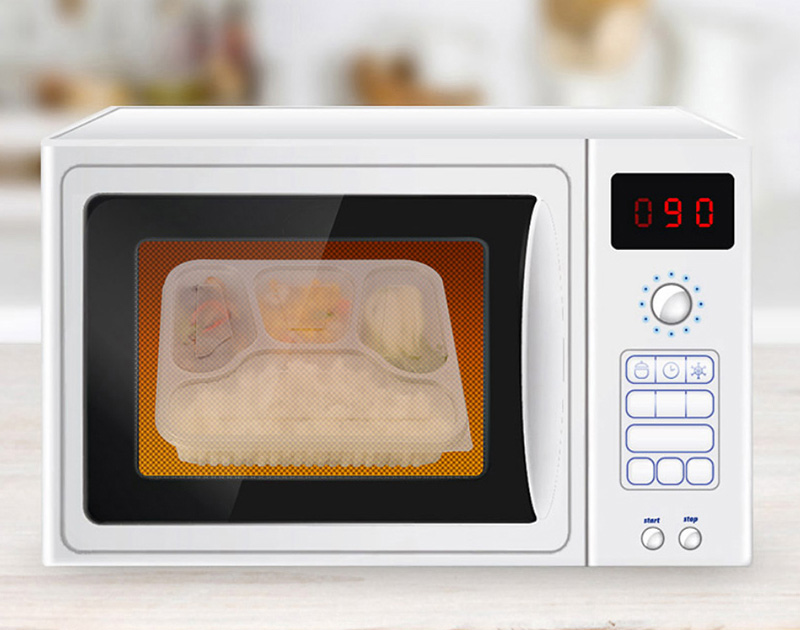
“Microwave-safe” should never be a casual label.
It refers to three separate performance dimensions:
3.1 Heat stability
The packaging must not melt, deform, or burst under microwave temperatures.
3.2 Structural integrity
The container should maintain shape when hot food is lifted, carried, or handled.
3.3 Chemical safety
Material must not migrate substances into food at elevated temperatures, within regulatory limits.
Bagasse performs well here because molded fiber tolerates heat better than many plastics.
However, “microwave-safe” still has limits.
3.4 Risks when using the wrong packaging
-
surface softening under intense heat
-
lid deformation
-
steam pressure buildup
-
burns due to hot liquid accumulation
-
unpleasant odors when coatings are poor quality
If the dish is oily, temperature rises faster than with water-based foods. Oil can reach significantly higher temperatures in a microwave. This increases risk.
3.5 Practical guidance
-
reheating leftovers
-
takeaway meals with moderate sauces
-
baked or roasted dishes
But avoid:
-
reheating extremely oily, deep-fried foods for long periods
-
continuous heating over 3–5 minutes at maximum power
-
sealed containers without ventilation
Responsible suppliers always recommend controlled testing before large-scale rollout.
4. Grease-Resistance: Natural vs. Coated Approaches
Oil resistance is both a functional and safety issue.
4.1 Where grease resistance comes from
Bagasse has natural fibrous structure that slows penetration. However, certain foods — especially hot, high-oil dishes — can eventually saturate fibers.
Manufacturers may enhance performance using:
-
water-based coatings
-
PLA coatings
-
plant-derived barrier layers
Each coating has a specific purpose and regulatory path.
4.2 The PFAS issue
Some historic fiber packaging used PFAS chemicals to resist grease.
These substances are increasingly restricted worldwide.
Professional buyers should always confirm:
-
PFAS-free declaration
-
test reports from accredited laboratories
-
compliance with applicable food contact regulations (EU / US / local)
4.3 Real-world performance
Short-term takeaway use:
Excellent.
Long-duration oily storage:
Requires testing, and sometimes alternative specification.
Grease resistance must be considered together with heat, time, and storage.
5. Important Variables Buyers Commonly Overlook
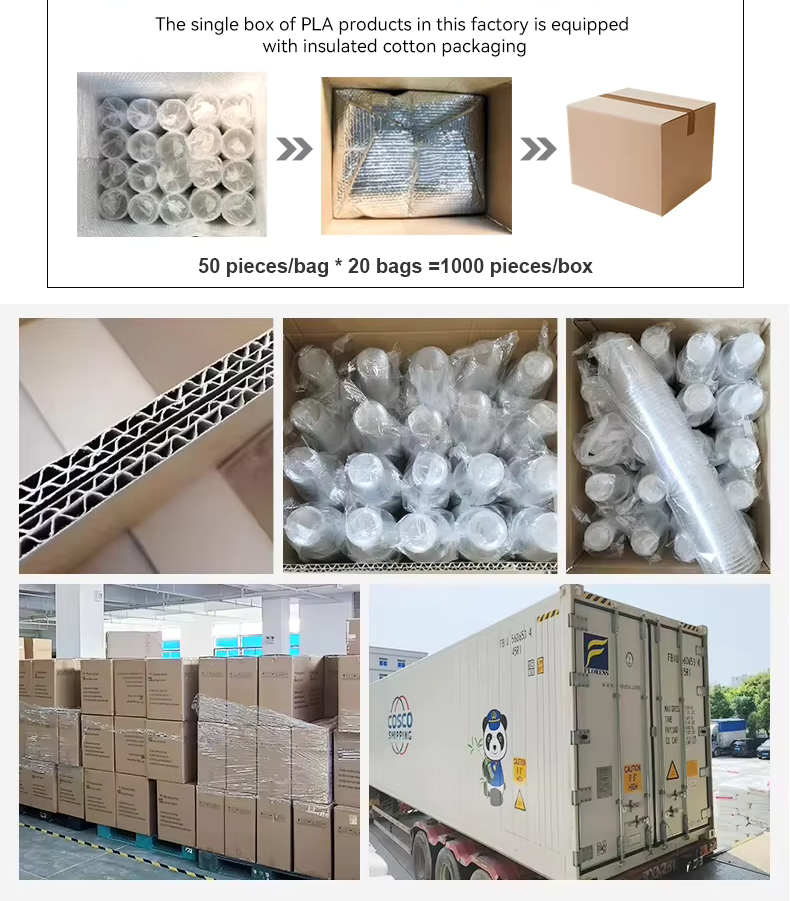
Performance labels address only part of the reality.
Professional procurement teams evaluate additional dimensions:
5.1 Compression and stacking strength
Packaging must withstand stacking during storage and delivery without collapsing.
5.2 Insulation
Molded fiber retains heat better than thin plastics — an advantage for hot meals.
5.3 Lid system engineering
A good container with a poor lid becomes a failure in daily operations.
5.4 Sustainability vs. practicality
Compostable does not always mean composted. Infrastructure varies by country.
5.5 Total cost of ownership
Cheaper packaging that causes leakage, complaints, or food loss costs far more than a slightly higher-priced premium solution.
6. A Practical Example: How DASHAN Approaches Performance
Without being promotional, it is useful to show how experienced manufacturers think.
At DASHAN, molded fiber packaging is not treated as a commodity. Each product is evaluated through:
-
structural testing (stacking, bending, vibration)
-
leak and seepage evaluation across different foods
-
microwave performance assessment
-
grease resistance checks
-
documentation and regulatory compliance review
For specific projects, customers often receive application-based recommendations instead of “one-product-fits-all” proposals.
The objective is simple: reduce post-delivery risk.
7. How Buyers Should Evaluate Claims
When suppliers say:
“Our products are leak-proof, microwave-safe, and grease-resistant,”
ask for evidence.
Request:
-
test reports
-
reference conditions (temperature, duration, load)
-
sample verification
-
performance under real food scenarios
Then, replicate your own in-house testing.
Test with your food.
Test with your delivery conditions.
Test across different holding times.
This is the only way to avoid surprises.
8. A Decision Framework: What Actually Matters Most
Here is a practical checklist when selecting food packaging:
| Evaluation Item | Key Question | Why It Matters |
|---|---|---|
| Leak Resistance | Does it hold liquids for the necessary time? | Prevents customer complaints and brand damage |
| Heat Performance | How does it behave during reheating? | Safety and structural integrity |
| Grease Resistance | Does oil penetrate or stain? | Hygiene perception, food quality |
| Lid Fit | Snap, film seal, hinge — which works better? | Logistics stability |
| Food Contact Safety | Are reports and declarations available? | Legal compliance |
| Sustainability | Does it align with brand policy and local disposal rules? | ESG alignment |
| Cost vs. Risk | Does performance justify price? | Total business value |
When these questions are answered honestly, labels become secondary.
9. Final Thoughts
“Leak-proof, microwave-safe, grease-resistant” should not be marketing slogans.
They should be engineering outcomes supported by testing, documentation, and realistic expectations.
For foodservice brands, importers, and distributors, the smartest strategy is not chasing claims. It is selecting packaging scientifically — based on use case, compliance, logistics, and customer experience.
Do that consistently, and your packaging becomes an asset instead of a risk.
Conclusion
Performance labels such as “leak-proof,” “microwave-safe,” and “grease-resistant” can be useful — but only when they are understood in context. Packaging does not succeed because of a claim on a catalog page; it succeeds when design, materials, lids, logistics, and compliance work together under real operating conditions. For buyers, the safest approach is application-based testing, credible documentation, and a clear understanding of the limits of each material. When packaging is evaluated scientifically — not just marketed — brands reduce complaints, protect food quality, and avoid costly surprises. In the end, the best packaging is not the one that promises the most, but the one that performs reliably in everyday use.
References
-
U.S. FDA – Food Contact Substances
https://www.fda.gov/food/food-ingredients-packaging/food-contact-substances-fcs -
U.S. FDA – Guidance for Industry:Preparation of Food Contact Notifications
https://www.fda.gov/regulatory-information/search-fda-guidance-documents/guidance-industry-preparation-and-submission-food-contact-notifications -
European Commission – Food Contact Materials
https://food.ec.europa.eu/safety/chemical-safety/food-contact-materials_en -
EU Regulation (EC) No 1935/2004 — Materials and Articles Intended to Come into Contact with Food
https://eur-lex.europa.eu/legal-content/EN/TXT/?uri=CELEX:32004R1935 -
EFSA — Scientific Opinions on Food Contact Materials
https://www.efsa.europa.eu/en/topics/topic/food-contact-materials -
ASTM International — Packaging Standards Overview
https://www.astm.org/standards/packaging-standards.html -
OECD — PFAS and Their Use in Food Packaging
https://www.oecd.org/chemicalsafety/portal-perfluorinated-chemicals/ -
European Chemicals Agency (ECHA) — PFAS Restrictions Updates
https://echa.europa.eu/hot-topics/perfluoroalkyl-chemicals-pfas -
FDA — Microwave Use and Safety
https://www.fda.gov/consumers/consumer-updates/microwaves-and-food-safety -
FAO — Food Packaging and Food Safety
Copyright Statement
© 2025 Dashan Packing. All rights reserved.
This article is an original work created by the Dashan Packing editorial team.
All text, data, and images are the result of our independent research, industry experience,
and product development insights. Reproduction or redistribution of any part of this content
without written permission is strictly prohibited.
Dashan Packing is committed to providing accurate, evidence-based information and
to upholding transparency, originality, and compliance with global intellectual property standards.