
Quick Summary
The article delves into the global demand for eco-friendly packaging, analyzing key drivers such as government regulations, consumer demand, and business innovations. It explores how Europe, North America, and Asia are leading the way in adopting sustainable packaging solutions, with a particular focus on recyclable materials, biodegradable alternatives, and plastic reduction policies. The piece also highlights the challenges and opportunities businesses face as they adapt to these changes, offering real-world examples from major corporations like Unilever and Coca-Cola. The future of packaging lies in sustainability, and this article sheds light on how industries can capitalize on this growing trend to benefit both the environment and their bottom line.
Introduction: The Growing Demand for Eco-Friendly Packaging Globally
As environmental concerns continue to rise, the demand for eco-friendly packaging has increased significantly across global markets. Governments, consumers, and businesses are collectively driving this trend, aiming to reduce plastic waste, improve resource efficiency, and promote sustainability. This article explores how policy regulations, consumer demand, and business adaptability contribute to the widespread adoption of eco-friendly packaging across different regions.
1. Government Policies Driving the Adoption of Eco-Friendly Packaging
1.1 Europe
Europe has been a frontrunner in implementing strict packaging regulations to reduce plastic waste and promote sustainable packaging solutions. The European Union’s Plastic Strategy sets ambitious targets to reduce single-use plastic by 2029 and make all packaging recyclable or reusable by 2030.
-
Directive on Packaging and Packaging Waste: Introduced by the EU, this directive mandates that all packaging placed on the market must be recyclable or reusable by 2030.
-
Single-Use Plastics Ban: In 2021, the EU banned single-use plastics, including cutlery, plates, and straws, creating a shift toward alternative eco-friendly materials such as PLA, bagasse, and RPET.
-
France: France’s 2020 ban on non-recyclable packaging is an example of how strict regulations in European countries encourage businesses to innovate and invest in eco-friendly alternatives.
Table 1: Key EU Regulations on Eco-Friendly Packaging
| Regulation | Description | Date Enforced | Impact |
|---|---|---|---|
| EU Plastic Strategy | Targets to make packaging recyclable or reusable | 2030 | Promotes investment in recycling and material innovation |
| Single-Use Plastics Ban | Ban on non-recyclable single-use plastics | 2021 | Forces industries to adopt sustainable alternatives |
| France’s Non-Recyclable Packaging Ban | France bans non-recyclable packaging | 2020 | Leads to a significant rise in biodegradable packaging solutions |
1.2 North America
North America, particularly the United States and Canada, has also implemented progressive policies to encourage eco-friendly packaging.
-
California: The state of California introduced the California Circular Economy and Plastic Pollution Reduction Act in 2022, setting ambitious goals to reduce plastic waste and increase recycling.
-
Canada: Canada has proposed a national ban on single-use plastics by 2023 and has invested heavily in extended producer responsibility (EPR) programs to reduce packaging waste.
1.3 Asia
In Asia, the adoption of eco-friendly packaging varies significantly by country.
-
China: China’s “Plastic Waste Reduction Strategy” includes a ban on single-use plastic products and the promotion of biodegradable packaging.
-
Japan: Japan’s rigorous recycling system and strong public awareness about environmental issues have led to a high demand for recyclable PET and PLA packaging.
-
India: India’s National Plastic Waste Management Rules encourage businesses to reduce plastic waste and shift to eco-friendly alternatives, including paper and plant-based packaging.
2. Consumer Demand for Eco-Friendly Packaging
2.1 European Market Trends
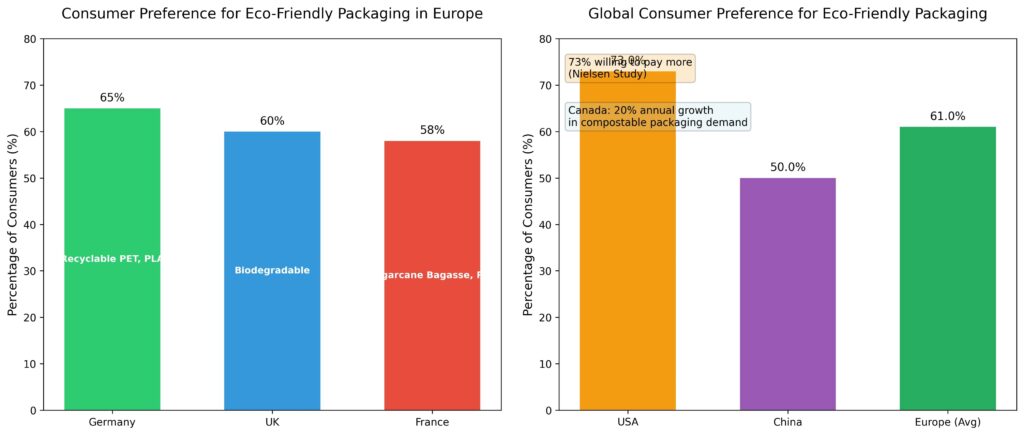
Consumers in Europe have become increasingly aware of the environmental impact of packaging. A survey by Euromonitor found that 63% of European consumers prefer products with sustainable packaging.
-
Germany: As one of the leaders in sustainable packaging, Germany’s consumer demand for recyclable and reusable packaging has prompted major retail chains to shift toward eco-friendly materials.
-
UK: The UK has seen a 40% increase in consumer preference for products with biodegradable packaging in the last five years, as noted by the British Retail Consortium.
Table 2: Consumer Preferences in Eco-Friendly Packaging in Europe
| Country | % of Consumers Preferring Eco-Friendly Packaging | Key Material Preferences |
|---|---|---|
| Germany | 65% | Recyclable PET, PLA |
| UK | 60% | Biodegradable Packaging |
| France | 58% | Sugarcane Bagasse, PLA |
2.2 North American Trends
In North America, there is a significant shift in consumer behavior towards sustainability.
-
A study by Nielsen found that 73% of U.S. consumers are willing to pay more for products with eco-friendly packaging.
-
The demand for compostable packaging has risen by 20% annually in Canada over the past three years, according to GreenBiz.
2.3 Asian Market Trends
Consumer demand for sustainable packaging is also increasing in Asia.
-
China: Despite the initial resistance to eco-friendly packaging, a Mintel report revealed that 50% of Chinese consumers now prefer eco-friendly packaging options.
-
Japan and South Korea: Consumers have a long history of prioritizing eco-friendly packaging, with recyclable PET and biodegradable materials being highly sought after.
3. Business Adaptability and Innovation in Eco-Friendly Packaging
3.1 European and North American Innovations
In response to growing demand and regulations, businesses are adapting and innovating their packaging solutions. Companies like Unilever, Nestlé, and Coca-Cola have committed to using 100% recyclable or biodegradable packaging by 2025.
-
Unilever has already switched to recycled plastic in 50% of its packaging.
-
Coca-Cola has launched PlantBottle, a packaging made from up to 30% plant-based materials.
3.2 Asia-Pacific Business Adaptation
Companies in Asia are also stepping up their efforts. In Japan, major retailers such as Muji and 7-Eleven have introduced sustainable packaging solutions, such as biodegradable packaging and paper-based alternatives.
-
India: Many Indian startups, like EcoRight and Beco, are pioneering the use of sustainable packaging in everyday consumer goods.
Table 3: Corporate Initiatives on Sustainable Packaging
| Company | Target | Materials Used | Deadline |
|---|---|---|---|
| Unilever | 100% recyclable packaging | Recycled PET, PLA | 2025 |
| Coca-Cola | 50% plant-based packaging | PlantBottle, Recycled PET | 2025 |
| Nestlé | 100% recyclable packaging | Paper, RPET, PLA | 2025 |
4. Challenges and Opportunities in the Global Shift to Eco-Friendly Packaging
4.1 Challenges
-
Cost: Eco-friendly packaging materials, especially biodegradable ones like PLA and bagasse, are often more expensive than traditional plastic.
-
Consumer Awareness: Although demand is growing, many consumers are still unaware of the benefits of eco-friendly packaging, which limits its widespread adoption.
-
Recycling Infrastructure: While some regions have advanced recycling systems, others still struggle with insufficient infrastructure to handle eco-friendly materials.
4.2 Opportunities
-
Technological Innovation: Advancements in biodegradable plastics and smart packaging present opportunities to reduce costs and increase the functionality of sustainable packaging.
-
Circular Economy: The shift toward a circular economy model, where products and materials are continuously recycled, presents a significant opportunity for both businesses and consumers to participate in sustainability efforts.
5. Conclusion: The Future of Eco-Friendly Packaging
As environmental regulations tighten, consumer awareness increases, and businesses innovate, the demand for eco-friendly packaging is expected to continue to grow. Governments will play a crucial role in shaping this transition through policy enforcement, while businesses will need to invest in sustainable packaging solutions to meet consumer expectations.
The future of packaging lies in the adoption of recyclable, biodegradable, and compostable materials, and those businesses that adapt quickly to these demands will be better positioned to succeed in an increasingly green-conscious global marketplace.
FAQ (Frequently Asked Questions)
Q1: What is eco-friendly packaging?
A1: Eco-friendly packaging refers to packaging materials that are sustainable, biodegradable, recyclable, or compostable. These materials are designed to reduce environmental impact, including the reduction of plastic waste and carbon emissions. Examples include PLA (Polylactic Acid), sugarcane bagasse, RPET (Recycled PET), and paper-based packaging.
Q2: How does government regulation affect eco-friendly packaging?
A2: Government regulations are a significant driver for the adoption of eco-friendly packaging. Policies such as the EU’s Single-Use Plastics Directive, plastic waste bans, and extended producer responsibility (EPR) programs require businesses to adopt sustainable packaging solutions. These regulations aim to reduce plastic waste and promote the use of recyclable or biodegradable materials.
Q3: What are the main challenges in adopting eco-friendly packaging?
A3: The primary challenges include higher production costs of eco-friendly materials, limited recycling infrastructure, consumer awareness, and inconsistent regulations across regions. These challenges may slow the adoption of sustainable packaging solutions, particularly in regions with underdeveloped recycling systems.
Q4: What are the benefits of using biodegradable packaging?
A4: Biodegradable packaging, such as PLA or sugarcane bagasse, offers the benefit of breaking down naturally over time, reducing the environmental impact compared to traditional plastics. These materials often require fewer natural resources to produce and are less likely to contribute to long-term pollution when disposed of properly.
Q5: Are consumers willing to pay more for eco-friendly packaging?
A5: Yes, a growing number of consumers are willing to pay more for products with eco-friendly packaging. Studies indicate that over 70% of consumers in markets like North America and Europe prefer brands that use sustainable packaging. Consumers are increasingly driven by concerns about plastic pollution and environmental sustainability.
Q6: How can businesses benefit from switching to eco-friendly packaging?
A6: Businesses that adopt eco-friendly packaging can enhance their brand image, meet regulatory requirements, and appeal to environmentally conscious consumers. This can result in increased customer loyalty, higher sales, and a competitive advantage in markets that prioritize sustainability. Moreover, businesses that innovate with sustainable packaging can reduce waste, improve resource efficiency, and lower long-term costs.
References
-
European Commission. (2020). The European Green Deal: Making Europe the First Climate-Neutral Continent.
Retrieved from https://ec.europa.eu/green-deal -
Euromonitor International. (2021). Global Consumer Trends in Packaging: Sustainability and Eco-Friendly Alternatives.
Retrieved from https://www.euromonitor.com -
Nielsen. (2020). Sustainable Packaging Trends: What Consumers Want and Why It Matters.
Retrieved from https://www.nielsen.com -
GreenBiz. (2021). The Growing Demand for Sustainable Packaging Solutions.
Retrieved from https://www.greenbiz.com
Copyright Statement
© 2025 Dashan Packing. All rights reserved.
This article is an original work created by the Dashan Packing editorial team.
All text, data, and images are the result of our independent research, industry experience,
and product development insights. Reproduction or redistribution of any part of this content
without written permission is strictly prohibited.
Dashan Packing is committed to providing accurate, evidence-based information and
to upholding transparency, originality, and compliance with global intellectual property standards.