

As the world races to combat plastic pollution and climate change, cornstarch-based materials are rising as a leading solution. Derived from plants and fully compostable, these materials are especially valuable in food packaging, agriculture, and consumer products.
This article explores the science, benefits, challenges, and applications of cornstarch materials—plus how manufacturers like Xiamen Dashan are using them to build a more sustainable future.
🧪 What Are Cornstarch Materials?
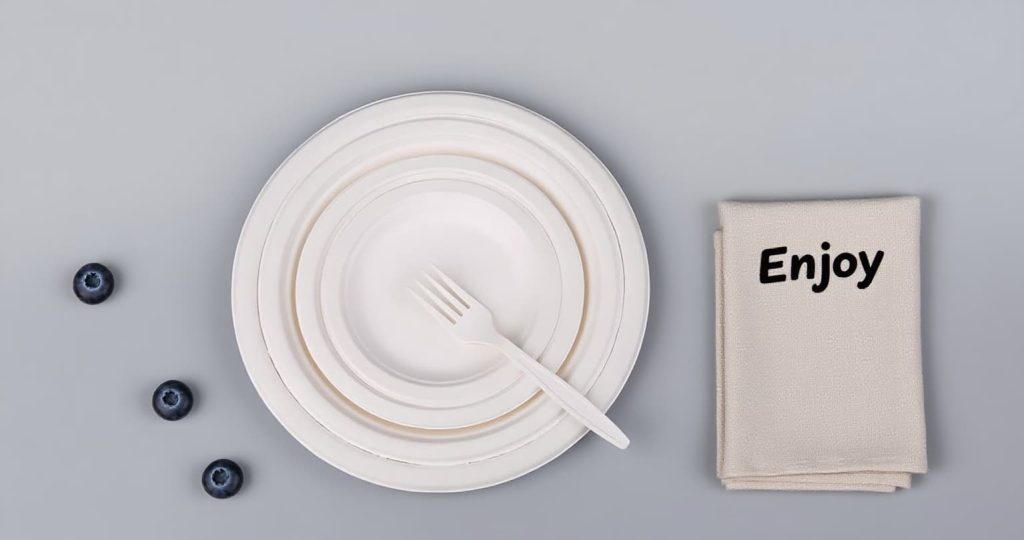
Cornstarch materials refer to biodegradable polymers made from the starch of corn (maize), typically processed into Polylactic Acid (PLA) or starch-based composites. These polymers resemble plastic in functionality but are sourced from plants and decompose under composting conditions.
➤ Manufacturing Process:
- Extraction: Corn starch is extracted from kernels.
- Fermentation: Natural fermentation converts starch to lactic acid.
- Polymerization: Lactic acid is polymerized into PLA.
- Molding/Forming: PLA is thermoformed into trays, cups, bags, etc.
⚙️ PLA = Polylactic Acid, a biodegradable thermoplastic derived from renewable resources.
🌱 Key Environmental Advantages
✅ 1. Fully Compostable
- Industrial composting breaks PLA down in 90–180 days.
- Produces carbon dioxide, water, and biomass—no microplastics.
✅ 2. Low Carbon Footprint
- Cornstarch absorbs CO₂ during growth.
- Life-cycle emissions are up to 75% lower than conventional plastics.
✅ 3. Renewable & Abundant
- Corn is globally cultivated and easily sourced.
- Encourages the use of agricultural byproducts.
✅ 4. Safe for Food Contact
- BPA-free, phthalate-free, non-toxic.
- Meets FDA and EU food safety standards.
🆚 Cornstarch Materials vs. Traditional Plastic
| Property | Cornstarch Materials | Traditional Plastics |
|---|---|---|
| Source | Corn (renewable) | Petroleum (non-renewable) |
| Biodegradability | Yes (compostable) | No (persists for centuries) |
| Food Safety | High | Varies (may leach toxins) |
| Cost | Moderate to High | Low |
| Heat Resistance | Up to ~60°C (standard PLA) | Up to ~120°C (PP, PET, etc.) |
| End-of-Life | Compost | Landfill/incineration |
⚠️ Note: For high-temperature applications, blended materials or modified PLA may be used.
🌍 Global Market & Regulatory Trends
- EU: Bans on single-use plastics (SUPD) driving demand for compostables.
- USA: Over 200 cities mandate compostable foodservice packaging.
- Japan & South Korea: Introduced subsidies for bioplastic adoption.
- Global Bioplastics Market: Expected to reach $29B by 2033.
🌱 PLA, made from cornstarch, accounts for ~20% of all bioplastics produced globally. (Source: European Bioplastics, 2024)
🛍️ Industry Applications
🍱 Food Packaging
- Salad bowls, sushi trays, fruit clamshells, and drink cups.
- Suitable for cold foods or moderate heat.
🥤 Beverage Industry
- PLA cold drink cups and dome lids used in milk tea and juice shops.
- Biodegradable straws made from cornstarch polymers.
🍽️ Disposable Tableware
- Plates, cutlery, and clamshell containers.
- Common in eco-restaurants and catering events.
🛒 Retail & E-Commerce
- Compostable shopping bags and mailers.
- Biodegradable blister packaging for electronics and cosmetics.
🚜 Agriculture
- Seedling pots and mulch films that decompose in soil.
- Reduces plastic residue in farming fields.
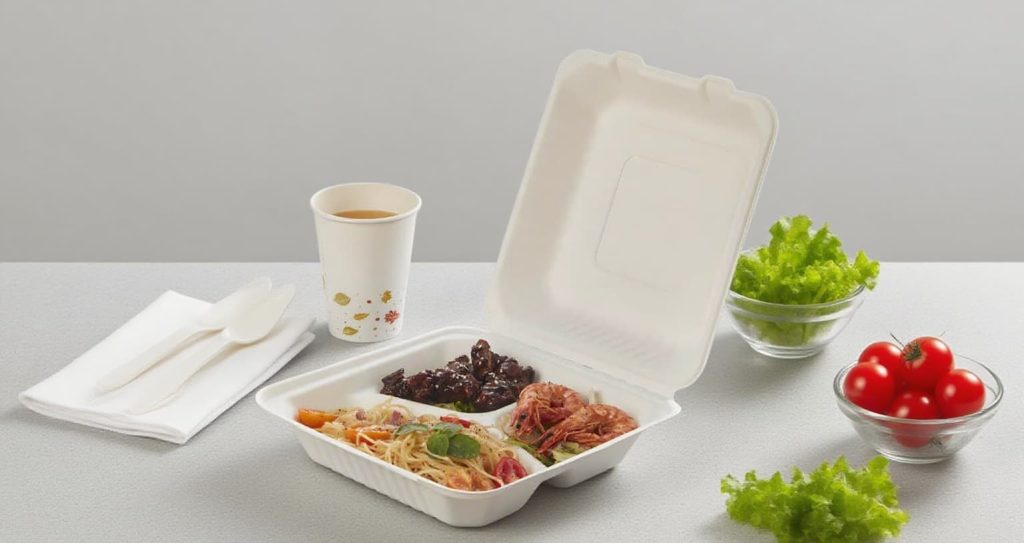
💡 Real-World Use: Xiamen Dashan’s Cornstarch Packaging
Xiamen Dashan, a leading manufacturer of food-grade packaging, integrates cornstarch-based PLA in its:
- Cold drink cups
- Transparent salad containers
- Dessert trays and dome lids
- Biodegradable cutlery
🌎 Export-ready features:
- International certifications: EN13432, ASTM D6400, OK Compost, FDA, QS, EC-EU
- Flexible customization for retail and foodservice clients
- Available in EXW, FOB, CIF, DDP terms for over 100 countries
💸 Cost and Performance Considerations
While cornstarch materials are more expensive than traditional plastic, their benefits often outweigh the cost, especially as:
- Governments penalize non-compostable packaging
- Consumers prioritize sustainability
- Production scales reduce unit costs
| Factor | Cornstarch Material |
|---|---|
| Price (vs. plastic) | +20–60% higher (2025 data) |
| Durability | Moderate |
| Barrier Properties | Good for dry, cold products |
| Shelf Life | 6–12 months (dry storage) |
🌿 Sustainability Scorecard
| Metric | Cornstarch-Based PLA |
|---|---|
| Renewable Resource | ✅ |
| Compostable | ✅ |
| Recyclable | ♻️ (Not in all systems) |
| Toxic Emissions | ❌ None |
| Supports Circular Economy | ✅ |
❓ Frequently Asked Questions
Q1: Can cornstarch packaging replace plastic in all cases?
A: Not always. It performs best in cold or dry applications, but struggles with heat or moisture unless blended with other biopolymers.
Q2: Is it really biodegradable in nature?
A: It needs industrial composting to break down efficiently. In landfills or oceans, it degrades slower than advertised.
Q3: Is PLA recyclable?
A: Technically yes, but only in facilities equipped for #7 PLA recycling—still rare in many regions.
Q4: Is cornstarch material safe for hot food?
A: Basic PLA softens above 60°C. For hot meals, CPET or PP trays are better choices.
🧾 Conclusion
Cornstarch-based materials are an innovative and responsible alternative to petroleum plastics. From food packaging to agriculture, they offer biodegradability, renewability, and consumer appeal—helping businesses and governments align with global sustainability goals.
Manufacturers like Xiamen Dashan are at the forefront, providing certified, export-ready compostable packaging made from cornstarch and other plant-based resources.
Choosing cornstarch materials is not just a trend—it’s a step toward a truly circular economy.
📚 References
- European Bioplastics. (2024).
Market Data 2023: Global Production Capacities of Bioplastics.
Retrieved from https://www.european-bioplastics.org/market/ - U.S. Environmental Protection Agency (EPA).
Managing Biodegradable Plastics in Commercial Composting Systems.
Retrieved from https://www.epa.gov/smm/composting-biodegradable-plastics - Song, J. H., Murphy, R. J., Narayan, R., & Davies, G. B. H. (2009).
Biodegradable and compostable alternatives to conventional plastics.
Philosophical Transactions of the Royal Society B: Biological Sciences, 364(1526), 2127–2139.
https://doi.org/10.1098/rstb.2008.0289 - Avérous, L. (2008).
Polylactic acid: Synthesis, properties and applications.
Current Opinion in Biotechnology, 19(6), 528–536.
https://doi.org/10.1016/j.copbio.2008.10.001 - Grand View Research. (2024).
Polylactic Acid Market Size, Share & Trends Analysis Report.
Retrieved from https://www.grandviewresearch.com/industry-analysis/polylactic-acid-pla-market - Fortune Business Insights. (2023).
Bioplastics Market Size, Share & Trends Analysis, by Type (PLA, Starch Blends, etc.).
Retrieved from https://www.fortunebusinessinsights.com/bioplastics-market-102273 - Biodegradable Products Institute (BPI).
Standards and Certifications for Compostable Plastics.
Retrieved from https://bpiworld.org/
Disclaimer & Copyright Notice
This article is created by the Dashan Packing editorial and research team.All information presented here is for educational and industry reference purposes only.Some data and standards cited in this article are sourced from publicly available materials,official regulatory documents, or third-party publications, which are properly credited where applicable.
All rights to third-party trademarks, images, and content belong to their respective owners.If any copyrighted material has been used inadvertently, please contact us at [email protected].We respect intellectual property rights and will promptly remove or revise any material upon verification.