

Quick Summary
Many food packaging products pass laboratory compliance tests but still fail in real-world use. This happens because standardized tests focus on safety and legality under controlled conditions, not on complex, real-life stress factors such as prolonged heat, oil exposure, stacking pressure, and human handling. Importers who understand the limits of testing—and validate packaging based on actual application scenarios—can significantly reduce performance failures, claims, and supply chain risk.
Introduction: “It Passed the Test — So Why Did It Fail?”
In food packaging procurement, few moments are more frustrating than this:
The product passed all required tests.
The documentation looked complete.
Samples seemed acceptable.
Yet once the packaging reached real operations—hot filling lines, delivery systems, retail shelves, or consumer hands—problems appeared.
Trays warped.
Containers leaked oil.
Lids cracked under stacking pressure.
Compostable items softened faster than expected.
For importers, distributors, and brand owners, these failures often feel unexpected. After all, the packaging was “compliant.”
But compliance and real-world performance are not the same thing.
This article explains why food packaging can pass laboratory tests and still fail in actual use, and more importantly, how experienced buyers reduce that risk before placing large orders.
1. What Packaging Tests Are Designed to Prove — and What They Are Not
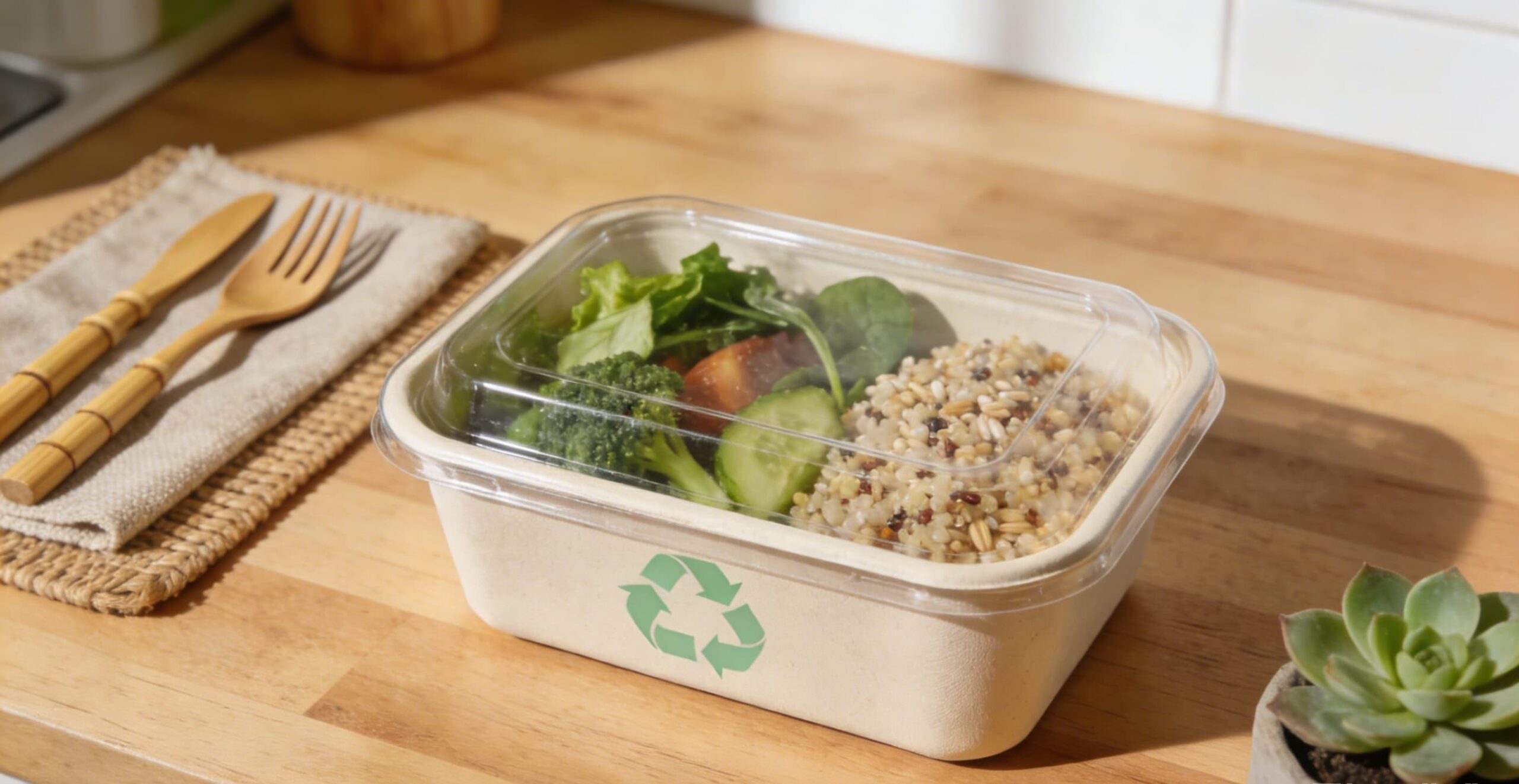
Food packaging tests are often misunderstood—not because they are unreliable, but because they are frequently overinterpreted.
1.1 The Real Purpose of Compliance Testing
Most mandatory packaging tests are designed to confirm one thing only:
That a material is safe and legally acceptable for food contact under defined conditions.
They are not designed to guarantee performance across every application.
Typical tests include:
-
Food contact migration testing
-
Temperature resistance testing under fixed conditions
-
Basic mechanical strength tests
-
Chemical safety and composition verification
These tests are essential. Without them, a product cannot legally enter many markets.
However, passing these tests does not mean the packaging is suitable for all food types, usage durations, or handling environments.
1.2 Tests Are Performed Under Controlled Assumptions
Laboratory tests rely on assumptions:
-
Fixed temperatures
-
Fixed exposure times
-
Specific food simulants
-
Controlled pressure and load
-
No human handling variability
Real-world use rarely respects these assumptions.
2. The Critical Gap Between Lab Conditions and Real Use

The core reason packaging fails in the field is simple:
Laboratory tests isolate variables. Real life stacks them.
2.1 Static vs Dynamic Environments
In testing:
-
Temperature is stable
-
Load is constant
-
Orientation is fixed
In reality:
-
Food cools and reheats
-
Containers are tilted, squeezed, and stacked
-
Transport vibrations apply repeated micro-stress
Even durable materials degrade differently under dynamic stress.
2.2 Single Variable vs Compound Stress
Most tests evaluate one variable at a time.
Real use combines:
-
Heat + time
-
Oil + pressure
-
Moisture + stacking
-
Temperature fluctuation + handling
Failures typically occur at the intersection of multiple stresses, not at extremes of a single one.
2.3 Short Tests vs Long Exposure
A 30-minute heat test may pass easily.
A 2-hour hot holding scenario may fail.
Time is often the missing factor in performance assumptions.
3. Common Real-World Stress Factors That Tests Rarely Simulate
This section explains where packaging performance usually breaks down, even when compliance documents look perfect.
3.1 Heat + Time: The Silent Deformation Trigger
Many materials are described as “heat resistant,” but this label hides an important distinction:
Heat resistance is time-dependent.
-
Short exposure ≠ prolonged holding
-
Initial rigidity ≠ long-term stability
For example:
-
A PP tray may withstand 100°C briefly but slowly warp when holding hot food for extended periods.
-
Bagasse containers may retain shape during filling but soften during hot holding or delivery.
What tests prove:
-
Initial tolerance
What they do not prove:
-
Dimensional stability over time
3.2 Oil and Fat: A Chemical Stress, Not Just a Surface Issue
Oil is one of the most underestimated stress factors in food packaging.
-
Oils can migrate into polymer chains
-
Fats weaken fiber bonding in molded pulp
-
Oil absorption changes stiffness over time
Packaging that performs well with dry foods may fail completely with oily dishes.
Tests often use standardized simulants, which do not always represent real recipes, spice levels, or oil concentrations.
3.3 Load, Stacking, and Transportation Pressure
Laboratory load tests typically apply:
-
Vertical, evenly distributed force
-
Short durations
In reality:
-
Stacking occurs unevenly
-
Containers are offset, not perfectly aligned
-
Transport introduces vibration and repeated stress cycles
Many failures appear after transportation, not at the factory or warehouse.
3.4 Handling Behavior: The Human Variable
No test can fully replicate:
-
Consumer grip strength
-
Speed of service handling
-
Accidental squeezing
-
One-handed lifting with hot contents
Packaging that survives machines may fail under people.
4. Why Material Labels Create False Confidence
Material names often create assumptions that are only partially true.
4.1 “PP Is Heat Resistant”
PP generally performs well at elevated temperatures, but:
-
Wall thickness matters
-
Tray geometry matters
-
Fill temperature duration matters
Thin-wall PP trays may pass heat tests but deform under long holding times.
4.2 “Bagasse Is Strong”
Bagasse is structurally rigid when dry.
Its weakness emerges under:
-
Moisture
-
Oil
-
Prolonged heat
Without surface treatment or structural reinforcement, strength claims are conditional.
4.3 “RPET Behaves Like PET”
Recycled content introduces:
-
Variability between batches
-
Slightly reduced molecular consistency
-
Sensitivity to thermal history
RPET can perform excellently—but assumptions based on virgin PET often fail without validation.
5. Real-World Failure Scenarios (Based on Common Industry Patterns)
5.1 Heat-Stable Tray That Warped During Delivery
-
Passed heat resistance testing
-
Used for hot meals with extended holding
-
Stacked tightly during transport
Failure cause:
-
Cumulative heat + stacking pressure
Root issue:
-
Application exceeded the tested use window
5.2 Compostable Container That Leaked Oil
-
Passed food contact safety
-
Approved for hot food
-
Used with oily cuisine
Failure cause:
-
Oil absorption over time
Root issue:
-
Oil exposure duration was never evaluated
5.3 Lid Cracking Despite Passing Impact Tests
-
Passed drop and impact testing
-
Cracked during customer handling
Failure cause:
-
Stress concentration at hinge or snap points
Root issue:
-
Tests did not simulate real grip forces
6. Why Passing Tests Still Matters — But Is Not Enough
Compliance testing remains essential.
Without it:
-
Products cannot enter regulated markets
-
Legal risks increase
-
Brand liability grows
However, testing should be treated as a baseline, not a performance guarantee.
Experienced buyers understand:
-
Tests reduce risk
-
They do not eliminate it
7. How Experienced Buyers Reduce Real-Use Failure Risk
Professional importers take additional steps before scaling orders.
7.1 Application-Specific Testing
Instead of asking:
“Does it pass the test?”
They ask:
“Does it survive my use case?”
7.2 Scenario Simulation
-
Hot filling with real food
-
Holding for real durations
-
Stacking in realistic quantities
7.3 Small Batch Validation
Limited pilot orders often reveal:
-
Warping thresholds
-
Leakage timing
-
Handling weaknesses
7.4 Supplier Transparency
Experienced suppliers clearly state:
-
Recommended use limits
-
Known failure conditions
-
Trade-offs between materials
8. What Importers Should Ask Suppliers Before Ordering
A practical checklist:
-
What real-use scenarios has this packaging been tested in?
-
What is the maximum recommended holding time for hot food?
-
How does oil or moisture affect performance over time?
-
What stacking height is considered safe?
-
What variability exists between production batches?
Clear answers often matter more than additional certificates.
FAQ
1. If packaging passes food contact tests, why can it still fail?
Because food contact tests confirm material safety, not functional performance. They do not simulate long holding times, real food compositions, stacking, or transportation stress.
2. Are heat resistance tests reliable indicators of real use?
They are reliable within defined test conditions only. Heat resistance is highly dependent on time, load, and product geometry, which are often different in real operations.
3. Why does packaging fail more often with oily or hot foods?
Oil and fat can chemically and physically weaken packaging materials over time, while prolonged heat accelerates deformation. These combined effects are rarely fully simulated in standard tests.
4. Do material labels like PP, RPET, or bagasse guarantee performance?
No. Material type alone does not define performance. Thickness, structure, processing method, and usage conditions all play a critical role in how packaging behaves in real use.
5. How can importers reduce the risk of real-use failure?
By validating packaging under actual application scenarios, conducting pilot orders, understanding usage limits, and working with suppliers who clearly communicate performance boundaries.
Conclusion: Real Performance Lives Outside the Lab
Food packaging failures rarely occur because tests are wrong.
They occur because tests are misunderstood.
Compliance testing confirms safety and legality.
Real-world performance depends on application, duration, handling, and environment.
Importers who understand this distinction:
-
Reduce claims and returns
-
Improve customer satisfaction
-
Build more reliable supply chains
The most successful packaging decisions are not based solely on material labels or test reports—but on how packaging actually behaves once it leaves the lab.
References
-
European Commission – Food Contact Materials Regulation (EC) No 1935/2004
https://food.ec.europa.eu/safety/chemical-safety/food-contact-materials_en -
U.S. FDA – Guidance for Industry: Use of Food Contact Substances
https://www.fda.gov/food/packaging-food-contact-substances-fcs -
Smithers – Packaging Testing and Performance Evaluation
https://www.smithers.com/services/testing/packaging-testing -
PlasticsEurope – Polypropylene (PP) Properties and Applications
https://plasticseurope.org/knowledge-hub/polypropylene-pp/ -
FAO – Food Packaging Materials and Food Safety
https://www.fao.org/food-safety/scientific-advice/food-packaging/en/
Copyright Statement
© 2026 Dashan Packing. All rights reserved.
This article is an original work created by the Dashan Packing editorial team.
All text, data, and images are the result of our independent research, industry experience,
and product development insights. Reproduction or redistribution of any part of this content
without written permission is strictly prohibited.
Dashan Packing is committed to providing accurate, evidence-based information and
to upholding transparency, originality, and compliance with global intellectual property standards.