

Quick Summary
Airline, delivery, and retail food packaging expose containers to very different physical stresses — from sustained high heat in ovens to steam and movement during delivery, to visual clarity needs in refrigerated retail. This article explains why no single material works across all channels, how common materials (CPET, PP, PET/RPET, bagasse) behave differently, and how matching material choice to scenario reduces failure, waste, and operational risk.
Introduction: The Same Food, Three Very Different Packaging Problems
At first glance, food packaging seems deceptively simple. A tray is a tray. A container is a container. If a material can hold food safely, many buyers assume it should work across airline meals, food delivery, and retail shelves alike.
In reality, this assumption is one of the most common — and costly — mistakes in food packaging selection.
The same dish can perform perfectly in one channel and fail catastrophically in another, even when the container appears identical. Warping, leakage, sogginess, odor transfer, seal failure, and customer complaints rarely originate from poor manufacturing quality. They almost always result from material–use mismatch.
Airline catering, delivery logistics, and retail display expose packaging to entirely different physical stresses. These environments demand fundamentally different material behaviors. That is why no single packaging material dominates all three channels — and why professional packaging systems are engineered by use scenario first, not by appearance or unit cost.
1. Three Use Environments, Three Distinct Failure Risks
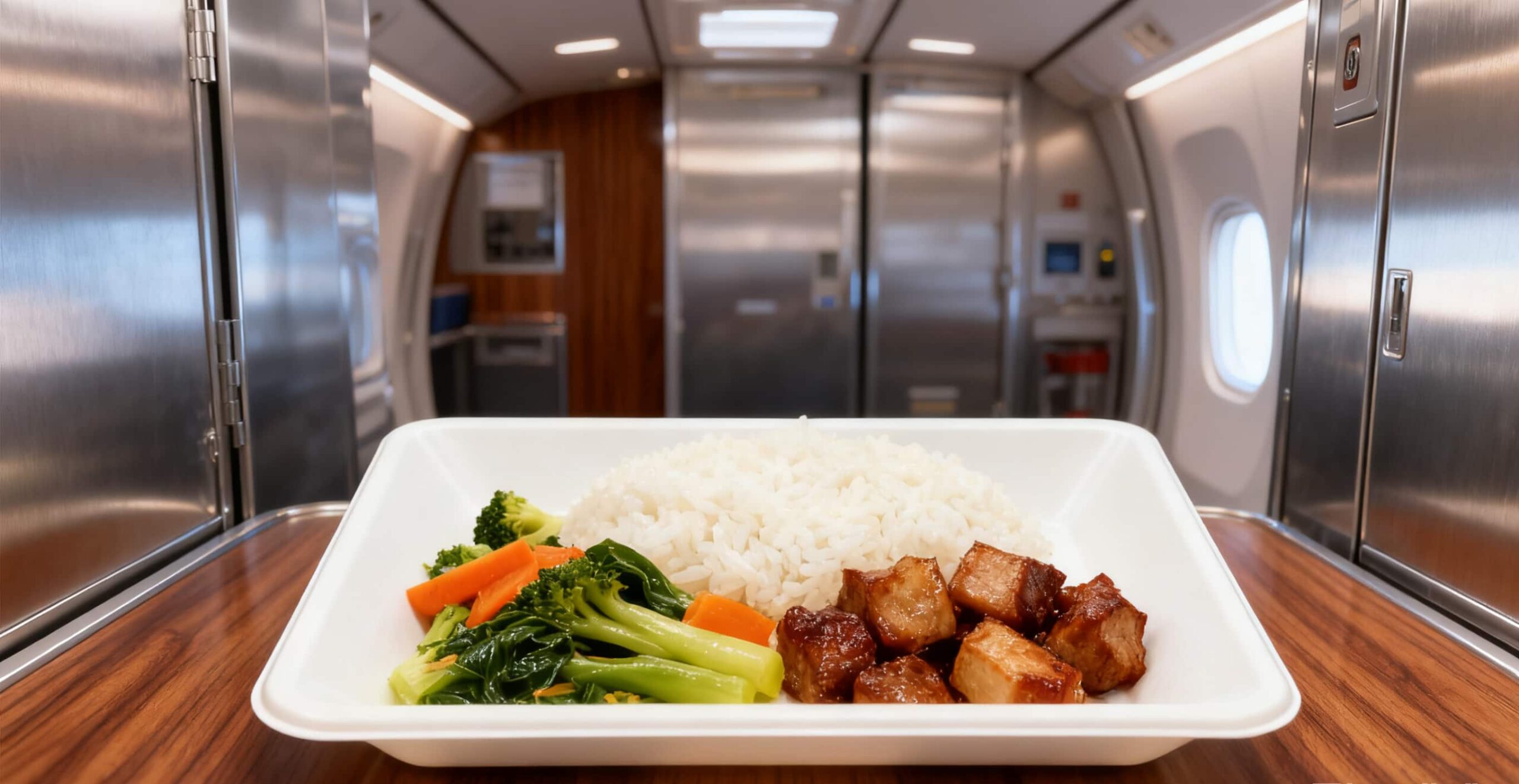
1.1 Airline Catering: Heat, Time, and Absolute Stability
Airline food packaging operates under some of the harshest constraints in the foodservice world.
Meals are often:
-
Prepared hours in advance
-
Stored under controlled conditions
-
Reheated in convection or steam ovens onboard
-
Served in confined spaces with zero margin for failure
Packaging must tolerate sustained high temperatures, not just brief heat exposure. Deformation is unacceptable, as trays must slide into standardized airline carts and ovens. Any leakage, odor release, or structural collapse can create safety risks and operational disruption.
This is why airline packaging prioritizes:
-
Thermal stability over appearance
-
Dimensional consistency over flexibility
-
Proven material behavior under repeated heating
1.2 Food Delivery: Steam, Oil, and Mechanical Stress
Food delivery presents an entirely different set of challenges — often underestimated by buyers.
Unlike airline meals, delivery packaging rarely fails because of oven heat. Instead, failure occurs during:
-
Transport vibration
-
Stacking pressure
-
Steam buildup from freshly cooked food
-
Oil migration and condensation
Hot food placed into sealed containers generates steam immediately. Without the right balance between rigidity and flexibility, containers warp or leak. Excess moisture compromises structural strength, leading to collapsed lids or soggy bases by the time food arrives.
For delivery, the dominant risks are:
-
Seal integrity under pressure
-
Oil resistance
-
Controlled moisture management
-
Impact resistance during transit
1.3 Retail & Supermarket: Visibility, Shelf Life, and Perception
Retail packaging prioritizes a completely different objective: selling the food before it is eaten.
Here, food is usually:
-
Cold or chilled
-
Stored for extended periods
-
Displayed under bright lighting
-
Evaluated visually before purchase
Material clarity, rigidity, and appearance play a decisive role. Consumers associate transparency with freshness and quality. Even the best-performing heat-resistant container will fail in retail if it obscures the product or distorts its visual appeal.
Retail packaging failures are not structural — they are perceptual:
-
Fogging reduces visibility
-
Deformation damages shelf presentation
-
Poor sealing shortens shelf life
2. Why No Single Packaging Material Works Everywhere
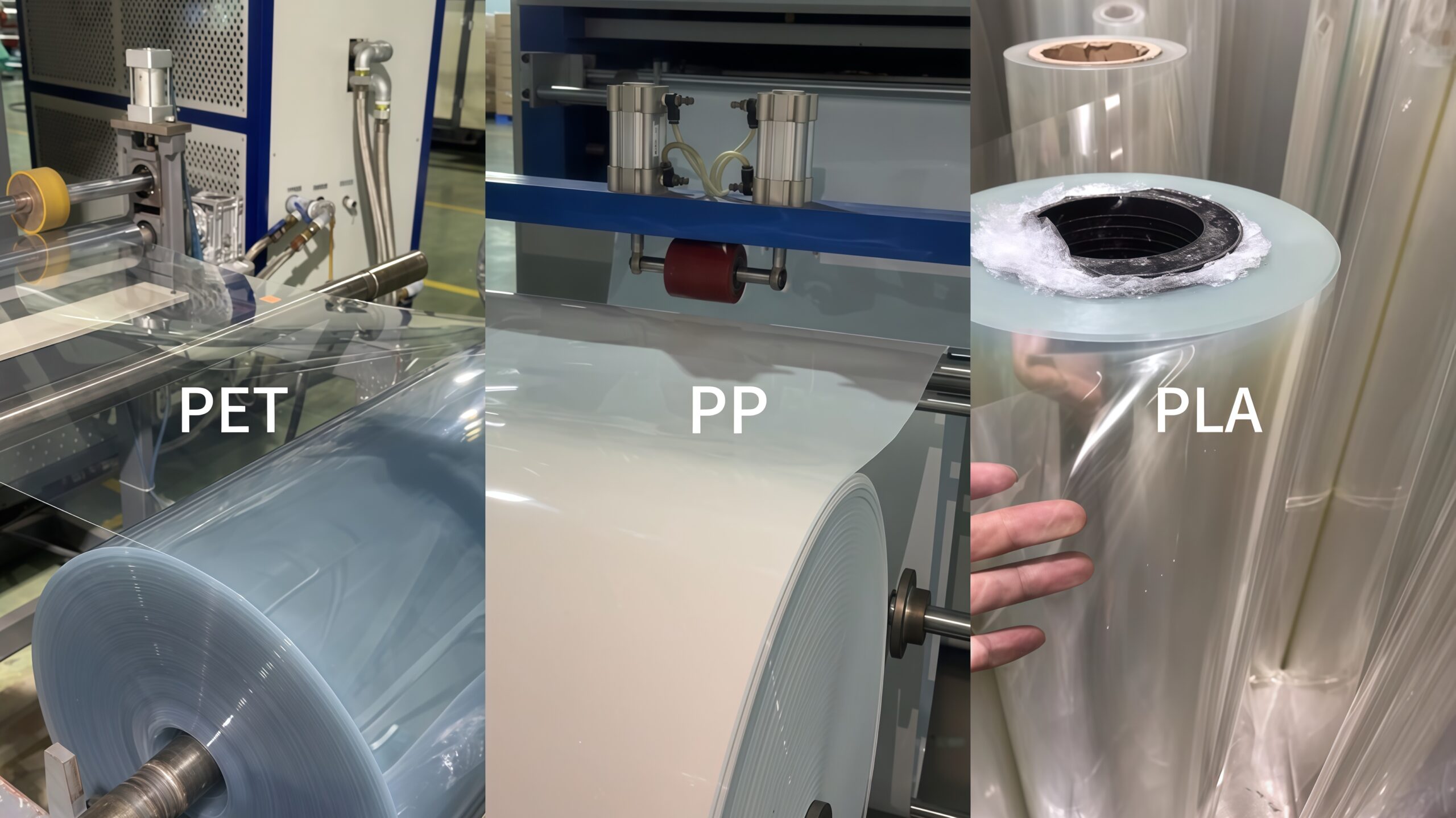
From an engineering perspective, packaging materials operate under unavoidable trade-offs.
Increasing heat resistance often reduces transparency. Improving rigidity can reduce impact tolerance. Enhancing moisture barriers may compromise breathability. These characteristics are governed by polymer structure, crystallinity, and material chemistry — not marketing claims.
Attempts to create “one container for all uses” typically rely on:
-
Increased thickness
-
Additives
-
Overengineering
These approaches raise costs without eliminating fundamental material limitations.
In practice, materials succeed when they are specialized, not generalized.
3. Core Material Performance Requirements by Channel
Key Performance Factors
-
Heat resistance
-
Structural stability
-
Moisture and oil resistance
-
Transparency
-
Weight and stackability
-
Regulatory compliance
Each channel weights these factors differently, leading to distinct material choices.
4. How Common Food Packaging Materials Perform
4.1 CPET: Built for Airline and High-Heat Applications

Crystallized PET (CPET) was developed specifically to overcome PET’s thermal limitations. Through controlled crystallization, CPET achieves heat resistance up to 200–220°C, allowing it to withstand oven reheating without deformation.
This makes CPET the industry standard for:
-
Airline meals
-
Ready meals
-
Institutional catering
Its opaque appearance is not a design flaw, but a consequence of crystallization — a necessary trade-off for thermal stability.
4.2 PP: The Workhorse of Food Delivery
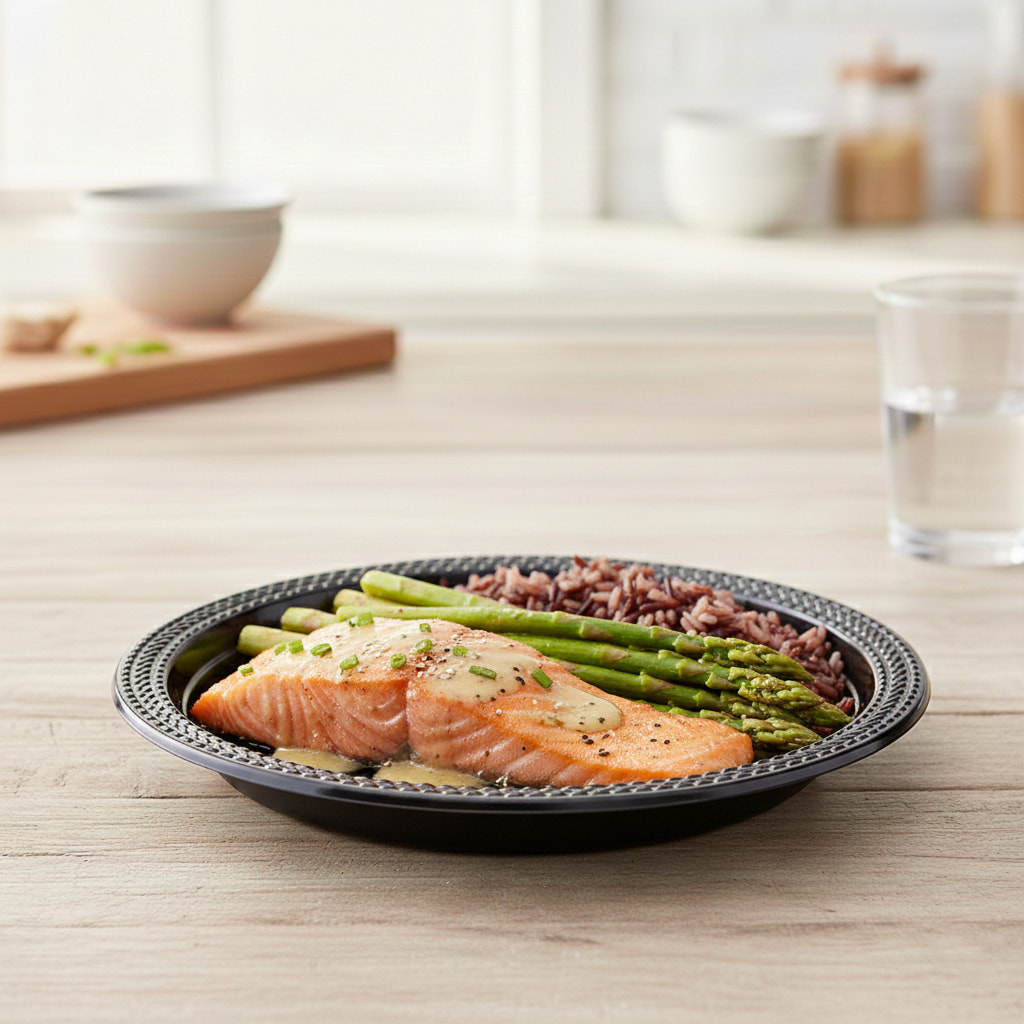
Polypropylene (PP) offers a balanced performance profile that suits delivery environments exceptionally well.
PP provides:
-
Moderate heat resistance
-
Excellent oil resistance
-
Flexibility under pressure
-
Resistance to cracking during transport
While PP cannot match CPET’s oven performance, it excels where steam, movement, and handling dominate — which is why it remains the dominant material for hot food delivery containers worldwide.
4.3 PET and RPET: Optimized for Retail Display
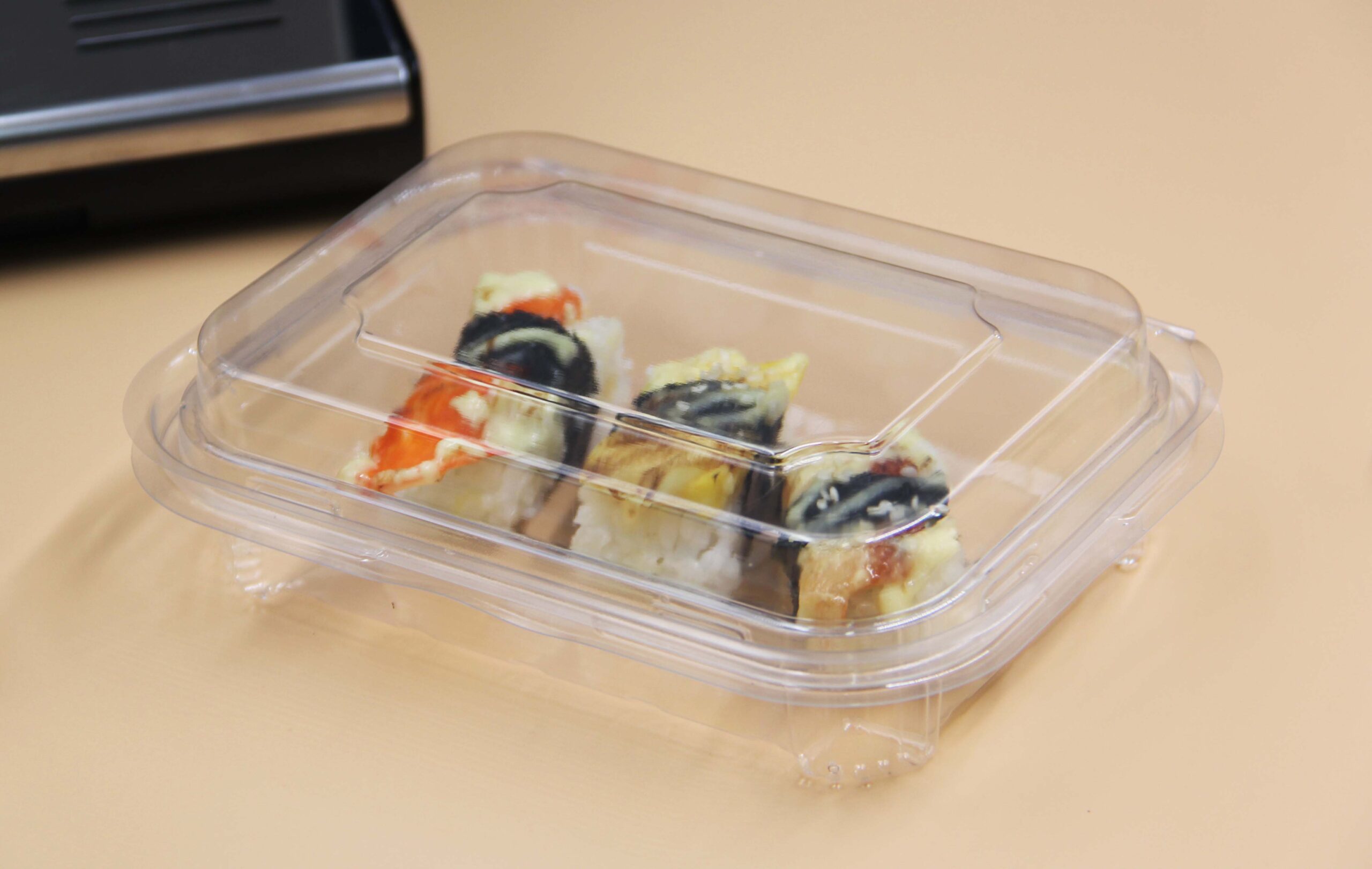
PET and recycled PET (RPET) are favored in retail due to:
-
High transparency
-
Strong rigidity at low thickness
-
Lightweight structure
They perform exceptionally well for:
-
Cold foods
-
Salads
-
Desserts
-
Chilled ready meals
However, their low heat resistance makes them unsuitable for reheating or hot filling beyond controlled conditions.
4.4 Bagasse: Sustainable, With Clear Boundaries
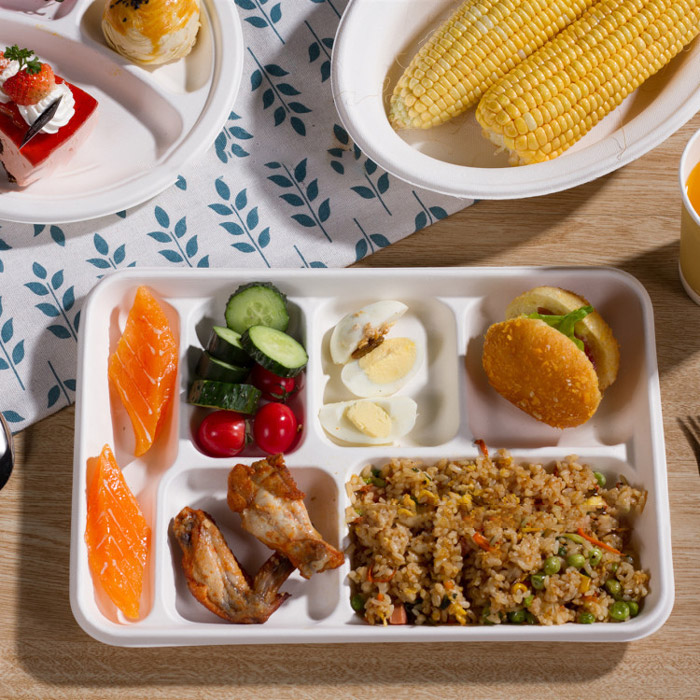
Bagasse packaging offers strong environmental appeal and performs well for:
-
Dry foods
-
Short holding times
-
Low-oil applications
Its limitations become evident with oily, wet, or long-duration hot foods. Moisture absorption and oil penetration can compromise strength, making it unsuitable for many delivery or airline uses without coatings.
5. Cost, Compliance, and Operational Reality
Each channel also operates under different regulatory and economic pressures.
-
Airlines prioritize compliance and reliability over unit cost
-
Delivery platforms balance cost against failure rates and customer complaints
-
Retailers prioritize appearance, recyclability, and shelf efficiency
Material decisions reflect these realities, not simply raw material prices.
6. Common Buyer Misuse Scenarios
Many packaging failures stem from well-intentioned but flawed substitutions:
-
Using PET containers for reheated meals
-
Choosing bagasse for oily delivery foods
-
Selecting CPET for retail where transparency matters
These choices often appear cost-effective upfront but result in higher returns, negative reviews, and brand damage.
7. Choosing the Right Material by Channel
(A second decision-focused table fits well here.)
Rather than asking “Which material is best?”, buyers should ask:
-
How will the food be heated?
-
How long will it be held?
-
How will it be transported?
-
How will the customer interact with it?
Material choice follows naturally from these answers.
8. Where DASHAN Fits Into Multi-Channel Packaging Needs
Brands operating across airline, delivery, and retail channels rarely benefit from a single-material strategy.
DASHAN supports multi-channel food businesses by offering purpose-designed packaging solutions across PP, PET, RPET, CPET, and bagasse, helping clients match materials to real-world use rather than forcing one solution across incompatible environments.
This approach reduces failure rates, improves customer satisfaction, and supports more sustainable material use by avoiding unnecessary overengineering.
Conclusion: Packaging Works When Materials Match Reality
Food packaging does not fail because materials are weak. It fails because expectations ignore physics.
Airline, delivery, and retail environments impose fundamentally different stresses. Materials that excel in one context may underperform in another — not due to quality issues, but because they were never designed for that use.
Understanding these differences allows brands to make smarter material decisions, reduce waste, and protect both food quality and brand reputation.
In food packaging, success is not about choosing the “best” material — it is about choosing the right material for the job.
FAQ
1. Why do airline meals require different packaging materials than delivery food?
Airline meals undergo sustained high heat exposure (oven or reheating) and long holding times, requiring materials with high thermal stability, such as CPET, that maintain structural integrity at elevated temperatures.
2. What makes delivery food packaging different from airline or retail packaging?
Delivery packaging must manage steam buildup, oil contact, vibration, and stacking pressure during transport — stresses that are mechanical and moisture-related rather than purely thermal.
3. Why is PET/RPET commonly used in retail food packaging?
PET and RPET offer high transparency and rigid shape, which enhance visual appeal and cold shelf display performance, making them ideal for cold or chilled foods seen by consumers before purchase.
4. Can one material be used for all food packaging channels?
No. Different food channels impose different stresses (heat, moisture, movement, display), and each material has strengths and limitations that make it suitable for specific scenarios, not universal use.
5. What are the limitations of bagasse in food packaging?
Bagasse performs well for dry, short-use foods but is prone to moisture absorption and oil penetration in high-moisture or oily foods, reducing structural strength under delivery or heat.
6. How should brands choose the right packaging material?
Packaging decisions should be based on food temperature profile, heating/reheating method, holding time, and transport conditions, rather than focusing on brand labels or assumed universality.
References
-
CPET Material Properties and Applications — Overview of CPET’s crystallized structure, thermal stability, and uses in high-heat food packaging.
https://www.jwellmech.com/What-Material-Is-CPET-id49159026.html -
CPET/RPET Packaging Solutions — Summary of CPET and RPET performance, including temperature tolerance and food contact suitability.
https://euralpack.com/en/packaging-solutions/trays-and-lids/cpet-rpet/ -
Packaging Europe — Heat-Resistant Food Packaging Materials — Industry insights on materials used for high-temperature food packaging.
https://packagingeurope.com/type-of-article/industry-news/heat-resistant-food-packaging/ -
Smithers — Trends in Food Packaging Performance — Analysis of food packaging performance requirements across different channels.
https://www.smithers.com/services/market-reports/packaging -
PlasticsEurope – Polyethylene Terephthalate (PET) Overview — Technical and performance properties of PET and its use in food packaging.
https://plasticseurope.org/knowledge-hub/plastics-explained/polymers/polyethylene-terephthalate-pet/
Copyright Statement
© 2026 Dashan Packing. All rights reserved.
This article is an original work created by the Dashan Packing editorial team.
All text, data, and images are the result of our independent research, industry experience,
and product development insights. Reproduction or redistribution of any part of this content
without written permission is strictly prohibited.
Dashan Packing is committed to providing accurate, evidence-based information and
to upholding transparency, originality, and compliance with global intellectual property standards.