

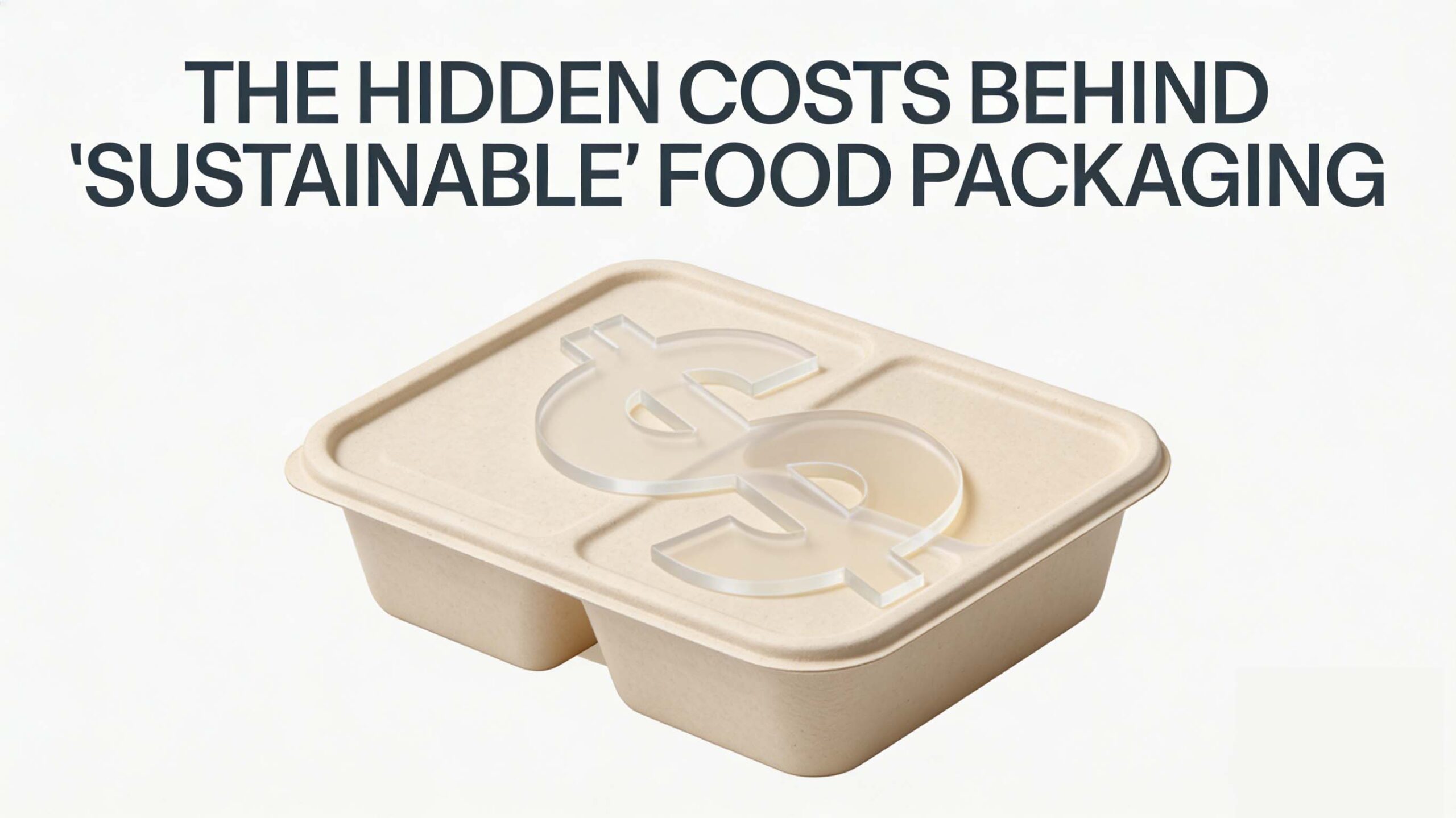
Sustainable food packaging is often presented as a simple decision: switch to a greener material, reduce plastic, or choose a compostable option. On paper, these choices appear to lower environmental impact and improve brand perception. In practice, many buyers discover that sustainability decisions introduce a different category of costs—costs that are not visible at the time of ordering.
These hidden costs do not show up on the quotation sheet. They appear after packaging enters real operations: during food service, transportation, storage, regulatory review, and disposal. Understanding these costs is essential for importers and brand owners who want sustainability to improve outcomes rather than undermine them.
Sustainable Packaging Looks Simple — Until Costs Appear
The term “sustainable packaging” is widely used, but rarely defined with operational precision. Buyers are often encouraged to evaluate packaging primarily by material category: recyclable, compostable, bio-based, or reduced-plastic.
This approach assumes that sustainability is an inherent property of the material itself. In reality, environmental impact is shaped by how packaging performs, how consistently it is manufactured, how it moves through the supply chain, and how it is ultimately handled after use.
The most expensive sustainability failures are not dramatic. They are incremental, distributed, and cumulative—small performance issues that quietly increase waste, labor, logistics costs, and regulatory risk.
Cost #1: Performance Failure and Food Waste
The most significant hidden cost of poorly matched sustainable packaging is food waste.
Packaging that lacks adequate heat resistance, moisture barrier performance, or structural integrity often fails under real service conditions. Deformation, leakage, or compromised sealing can occur even when packaging meets basic laboratory specifications.
From an environmental standpoint, food waste is far more damaging than packaging waste. The resources embedded in food—water, energy, land, and emissions—far exceed those required to manufacture a tray or cup. When packaging failure leads to food loss, the environmental cost multiplies.
In real-world applications, a package that appears sustainable but cannot reliably protect food often produces the opposite environmental outcome.
Cost #2: Secondary Packaging and Operational Adjustments
When primary packaging underperforms, operations adapt.
Additional liners, outer bags, sleeves, or containers are introduced to compensate for fragility or leakage risk. Staff may double-pack items, reduce fill levels, or alter handling procedures to prevent failure.
These adjustments increase material usage, labor time, and complexity. They also undermine the original sustainability objective by introducing additional packaging layers that were not part of the initial design.
In many cases, buyers do not attribute these downstream changes to the original packaging decision, even though they are direct consequences of it.
Cost #3: Logistics and Transportation Inefficiency
Sustainable packaging decisions can also introduce inefficiencies in logistics.
Design compromises—such as thinner walls, altered geometries, or reduced rigidity—can negatively affect stackability and load stability. Poor dimensional efficiency increases empty space during transportation and storage, raising emissions per unit delivered.
Deformation during transit is another common issue. Packaging that arrives warped or compressed may still be technically usable, but it increases handling time, rejection rates, and perceived quality risk.
Transportation inefficiency is rarely included in sustainability calculations, yet it plays a major role in total environmental impact.
Cost #4: Manufacturing Variability and Quality Risk
Manufacturing stability is a critical but often overlooked sustainability factor.
Sustainable materials can be more sensitive to processing conditions, requiring tighter control over temperature, pressure, and forming parameters. When production processes are not fully stabilized, performance variability increases.
Variability leads to higher rejection rates, inconsistent product behavior, and increased waste—both at the factory level and in downstream use. Each rejected unit represents wasted material, energy, and labor.
From an environmental perspective, sustainability cannot be separated from manufacturing discipline. Consistency reduces waste more effectively than marginal material changes.
Cost #5: Compliance and Documentation Gaps
Another hidden cost emerges during regulatory review and import clearance.
Buyers often assume that using an approved material automatically ensures compliance. In reality, food-contact regulations focus on the final article and its intended use, not just the raw material.
Documentation gaps—such as incomplete migration testing, mismatched usage conditions, or unclear traceability—can delay customs clearance or require additional verification. These delays carry financial and reputational risk, especially for brands operating in tightly regulated markets.
Sustainable packaging that introduces compliance uncertainty can become a liability rather than an asset.
Cost #6: Misalignment With Local Disposal Infrastructure
End-of-life assumptions frequently determine whether sustainable packaging delivers real benefits.
Compostable packaging offers little environmental advantage if industrial composting facilities are unavailable. Recyclable packaging may be rejected by local sorting systems due to contamination, color, or format limitations.
Environmental claims that ignore disposal infrastructure risk shifting waste rather than reducing it. True sustainability depends on where packaging actually goes, not where it is theoretically designed to go.
This misalignment often becomes visible only after packaging is already in circulation.
Why Experienced Buyers Evaluate Sustainability Differently
Experienced buyers tend to approach sustainability as a system-level decision rather than a material upgrade.
They evaluate packaging based on real use scenarios, performance margins, logistics compatibility, regulatory exposure, and end-of-life realities. Instead of asking whether packaging is sustainable in theory, they ask whether it reduces risk across the entire lifecycle.
This mindset recognizes that sustainability failures are often operational failures first.
Where Manufacturer Experience Changes the Outcome
At this stage, manufacturer experience becomes a differentiating factor.
Manufacturers with hands-on production expertise and exposure to multiple materials and applications are better positioned to identify risks early. They can evaluate how design choices, processing conditions, and material behavior interact under real conditions.
At DASHAN, sustainability discussions typically begin with application analysis rather than material promotion. By aligning performance requirements, manufacturing stability, and regulatory expectations at the design stage, downstream waste and risk can often be avoided entirely.
This role is less about selling a material and more about preventing avoidable failure.
Sustainability Is a Cost Management Strategy — When Done Right
When sustainability is approached as a system optimization problem, it often reduces total cost of ownership.
Reliable performance lowers food waste. Stable manufacturing reduces scrap. Efficient logistics decrease emissions and transportation costs. Clear compliance documentation minimizes regulatory delays.
In this context, sustainability is not an added expense. It is a byproduct of alignment across decisions that would be necessary for operational efficiency anyway.
FAQ
1. Why does “sustainable” packaging sometimes increase total costs?
Because material sustainability does not guarantee real-world performance. Failures often lead to food waste, added packaging, labor inefficiencies, and logistics issues.
2. Is food waste really more harmful than packaging waste?
Yes. The environmental footprint of wasted food is significantly higher than that of packaging, making reliable performance a key sustainability factor.
3. Why do experienced buyers evaluate packaging differently?
They assess packaging as part of an operational system, considering performance margins, logistics, compliance risk, and disposal infrastructure—not just material type.
4. Can heavier or stronger packaging be more sustainable?
In many cases, yes. If it prevents food loss and operational failure, the total environmental impact can be lower.
5. How does manufacturing consistency affect sustainability?
Process instability increases scrap, defects, and performance variability, all of which generate hidden environmental and financial waste.
Conclusion
The hidden costs of sustainable food packaging emerge when decisions are made in isolation. Material labels alone do not determine environmental or commercial outcomes.
True sustainability is achieved when packaging decisions align performance, manufacturing stability, logistics efficiency, regulatory compliance, and disposal infrastructure. Without this alignment, even well-intentioned sustainable choices can increase waste, cost, and risk.
Packaging becomes environmentally responsible not by intention, but by execution.
References
-
FAO – Food Loss and Food Waste
https://www.fao.org/food-loss-and-food-waste/en/ -
Ellen MacArthur Foundation – Packaging and Circular Economy
https://ellenmacarthurfoundation.org/topics/packaging/overview -
U.S. EPA – Sustainable Materials Management
https://www.epa.gov/smm -
European Commission – Packaging and Packaging Waste
https://environment.ec.europa.eu/topics/waste-and-recycling/packaging-waste_en -
ISO 18601: Packaging and the Environment
https://www.iso.org/standard/59984.html
Copyright Statement
© 2026 Dashan Packing. All rights reserved.
This article is an original work created by the Dashan Packing editorial team.
All text, data, and images are the result of our independent research, industry experience,
and product development insights. Reproduction or redistribution of any part of this content
without written permission is strictly prohibited.
Dashan Packing is committed to providing accurate, evidence-based information and
to upholding transparency, originality, and compliance with global intellectual property standards.