

Introduction
As consumers demand healthier lifestyles and more environmentally responsible businesses, the foodservice industry faces growing pressure to replace plastic with sustainable packaging. Among the most promising innovations is the bagasse hamburger box—a biodegradable, plant-based container made from sugarcane fiber.Unlike traditional plastic or foam clamshells, bagasse food lock boxes align with global trends in eco-conscious dining, waste reduction, and corporate sustainability. In this article, we will explore the strengths, challenges, and real-world applications of bagasse packaging through the lens of E-E-A-T principles: Experience, Expertise, Authoritativeness, and Trustworthiness.
1. Experience:Bagasse burger box Real-World Applications in Foodservice
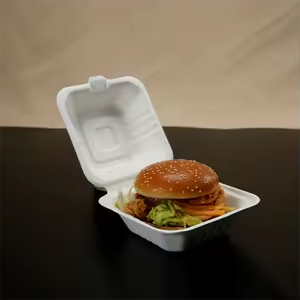
Restaurants, cafés, and global fast-food chains are increasingly switching to bagasse packaging. According to industry reports, the European Union’s Single-Use Plastics Directive has accelerated the transition, while markets in North America and Asia-Pacific are seeing rapid adoption due to consumer preference for greener options.
Many quick-service restaurants (QSRs) report that switching to bagasse has improved customer perception and strengthened their branding as eco-friendly businesses. For example:
-
Independent burger shops have highlighted that customers appreciate “the natural look” and “eco-feel” of bagasse packaging.
-
Catering services report that bagasse food lock boxes withstand handling during delivery better than expected.
-
Food trucks and street vendors value the durability and the “premium, sustainable touch” it adds to their offerings.
This hands-on experience suggests that bagasse packaging is no longer a niche alternative, but a mainstream solution for sustainable food packaging.
2. Expertise: What Makes Bagasse Different?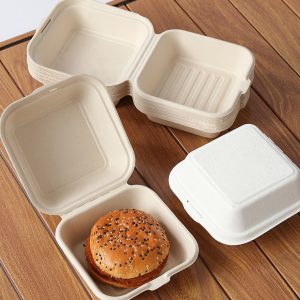
Bagasse is the fibrous byproduct left after extracting juice from sugarcane. Instead of being discarded or burned, this agricultural residue is transformed into a compostable material that can replace petroleum-based plastics.
Technical Advantages of Bagasse Packaging:
-
Renewable source: Utilizes agricultural waste, reducing reliance on fossil fuels.
-
Biodegradable: Breaks down in industrial composting within 60–90 days under optimal conditions.
-
Safe for food contact: Free from BPA, phthalates, and other harmful additives.
-
Durability: Resistant to oil and moderate heat, suitable for burgers, fries, and takeout meals.
-
Circular economy: Fits into global waste reduction strategies by turning waste into a valuable resource.
Expert studies (see Food Packaging Forum) confirm that plant-based fibers like bagasse reduce greenhouse gas emissions compared with plastics, especially when composted or processed through waste-to-energy systems.
3. Authoritativeness: Regulatory and Market Perspectives
Authorities worldwide are setting stricter packaging requirements:
-
European Union: The SUP Directive bans plastic cutlery, straws, and expanded polystyrene (EPS) boxes. Bagasse products provide compliant alternatives.
-
United States: States like California, New York, and Maine have implemented bans on foam containers.
-
Asia-Pacific: Countries such as India, China, and the Philippines are encouraging biobased alternatives.
Industry associations such as the Sustainable Packaging Coalition (SPC) and the European Bioplastics Association recognize bagasse as a reliable substitute that aligns with sustainability certifications and environmental labeling schemes.
This authoritative validation reassures food businesses that bagasse packaging is not only an environmental choice but also a regulatory-compliant investment for the future.
4. Trustworthiness: Challenges and Transparency
To establish credibility, it is important to acknowledge limitations:
-
Cost: Bagasse boxes are more expensive than foam or cheap plastic clamshells, especially in small volumes.
-
Moisture resistance: Extended storage of oily or saucy foods may require additional coating.
-
Degradation conditions: True biodegradability requires industrial composting facilities, which are not equally available worldwide.
By openly addressing these challenges, businesses can build consumer trust while emphasizing long-term benefits such as lower carbon footprint, improved brand loyalty, and compliance with environmental policies.
5. Comparative Analysis: Bagasse vs. Corn Starch Tableware
While bagasse is a leading solution, it is not the only eco-friendly material. Another key player is corn starch tableware, which is also biodegradable and increasingly popular.
Comparison at a glance:
-
Bagasse is excellent for sturdiness and larger packaging (e.g., burger boxes, trays).
-
Corn starch tableware is widely used for spoons, forks, and cups due to its smooth finish.
-
Both materials serve different niches, complementing each other in the broader eco-packaging ecosystem.
This highlights that the future of sustainable packaging is not one material, but a mix of solutions tailored to different needs.
6. Market Outlook and Expert Predictions
Market analysts project the global eco-friendly food packaging industry will exceed USD 450 billion by 2030, with bagasse and corn starch materials capturing significant shares.
Experts agree that future growth depends on:
-
Policy expansion: More countries banning single-use plastics.
-
Technological innovation: Coatings that improve water resistance and microwave safety.
-
Consumer education: Greater awareness of composting and disposal methods.
Dr. Laura McKinney, a researcher in sustainable packaging at the University of Leeds, notes:
“Plant-based packaging like bagasse provides a dual solution—it reduces agricultural waste while replacing fossil-based plastics. This is a win-win scenario for climate policy and consumer health.”
7. Practical Guidance for Businesses
If you are considering adopting bagasse hamburger boxes, here are some tips:
-
Test performance: Conduct trials with different food types to ensure heat, oil, and moisture resistance.
-
Educate customers: Print eco-labels or QR codes on packaging to inform about biodegradability.
-
Integrate branding: Use customization (logos, colors) to align with sustainable brand identity.
-
Manage costs: Offset higher material costs by marketing your eco-friendly approach as a value-add.
-
Monitor policies: Stay updated with packaging regulations in your target markets.
Conclusion
The shift toward sustainable packaging is not just an environmental gesture—it is a strategic business move. Bagasse hamburger boxes represent a practical, safe, and eco-friendly alternative to plastic. While challenges exist, their advantages in brand reputation, regulatory compliance, and consumer approval make them a smart investment.
Alongside other plant-based solutions like corn starch tableware, bagasse products are paving the way for a future where takeout convenience and environmental responsibility go hand in hand.
📌 FAQ
Q1: Are bagasse hamburger boxes really biodegradable?
Yes. Bagasse packaging can biodegrade under industrial composting conditions within 60–90 days. However, the speed of degradation depends on local waste management infrastructure.
Q2: How do bagasse boxes compare to plastic in terms of food safety?
Bagasse is free from harmful chemicals such as BPA and phthalates, making it safer for direct food contact compared with petroleum-based plastics.
Q3: Can bagasse hamburger boxes handle hot and oily foods?
Yes, they are designed to resist moderate heat and oils. However, for extremely greasy or saucy meals, businesses should conduct performance testing before large-scale adoption.
Q4: What is the difference between bagasse packaging and corn starch tableware?
Bagasse is sturdy and ideal for boxes, trays, and containers, while corn starch tableware is often used for cutlery, cups, and lightweight dishes. Both materials complement each other in sustainable packaging solutions.
Q5: Are bagasse boxes more expensive than plastic?
Currently, yes. Bagasse packaging usually costs more than foam or plastic clamshells. But as demand grows and production scales up, prices are expected to decrease.
Q6: Can bagasse packaging be recycled?
Bagasse products are not typically recyclable in traditional plastic recycling streams, but they are compostable and can be processed in facilities handling organic waste.
Q7: Why should restaurants switch to bagasse packaging?
Beyond environmental benefits, bagasse packaging improves brand image, aligns with global regulations, and meets growing consumer demand for eco-friendly dining options.
📚 References & Sources
-
European Commission – Single-Use Plastics Directive (SUP)
https://environment.ec.europa.eu/topics/plastics/single-use-plastics_en -
Food Packaging Forum – Biodegradable Food Packaging Materials
https://www.foodpackagingforum.org -
Sustainable Packaging Coalition (SPC) – Guidelines for Sustainable Packaging
https://sustainablepackaging.org -
European Bioplastics – Facts and Figures on Bioplastics
https://www.european-bioplastics.org -
Ellen MacArthur Foundation – The New Plastics Economy: Rethinking the Future of Plastics
https://ellenmacarthurfoundation.org -
Smithers Pira – The Future of Sustainable Packaging to 2030 (Market Research)
https://www.smithers.com -
United Nations Environment Programme (UNEP) – Single-Use Plastics: A Roadmap for Sustainability
https://www.unep.org/resources/report/single-use-plastics-roadmap-sustainability
Disclaimer & Copyright Notice
This article is created by the Dashan Packing editorial and research team.
All information presented here is for educational and industry reference purposes only.
Some data and standards cited in this article are sourced from publicly available materials,
official regulatory documents, or third-party publications, which are properly credited where applicable.
All rights to third-party trademarks, images, and content belong to their respective owners.
If any copyrighted material has been used inadvertently, please contact us at [email protected].
We respect intellectual property rights and will promptly remove or revise any material upon verification.