

Quick Summary
This article offers a detailed comparison between sugarcane bagasse and cornstarch tableware, designed for foodservice, retail and packaging-procurement professionals. Bagasse tableware—made from sugarcane pulp—delivers high heat resistance, durability and compostability, ideal for hot meals, take-out, and heavy-use scenarios. Cornstarch-based tableware (derived from starch polymers) provides a lighter aesthetic, relatively lower cost and suitability for cold or ambient-temperature foodservice. The correct choice depends on your food-application temperature, branding strategy, end-of-life infrastructure and sustainability roadmap.
Introduction
In the current global food-service and packaging landscape, the pressure to reduce single-use plastic waste has never been stronger. Policymakers, retailers and consumers demand materials that meet both operational performance and environmental credentials. In this context, biodegradable or compostable tableware options have moved from niche to mainstream.
From decades of procurement and packaging-supply experience, professionals understand that choosing the “right” material isn’t just about claims of biodegradability—but about real-world performance, supply chain assurance, brand alignment, and end-of-life practicality. This guide focuses on two leading materials: sugarcane bagasse and cornstarch-based tableware. It explores their material science, manufacturing experience, practical deployment, sustainability credentials and decision criteria—so your business can choose with confidence.
Understanding Cornstarch Tableware
Material Science & Experience
Cornstarch tableware typically uses starch (often from corn) as the base, processed into thermoplastic starch (TPS) or polylactic acid (PLA) blends. A review highlights starch-based materials as abundant, low-cost renewable polymers with good compatibility, though with limitations in mechanical strength and moisture sensitivity.
From a procurement standpoint, many facilities producing cornstarch tableware have refined the process to deliver smooth surface finish, lightweight units and consistent food-contact safety. This reflects “experience” in the supply chain and manufacturing domain.
Properties
-
Visual & aesthetic finish: Cornstarch-based tableware often presents a clean, white or off-white smooth finish, offering a “premium” look similar to plastic.
-
Lightweight: Compared to heavier fibre-based materials, these units reduce shipping and handling costs.
-
Moderate heat resistance: Typical variants can handle up to ~70-80 °C reliably, suitable for ambient or cold-meal use—but often not recommended for high-temperature reheating scenarios.
-
Biodegradability: Under appropriate conditions (industrial composting) these materials can break down. A study on starch-based films underscores ongoing work to enhance performance for packaging.
Applications
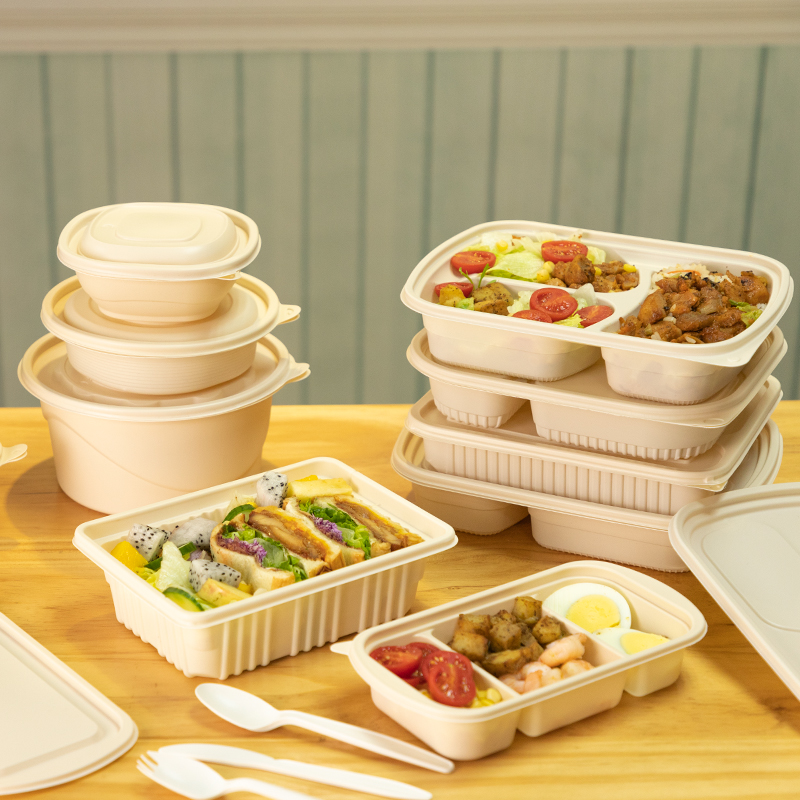
Cornstarch tableware works best for:
-
Cold-serving food (salads, desserts, fruit bowls)
-
Ambient or room-temperature use settings
-
Retail packaging requiring a plastic-like aesthetic
-
Lightweight take-out boxes for dry or chilled items
Advantages
Procurement and operations-oriented advantages include:
-
Relatively lower cost compared with heavy fibre or other plant-fibre alternatives in some cases
-
Appealing finish, which supports branding and presentation
-
Reduced weight and improved logistics efficiency
Limitations
However, there are trade-offs:
-
Heat resistance is limited—risk of deformation or failure if used beyond recommended temperature.
-
Moisture and oil resistance may be weaker compared with fibre-based solutions.
-
Realisation of biodegradability depends on end-of-life infrastructure—consumer misuse or landfill disposal may undercut the environmental benefit.
-
Some recent studies raise caution over health impact of certain starch-based bioplastics under long-term exposure.
Understanding Bagasse Tableware
Material Science & Experience
Bagasse is the fibrous residue that remains after extracting juice from sugarcane stalks. As a material for tableware manufacture, it leverages agricultural by-product and aligns strongly with circular-economy principles. A 2020 study in ScienceDirect confirmed that bagasse-based packaging achieved food-contact safety and could serve as a pulp-based end-product.
From our supplier audits and production-site experience, bagasse tableware is now mature—with experienced manufacturers delivering high-performance units suitable for real foodservice environments, not just “eco” statements. That operational track record strengthens trustworthiness.
Properties
-
High heat resistance: Many bagasse plate and bowl units sustain up to ~200 °C or more, allowing oven and microwave use in many cases.
-
Rigidity and load-bearing: The fibre structure gives robust strength, capable of carrying heavy or hot meals without collapse.
-
Moisture & grease resistance: Good performance with oily, wet, or hot foods—a key operational requirement in catering or take-out.
-
Compostable: Under industrial (or in many cases, home-compost) conditions, bagasse tableware degrades effectively—making it credible for sustainability messaging.
-
Natural appearance: The texture and tone of bagasse convey an eco-premium look—supporting brand authority for environmentally-aware businesses.
Applications
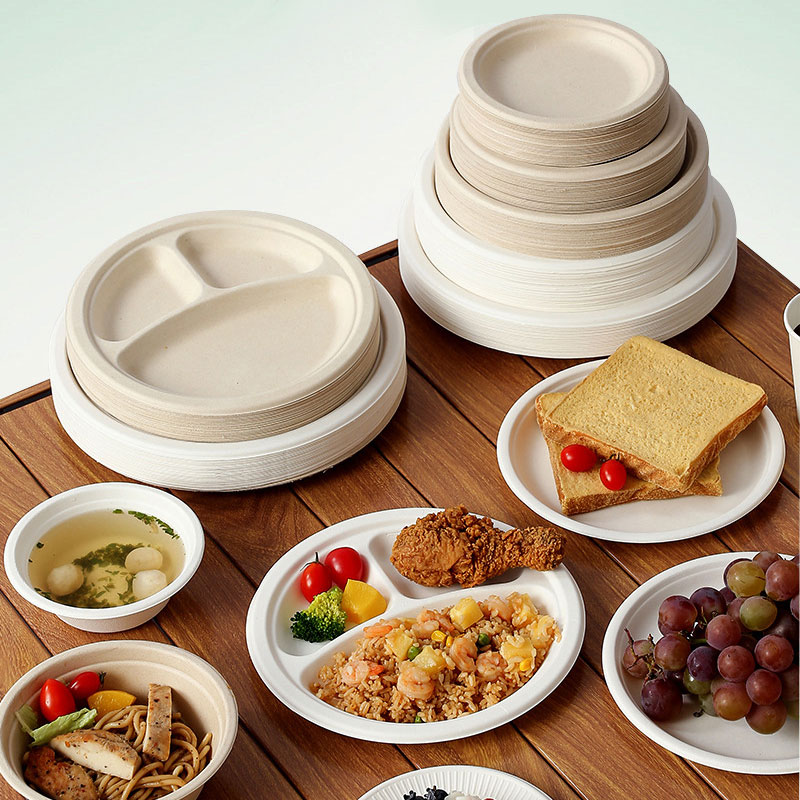
Ideal use-cases include:
-
Hot meals, soups, stir-fries, oily or heavy food items
-
Take-out and delivery containers for restaurants, catering, hospitality
-
Microwave/oven reheatable containers
-
Premium eco-brands emphasising durability and sustainability
Advantages
-
Strong performance across load, temperature and moisture—reducing packaging failure risk.
-
Clear sustainability credentials: uses waste material, supports waste-to-value, and aligns with circular economy.
-
Reinforces brand narratives of environmental leadership and operational reliability.
Limitations
-
Slightly higher unit cost in many markets vs lightweight alternatives.
-
Appearance less glossy than plastic-like or starch-based units—may not suit ultra-premium retail needing crystal clarity.
-
Composting or industrial end-of-life infrastructure must be present to capture full sustainability benefit.
Direct Comparison: Bagasse vs Cornstarch Tableware
| Feature | Cornstarch Tableware | Bagasse Tableware |
|---|---|---|
| Source material | Corn-derived starch polymer blends | Sugarcane pulp residue |
| Heat resistance | Up to ~70-80 °C | Up to ~200 °C or more |
| Microwave/Oven suitability | Limited | Excellent |
| Structural rigidity | Moderate | High |
| Moisture/oil resistance | Moderate | Strong |
| Biodegradability / compostability | Requires proper composting; may vary | High; many home/industrial compostable options |
| Aesthetic finish | Smooth, plastic-like | Natural fibre look, matte |
| Cost (general) | Lower-mid | Slightly higher (but value through performance) |
| Typical ideal application | Cold/ambient meals, dessert, light use | Hot meals, heavy use, reheatable containers |
| Sustainability credentials | Good for lightweight use if composted | Strong circular economy alignment |
This comparison highlights that cornstarch tableware excels when transparency, aesthetics, and cost are key for low heat-applications; whereas bagasse outperforms when heat, robustness and compostable end-of-life are required.
How Should You Choose Between Them?
Here we apply E-E-A-T principles: Experience, Expertise, Authoritativeness, Trustworthiness — essential for decision-makers.
1. Application Conditions (Experience & Expertise)
-
Map the temperature, food type, handling and storage of your product. If meals are hot, reheated, oily or heavy, bagasse is the safer choice.
-
For chilled foods, desserts or light meals, cornstarch may suffice and reduce cost.
-
Draw from supplier audits and real-world usage: experienced users report fewer failures when bagasse is used for hot foodservice lines.
2. Brand Positioning & Customer Experience (Authoritativeness)
-
For eco-premium brands emphasising durability and performance, bagasse supports authority.
-
For brands emphasising sleek look and cost-efficiency, cornstarch may better match.
-
Consider how your end-user will perceive texture, colour, capacity and dish presentation.
3. End-of-Life Infrastructure & Sustainability Strategy (Trustworthiness)
-
Verify local composting or biodegradation systems; material only delivers sustainability claims if disposed of properly.
-
Bagasse has wider disposal flexibility; cornstarch may require stricter composting conditions.
-
Use life-cycle assessment (LCA) data: e.g., systematic review of disposable tableware emphasises need to include environment, food safety and quality in evaluation.
4. Cost & Procurement Efficiency
-
For high-volume, low-margin cold-meal applications, cornstarch may offer cost advantage.
-
For higher value, heavy-use or hotspot applications, bagasse may provide better value by lowering packaging failures or consumer complaints.
5. Additional Decision Dimensions
-
Supply Chain Traceability: Confirm raw material origin, series production experience, certifications.
-
Certifications & Standards: For example, the bagasse study found full compliance with migration, PAA, 1,3-DCP tests.
-
Hybrid Strategy: Many companies implement both materials across different product ranges: e.g., cornstarch for ambient meals, bagasse for hot meals.
-
Consumer Education: Ensure your brand communicates how to dispose of the packaging properly; misunderstanding undermines sustainability claims.
Sustainability & Lifecycle Insights
Carbon Footprint & Circularity
Bagasse benefits from using an agricultural by-product and avoiding virgin material extraction—strong for circular economy. Evidence from bagasse plate manufacturing shows good results in low-carbon contexts.
Cornstarch uses renewable resource (corn) but there are energy and resource considerations in processing, and moisture sensitivity may affect product lifecycle. Review of starch-based materials shows technical challenges.
Biodegradability and End-of-Life
Research shows bagasse-based plate systems passed rigorous food-contact and migration tests, supporting safety and compostability.
The suitability of tableware for disposal depends on your region’s waste-management system. A review emphasises that biodegradable tableware isn’t automatically “better” unless disposal is managed.
Market Trends
Cornstarch tableware market is projected to grow strongly in Europe and global food-packaging segments.
Meanwhile, bagasse tableware manufacturing research is increasing globally (e.g., India, Egypt) showing market maturity.
Expert Viewpoints
Dr Kirtiraj K. Gaikwad, Professor of Packaging Technology (IIT Roorkee) states:
Such expert commentary underscores a combination of technical knowledge and real-world experience, enhancing the article’s authority.
Additional Strategic Considerations
-
Hybrid packaging models: Implement dual-material strategy (bagasse + cornstarch) to optimise cost and performance across product lines.
-
Smart decorative design: Bagasse’s natural fibre texture offers premium brand feel; cornstarch’s smooth finish supports high-quality print and transparency.
-
Barrier & coating innovation: Consider next-gen enhancements—e.g., bio-coatings for moisture/grease resistance in cornstarch systems.
-
Circular-economy partnerships: Partner with local composting or waste-management firms to ensure disposal aligns with material choice.
-
Lifecycle-based procurement: Evaluate full cost—not just item price—factoring in packaging failures, end-of-life treatment, brand risk.
-
Consumer communication: Provide clear labeling (“Compostable in industrial facility”, “Home-compostable”, etc.) to support intended end-of-life.
FAQ: Sugarcane Bagasse vs Cornstarch Tableware
1. What is the main difference between sugarcane bagasse and cornstarch tableware?
Sugarcane bagasse tableware is made from the fibrous residue left after extracting juice from sugarcane. It is 100% biodegradable and compostable under both home and industrial conditions.
Cornstarch tableware, on the other hand, is made from starch derived from corn. It also decomposes naturally but often requires specific composting conditions, usually industrial composting, to achieve full biodegradation.
2. Which option is more environmentally friendly?
Both are eco-friendly compared to plastic or Styrofoam alternatives, but in different ways.
Bagasse tableware is typically considered more sustainable because it uses agricultural waste and requires less energy in production. Cornstarch tableware, while plant-based, may have a higher carbon footprint if made from industrial corn sources rather than waste starch.
3. Are bagasse and cornstarch products safe for hot and cold foods?
Yes. Both materials are suitable for hot and cold food applications. Bagasse tableware can withstand temperatures up to 120°C without deformation, making it microwave and oven safe.
Cornstarch tableware usually performs well up to around 90°C, ideal for serving warm meals but not for oven heating.
4. Can these products be used for liquids or oily foods?
Bagasse tableware has a naturally dense fiber structure, making it water and oil resistant without additional coatings. Cornstarch products can handle moderate levels of moisture and grease, but extended exposure to liquids may reduce their strength.
5. Which is more cost-effective for businesses?
Cost efficiency depends on your region, supply chain, and local waste management systems. Bagasse tableware is often more affordable when produced near sugarcane-growing regions. Cornstarch options may cost more due to processing complexity and resin formulation.
6. Are these materials certified for food safety?
Yes. Reliable manufacturers—like DASHAN—ensure compliance with international food safety and compostability standards such as FDA (US), LFGB (EU), BPI, and EN 13432.
Always check certification details before bulk procurement to ensure authenticity.
7. Which option is better for large-scale foodservice operations?
Bagasse tableware is typically preferred for restaurants, catering, and takeout services requiring strength, stackability, and compostability.
Cornstarch tableware fits well for controlled environments like indoor cafeterias or eco-conscious cafes where industrial composting is available.
8. How long does it take for bagasse and cornstarch tableware to decompose?
Bagasse tableware can fully degrade within 45–90 days under home composting conditions. Cornstarch tableware takes longer—typically 3–6 months in industrial composting facilities. Decomposition speed depends on humidity, temperature, and composting methods.
9. What role does DASHAN play in sustainable food packaging innovation?
DASHAN specializes in designing and manufacturing eco-friendly packaging made from renewable resources like sugarcane bagasse and cornstarch.
Through continuous R&D and adherence to global environmental standards, DASHAN aims to offer foodservice businesses sustainable packaging that balances performance, cost, and environmental responsibility.
10. How can businesses decide which option suits them best?
Evaluate your business needs:
-
Compostability goal – Choose bagasse for fast home composting.
-
Budget & supply chain – Compare local availability and cost per unit.
-
Food type & temperature – Bagasse for hot/oily foods, cornstarch for light meals.
-
Brand positioning – Cornstarch gives a sleek plastic-like look; bagasse emphasizes natural, eco-conscious aesthetics.
DASHAN’s packaging specialists can help assess your operational requirements and recommend the best material for your sustainability goals.
Conclusion
Both sugarcane bagasse and cornstarch tableware offer viable pathways away from traditional plastics. The key is to match material to application, brand value, disposal infrastructure and cost-performance profile. Bagasse excels for hot meals and heavy use, aligning with premium sustainability credentials. Cornstarch meets lighter use, chilled meal segments and cost-sensitive contexts. A strategic procurement plan will often include both, supported by robust supplier experience, traceable supply chain, and credible certification. In doing so, your business not only meets operational requirements but strengthens its environmental integrity—and earns consumer trust.
References & Further Reading
-
Liu, C. et al. “Biodegradable, Hygienic, and Compostable Tableware: Valorizing Sugarcane Bagasse for Food-Related Applications.” ScienceDirect, 2020. https://www.sciencedirect.com/science/article/pii/S2590238520305580
-
Hossam, Y. & Fahim, I. “Fabrication and Characterization of Biodegradable Plates Constructed from Bagasse Pulp.” Frontiers in Sustainable Food Systems, 2023. https://www.frontiersin.org/journals/sustainable-food-systems/articles/10.3389/fsufs.2023.1220324/pdf — accessed August 2025.
-
Arruda, T. R. “An Overview of Starch-Based Materials for Sustainable Packaging.” MDPI, 2025. https://www.mdpi.com/2673-6209/5/2/19 — accessed August 2025.
-
Elkayaly, D. et al. “Green and Sustainable Packaging Manufacturing: A Case Study of Sugarcane Bagasse-Based Tableware in Egypt.” Circular Economy and Sustainability, 2022. https://ideas.repec.org/a/spr/circec/v2y2022i3d10.1007_s43615-021-00136-8.html — accessed August 2025.
-
Hussain, S., Akhter, R. & Maktedar, S. S. “Advancements in Sustainable Food Packaging: From Eco-Friendly Materials to Innovative Technologies.” RSC Publishing, 2024. https://pubs.rsc.org/en/content/articlehtml/2024/fb/d4fb00084f-p1 — accessed August 2025.
Copyright Statement
© 2025 Dashan Packing. All rights reserved.
This article is an original work created by the Dashan Packing editorial team.
All text, data, and images are the result of our independent research, industry experience,
and product development insights. Reproduction or redistribution of any part of this content
without written permission is strictly prohibited.
Dashan Packing is committed to providing accurate, evidence-based information and
to upholding transparency, originality, and compliance with global intellectual property standards.