
Quick Summary
Panama’s national plastic ban has accelerated demand for eco-friendly food packaging. Bagasse and corn starch containers now dominate importer preferences due to strong heat resistance, environmental compliance, and competitive FOB China pricing. This article explains why these materials outperform plastics in Panama’s regulatory landscape and why distributors increasingly choose reliable manufacturers like DASHAN for stable supply and product quality.
1. Introduction: Panama’s Shift Toward Sustainable Food Packaging
Panama has become one of the most progressive countries in Latin America in terms of regulating single-use plastics. Since the first phase of Law 1 (2018) took effect in 2019, the country has gradually restricted traditional plastic bags, followed by plates, straws, cutlery, and other food-service disposables.
As restaurants, hotels, supermarkets, importers, and distributors adjust to the legal landscape, compostable packaging—especially bagasse (sugarcane pulp) and corn starch–based food containers—is rapidly becoming the preferred replacement for banned items.
Why these two materials?
Why are importers shifting sourcing to China?
And which products deliver the best performance-to-cost ratio?
This article provides a clear, data-supported analysis.
2. Panama’s Single-Use Plastic Restrictions: What Importers Must Know
2.1 Timeline of Panama’s Plastic Ban
Panama’s ban was implemented in phases. Below is the simplified timeline:
| Year | Regulation | Notes |
|---|---|---|
| 2019 | Ban on thin plastic bags (retail, supermarkets) | First country in Central America to enforce nationally |
| 2021 | Ban on plastic straws, stirrers, cotton swabs | Restaurants must shift to paper or compostables |
| 2022 | Ban on plastic plates, disposable cutlery, and takeaway containers | Direct impact on foodservice importers |
| 2024–2025 | Expanding restrictions on more SUP items | Importers prefer “future-proof” eco packaging |
Panama’s legislation explicitly encourages biobased, compostable, and fiber-based alternative materials, accelerating demand for bagasse and corn starch packaging.
3. Why Bagasse & Corn Starch Meet Panama’s Regulatory Standards
3.1 100% Plant-Based Material Compliance
Both bagasse and corn starch fall under “acceptable alternatives” according to Panama’s Ministry of Environment because they are:
-
Renewable
-
Free of petroleum resin
-
Capable of biodegrading in commercial composting settings
Material Overview Table
| Material | Source | Degradation Behavior | Panama Compliance |
|---|---|---|---|
| Bagasse | Sugarcane fiber | Breaks down in 45–90 days under composting | ✔ Strongly recommended |
| Corn Starch (C-Starch) | Corn kernels (thermoformed into resin) | Degrades under controlled conditions | ✔ Accepted as biobased |
3.2 Performance Advantage for Foodservice Importers
| Feature | Bagasse Packaging | Corn Starch Packaging |
|---|---|---|
| Heat resistance | Excellent (up to 120°C) | Good (up to 100°C) |
| Moisture/oil resistance | Strong | Medium |
| Microwavable? | ✔ Yes | ✔ Yes |
| Freezer-safe? | ✔ Yes | ✔ Yes |
| Eco-friendly image | Very strong | Strong |
| Cost | Lower & stable | Higher (resin price fluctuates) |
Conclusion: Bagasse products provide better durability and lower cost, while corn starch products offer higher transparency and smoother surface.
4. Global Market Trends Supporting Panama’s Move
4.1 Rising Global Demand for Compostable Food Containers
According to international market data (2023–2024 reports):
-
Demand for fiber-based packaging is growing 15%+ annually.
-
Sugarcane-pulp containers are expected to reach USD 5.5 billion by 2028.
-
Latin America shows the fastest adoption, driven by regulatory pressure.
Panama fits squarely into this global trend.
4.2 Why Importers Prefer Bagasse Products from China
-
China is the world’s largest sugarcane-pulp producer.
-
Factories have stable fiber supply chains.
-
Lead times are short (15–25 days).
-
Pricing remains highly competitive compared to the U.S. or Europe.
4.3 Cost Comparison: Bagasse vs Corn Starch (FOB China)
Using real market price ranges:
| Product Type | Bagasse Price (FOB China) | Corn Starch Price (FOB China) | Notes |
|---|---|---|---|
| 1-C Bowls | $0.035–$0.055 | $0.045–$0.065 | Bagasse cheaper |
| Clamshell Boxes | $0.06–$0.09 | $0.07–$0.11 | Corn starch depends heavily on resin cost |
| Plates | $0.025–$0.045 | $0.035–$0.06 | Bagasse supply is more stable |
Takeaway: Importers generally choose bagasse for cost-sensitive segments (restaurants, delivery), and corn starch for premium markets (hotels, branding).
4.4 Panamá Import Duties & Landed Cost Consideration
Below is a simplified estimate commonly used by importers:
| Cost Component | Bagasse Products | Corn Starch Products |
|---|---|---|
| Import duty | 0–15% (depends on HS code) | 0–15% |
| Freight China→Panama | Moderate | Moderate |
| Warehousing & logistics | Low–medium | Medium |
Bagasse generally yields lower landed cost, which explains its popularity.
5. Recommended Products for Panama’s Market
5.1 Top-Selling Bagasse Products
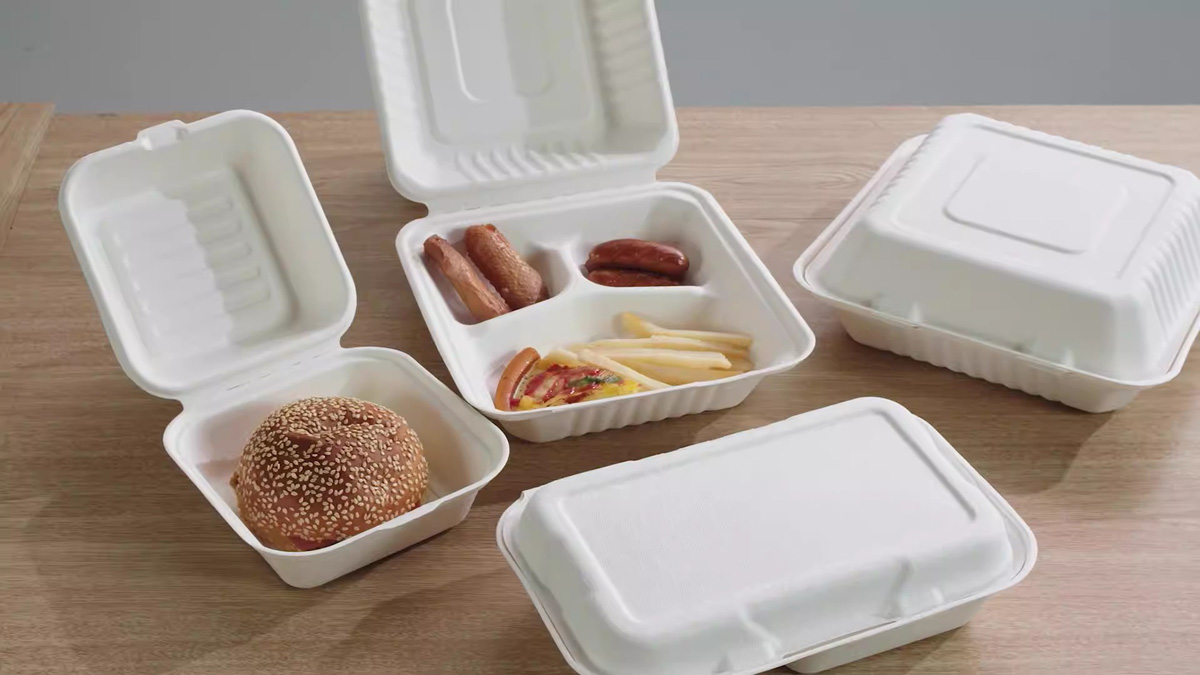
(1) Bagasse Clamshell Boxes (1-compartment, 3-compartment)
-
Best for restaurants and food delivery platforms
-
High rigidity and leak resistance
-
Fully compostable
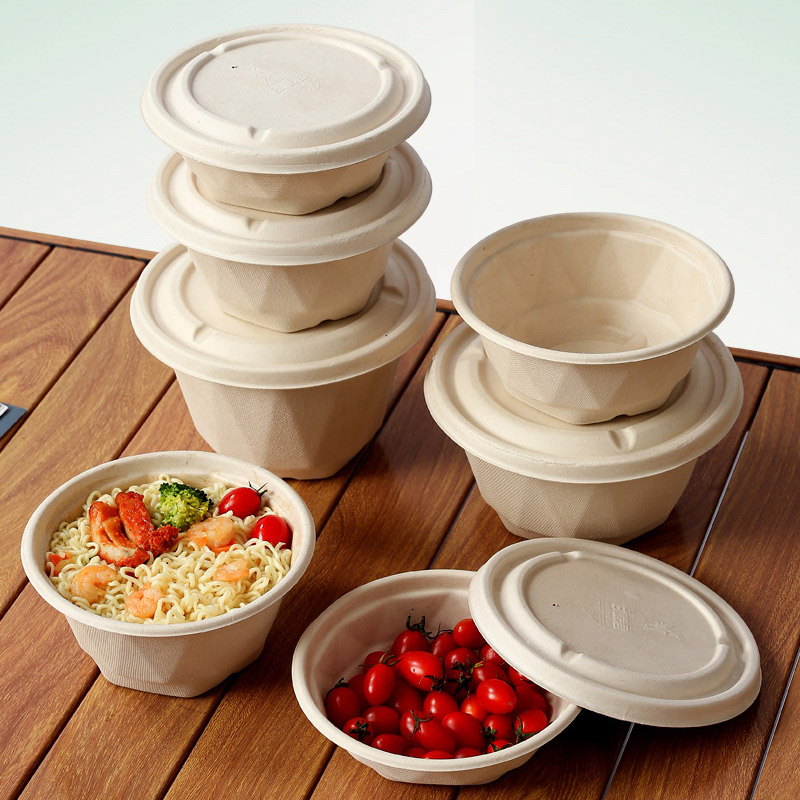
(2) Bagasse Round Bowls (12–32 oz)
-
Perfect for salad bars, poke shops, hotel buffets
-
Work with PET or paper lids
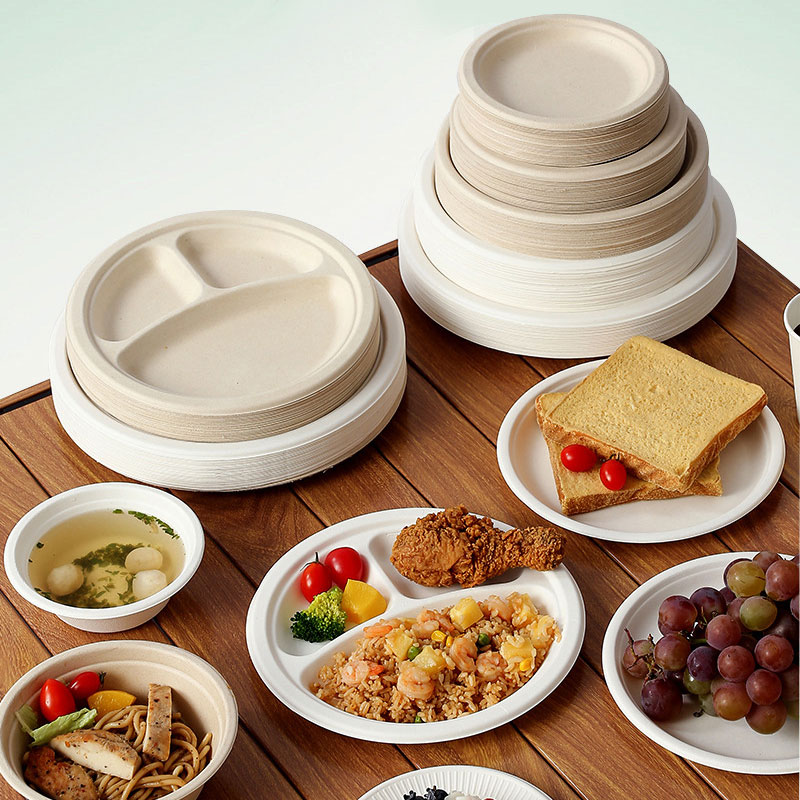
(3) Bagasse Plates (7″ / 9″ / 10″ / 12″)
-
Widely used for events, cafeterias, street food vendors
-
Strong profit margin for importers
5.2 Popular Corn Starch Products
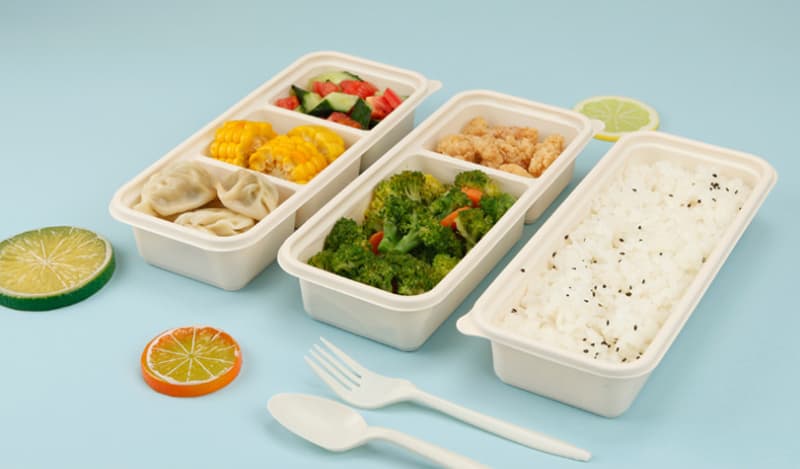
(1) Corn Starch Food Containers
-
Smooth texture
-
Ideal for premium restaurant chains
-
Good heat resistance
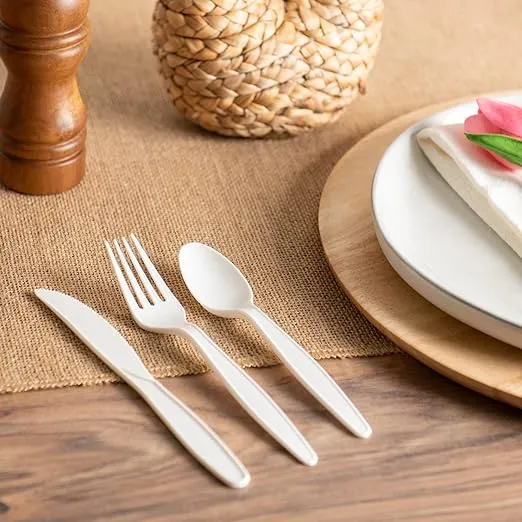
(2) Corn Starch Cutlery
-
Biobased alternative to plastic
-
Moisture-resistant and sturdy
6. Why Bagasse & Corn Starch Are the Future in Panama
Environmental & Business Advantages
-
Meet Panama’s evolving plastic regulations
-
Strong consumer acceptance
-
Compatible with hot, oily, or liquid foods
-
Lower carbon footprint
-
Suitable for tourism-heavy sectors like hotels & resorts
Panama’s expanding ban will continue pushing importers to adopt compostable packaging for long-term compliance and market advantage.
7. Why Importers Choose DASHAN ?

DASHAN is one of China’s leading manufacturers of bagasse trays, bowls, cups, clamshells, and corn-starch packaging. We support Panama importers with:
-
Full product range suitable for local foodservice and retail
-
Flexible OEM/ODM for branding
-
Stable production capacity with fast delivery
-
Competitive FOB China pricing
-
Product testing reports (FDA, LFGB, compostability)
-
Expert guidance on HS codes, shipping, and compliance
For distributors and wholesalers, DASHAN delivers a strong balance of cost, quality, and long-term supply stability.
FAQ
1. What types of plastic products are banned in Panama?
Panama has banned plastic bags, straws, plates, cutlery, stirrers, and many single-use food containers. More categories will be restricted under upcoming phases.
2. Are bagasse and corn starch products approved under Panama’s plastic laws?
Yes. Both materials are plant-based, compostable, and accepted as legal alternatives to petroleum-based plastics.
3. Which is better for hot foods: bagasse or corn starch?
Bagasse performs better with hot, oily, and liquid foods because it withstands temperatures up to 120°C and maintains rigidity.
4. Are these products safe for microwaves and freezers?
Yes, both bagasse and corn starch packaging can be used in microwaves and freezers, making them ideal for takeaway and delivery markets.
5. Why are importers sourcing from China?
China offers stable raw material supply, large-scale production, excellent pricing, and fast lead times—especially for bagasse products.
6. Which products are most popular in the Panama market?
Bagasse clamshells, plates, and round bowls dominate; corn starch containers and cutlery are preferred for premium-use segments.
7. Does DASHAN export to Central and South America?
Yes. DASHAN supplies bagasse and corn starch packaging to many Latin American importers, offering OEM/ODM, competitive pricing, and fast shipping.
Conclusion
Panama’s plastic ban has reshaped the country’s foodservice and retail packaging landscape. As regulations tighten, compostable materials—especially bagasse and corn starch—have emerged as the most practical and future-proof solutions. Their strong heat resistance, environmental compliance, and competitive landed cost make them ideal replacements for banned plastics. Importers choosing reliable suppliers like DASHAN gain consistent product quality, competitive pricing, and the supply stability needed to thrive in Panama’s rapidly evolving market.
Reference
- Euronews. (2019). Panama becomes first Central American nation to ban plastic bags.
https://www.euronews.com/2019/07/20/panama-becomes-first-central-american-nation-to-ban-plastic-bags - The Bocas Breeze. (2021). Many single-use plastics to be phased out in Panama during 2021–2023.
https://thebocasbreeze.com/environment/single-use-plastics-to-be-phased-out-in-panama-2021-2023/ - Packaging Dive. (2024). Bagasse sweetens the case for compostable packaging.
https://www.packagingdive.com/news/bagasse-sugarcane-compostable-packaging-food-service/703382/ - FAO (Food and Agriculture Organization). (2022). Agricultural residues and biomass utilization in Latin America.
https://www.fao.org - ScienceDirect. (2020). Biodegradable materials from renewable sources: Performance of starch-based and sugarcane fiber packaging.
https://www.sciencedirect.com - Abdullah, A., et al. (2024). Production of starch-based flexible food packaging in developing countries. Journal of Packaging Sustainability.
https://pmc.ncbi.nlm.nih.gov/articles/PMC11675729/ - Xiamen,DASHANpacking.Exploring the Growing Popularity of Sugarcane Bagasse and Corn Starch Food Packaging: Benefits, Global Trends, and Applications.
https://www.dashanpacking.com/exploring-the-growing-popularity-of-sugarcane-bagasse-and-corn-starch-food-packaging-benefits-global-trends-and-applications/
Copyright Statement
© 2025 Dashan Packing. All rights reserved.
This article is an original work created by the Dashan Packing editorial team.
All text, data, and images are the result of our independent research, industry experience,
and product development insights. Reproduction or redistribution of any part of this content
without written permission is strictly prohibited.
Dashan Packing is committed to providing accurate, evidence-based information and
to upholding transparency, originality, and compliance with global intellectual property standards.