

Introduction
In today’s highly competitive food industry, packaging is no longer just a protective layer between a product and the outside world. It has become a key part of branding, product presentation, logistics efficiency, and consumer experience. Whether selling fresh produce in supermarkets, offering ready-to-eat meals, operating a restaurant chain, or supplying airline catering services, businesses increasingly recognize that packaging can directly influence purchasing decisions and brand perception.
At the same time, global sourcing has given food businesses more options than ever before. Many companies turn to experienced manufacturers in China to develop cost-effective and scalable packaging solutions. However, one important question often arises early in the sourcing process:
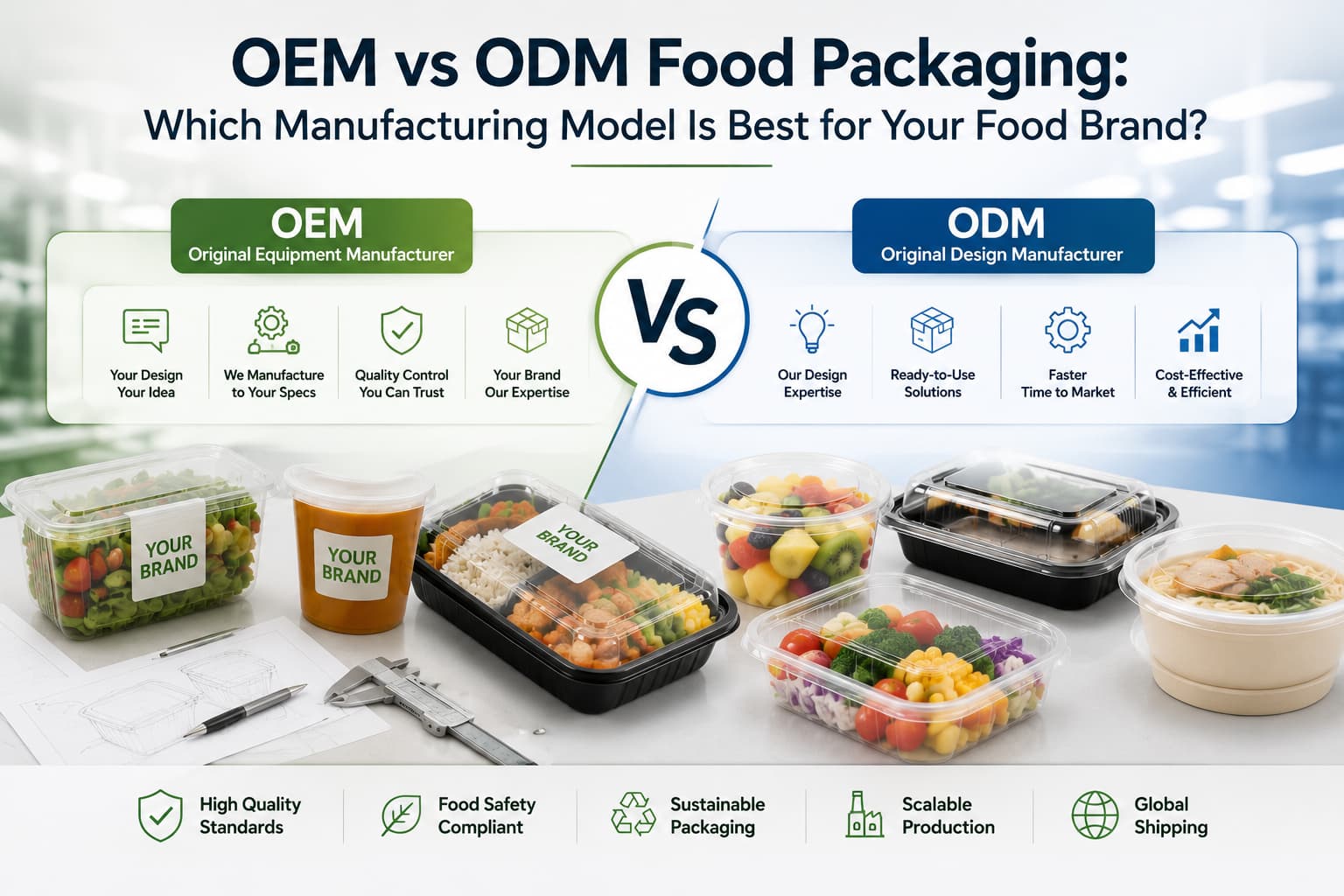
Should you choose OEM food packaging or ODM food packaging?
The answer is not always straightforward. Both manufacturing models offer unique advantages, and each serves different business goals. Some brands prioritize speed and low investment, while others focus on exclusivity, innovation, and long-term market differentiation.
Understanding the differences between OEM and ODM packaging can help buyers make smarter decisions, avoid costly mistakes, and build a packaging strategy that supports business growth.
In this guide, we will explore how OEM and ODM food packaging work, compare their benefits and limitations, examine cost considerations, and help you determine which model is best for your business.
What Is OEM Food Packaging?
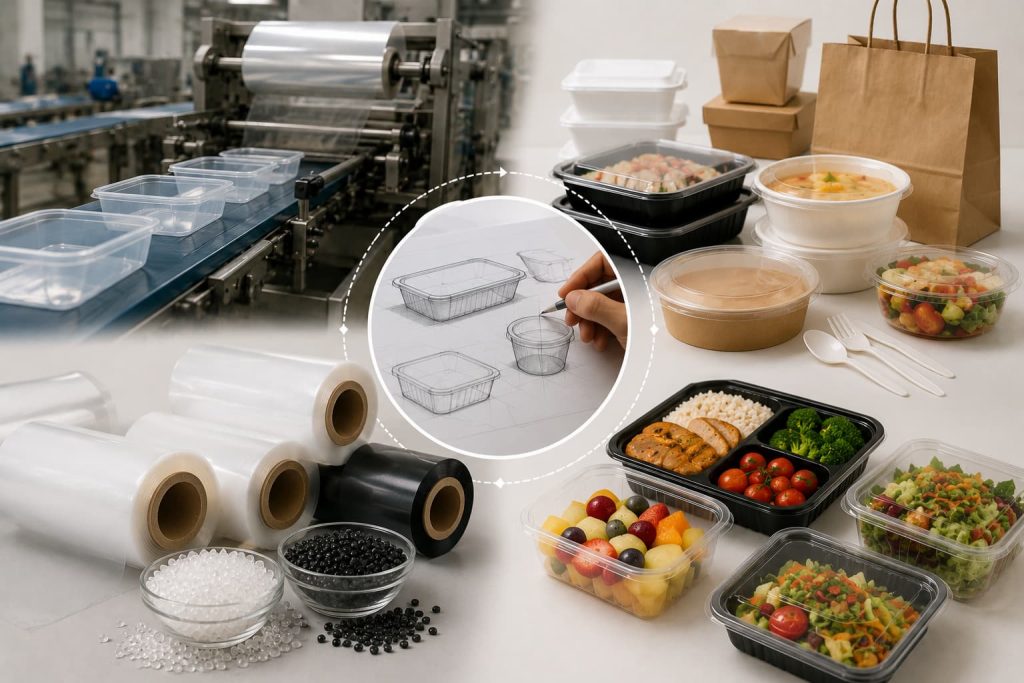
OEM stands for Original Equipment Manufacturing. In the food packaging industry, OEM refers to a manufacturing arrangement where the customer provides the concept, specifications, drawings, dimensions, branding requirements, or functional requirements, while the manufacturer produces the packaging according to those specifications.
In simple terms:
You create the idea. The manufacturer brings it to life.
OEM packaging can range from simple modifications of existing products to completely new packaging structures developed from scratch.
Common OEM food packaging projects include:
- Custom PP food containers
- Customized PET fruit packaging
- Airline meal trays
- Reusable PP cups
- Multi-compartment meal containers
- Specialized takeaway packaging
- Custom food bowls and lids
Because OEM products are designed specifically for a customer, they often require mold development, engineering support, and product validation before mass production begins.
Key Advantages of OEM Packaging
Greater Brand Differentiation
In crowded retail environments, unique packaging can help products stand out on shelves. Distinctive shapes, sizes, and structures create stronger visual impact and improve brand recognition.
Product Exclusivity
OEM packaging provides a higher degree of exclusivity because the design belongs to the customer. Competitors cannot simply purchase the same packaging design from the manufacturer.
Tailored Functionality
Some food products have unique packaging requirements. OEM allows businesses to optimize packaging dimensions, compartment layouts, sealing systems, and stacking performance according to their specific needs.
Long-Term Strategic Value
Although OEM typically requires higher initial investment, it often creates stronger long-term value through improved branding, customer recognition, and market differentiation.
What Is ODM Food Packaging?
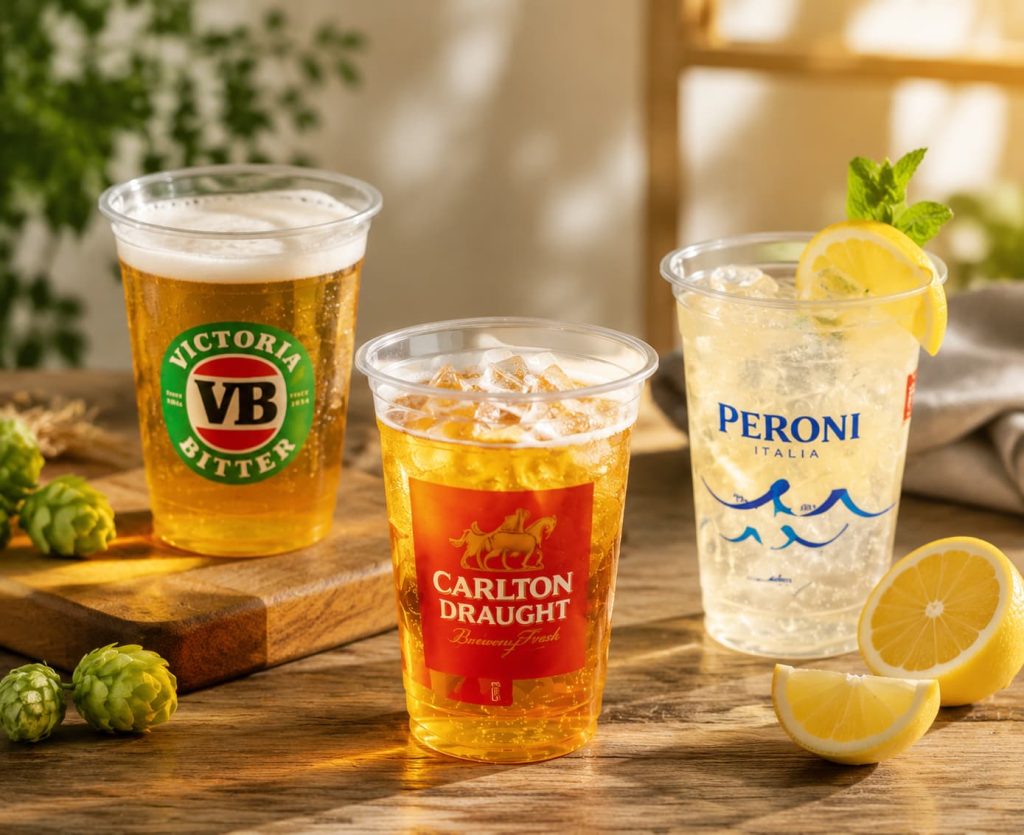
ODM stands for Original Design Manufacturing.
Unlike OEM, ODM packaging is developed by the manufacturer before customers place orders. The manufacturer owns the product design and tooling, while customers can customize branding elements such as logos, colors, labels, and printing.
In simple terms:
The manufacturer creates the product. You customize and sell it under your brand.
ODM packaging is widely used throughout the food industry because it enables businesses to launch products quickly and cost-effectively.
Examples include:
- Standard PP lunch boxes
- PET fruit containers
- Disposable food trays
- Soup bowls
- Sauce containers
- Beverage cups
- Bakery packaging
Most packaging manufacturers maintain extensive ODM product catalogs that allow customers to select products ready for production.
Key Advantages of ODM Packaging
Faster Market Entry
Since molds already exist, production can begin much sooner than with OEM projects.
Lower Upfront Costs
Customers avoid the costs associated with mold development, engineering design, and extensive testing.
Reduced Development Risk
ODM products have often been tested through previous production runs and real-world market applications.
Easier Product Expansion
Businesses can quickly add new packaging formats without investing in multiple custom development projects.
OEM vs ODM Food Packaging: Understanding the Key Differences
Although OEM and ODM both provide effective packaging solutions, they serve different strategic purposes.
| Factor | OEM | ODM |
|---|---|---|
| Product Design Ownership | Customer | Manufacturer |
| Mold Ownership | Usually Customer | Manufacturer |
| Initial Investment | Higher | Lower |
| Product Exclusivity | High | Limited |
| Development Time | Longer | Faster |
| Brand Differentiation | Excellent | Moderate |
| Market Entry Speed | Moderate | Fast |
| Customization Flexibility | Maximum | Limited |
| Long-Term Competitive Advantage | Strong | Moderate |
The decision should not be based solely on cost. Businesses should consider branding goals, production volume, launch timelines, and future growth plans.
Why Many Established Food Brands Choose OEM Packaging
As food markets become increasingly competitive, packaging has evolved into a strategic business asset.
For many established brands, OEM packaging offers advantages that go far beyond appearance.
Creating Strong Shelf Presence
Consumers often make purchasing decisions within seconds. Packaging is frequently the first thing they notice.
A unique container shape, innovative lid design, or distinctive food tray can attract attention and increase product visibility.
For example:
- Premium ready-meal brands often use custom compartment trays.
- Airline catering companies require specially designed meal trays.
- Fresh food brands may develop custom fruit containers to improve presentation.
OEM packaging helps transform packaging into a marketing tool.
Strengthening Brand Recognition
Successful brands create visual consistency across their product lines.
When customers repeatedly encounter the same packaging design, they begin associating it with product quality and reliability.
Over time, packaging itself becomes part of brand identity.
Improving Product Protection
Certain food products require specialized packaging structures.
OEM packaging allows businesses to optimize:
- Product fit
- Transportation stability
- Stackability
- Leak resistance
- Shelf presentation
These improvements can reduce damage rates and improve customer satisfaction.
Supporting Long-Term Growth
Although OEM projects require higher initial investment, they often provide stronger returns over time.
As sales volumes increase, the benefits of exclusivity and branding become more valuable, helping businesses maintain competitive advantages.
Why Many Startups and Growing Businesses Prefer ODM Packaging
Not every company needs a custom packaging solution immediately.
For startups and growing brands, speed and financial flexibility are often more important than exclusivity.
Faster Product Launches
Food trends move quickly.
Whether introducing a new ready meal, launching a beverage line, or entering a new retail market, businesses often need packaging immediately.
ODM allows companies to skip lengthy development cycles and begin production much faster.
Lower Financial Risk
Launching a new product always involves uncertainty.
ODM reduces risk by eliminating:
- Mold development costs
- Design fees
- Engineering expenses
- Product validation costs
This makes it easier for businesses to test markets without significant upfront investment.
Greater Operational Flexibility
Many companies experiment with multiple packaging formats before identifying their most successful products.
ODM packaging allows businesses to make these adjustments quickly and economically.
Easier International Expansion
When entering new markets, businesses often need packaging that complies with different regulations and consumer preferences.
ODM product catalogs provide a wide range of options that can be adapted for various markets.
Cost Analysis: OEM vs ODM Food Packaging
Cost is one of the most important factors influencing packaging decisions.
However, buyers should evaluate both short-term and long-term costs.
OEM Cost Structure
Typical OEM expenses may include:
- Product design
- Engineering development
- Mold manufacturing
- Sample production
- Testing and validation
These costs can appear substantial initially, but they are often spread across large production volumes.
ODM Cost Structure
ODM projects generally involve:
- Product selection
- Branding customization
- Printing setup
- Production costs
Since tooling already exists, startup costs remain significantly lower.
Comparing Cost Scenarios
Imagine two businesses launching a new food container.
Company A chooses OEM:
- Initial tooling investment
- Custom design fees
- Longer development timeline
Company B chooses ODM:
- Existing mold
- Faster production
- Lower startup cost
During the first year, Company B may spend less.
However, after several years of high-volume sales, Company A may achieve stronger brand recognition and better long-term returns.
This illustrates why packaging decisions should align with business strategy rather than short-term cost alone.
Understanding the OEM Development Process
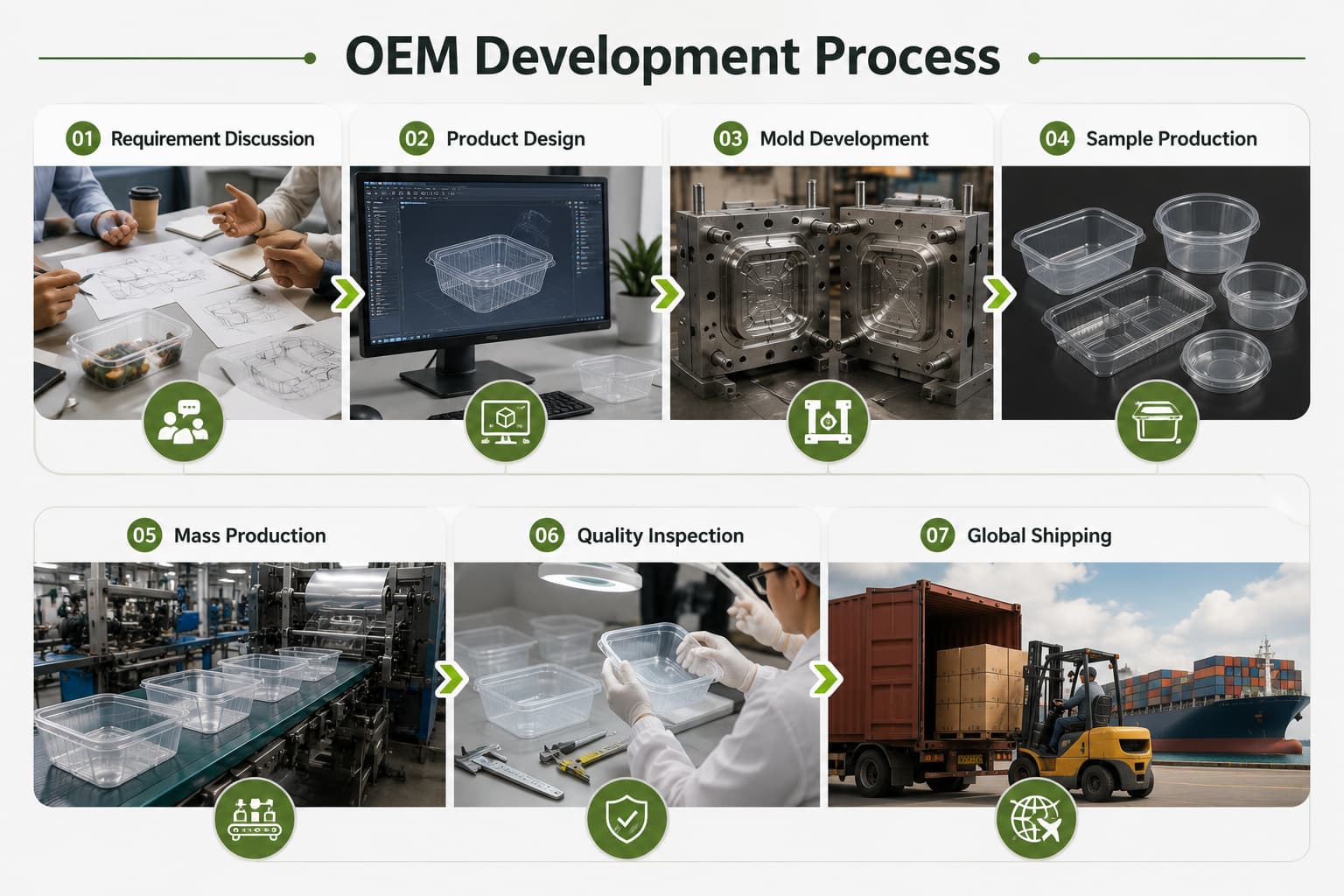
Many buyers are unfamiliar with how custom packaging is developed.
A typical OEM food packaging project follows several stages.
Step 1: Requirement Discussion
The customer shares product specifications, application requirements, dimensions, and branding objectives.
Step 2: Product Design
Engineers create 2D drawings and 3D models based on customer requirements.
Design considerations may include:
- Material selection
- Food safety requirements
- Structural strength
- Stacking performance
Step 3: Mold Development
Once designs are approved, tooling is manufactured.
This stage often represents the largest upfront investment.
Step 4: Sample Production
Prototype samples are produced for testing and evaluation.
Customers review:
- Appearance
- Dimensions
- Functionality
- Performance
Step 5: Mass Production
After sample approval, large-scale production begins.
Step 6: Quality Inspection
Products undergo quality control procedures to ensure consistency and compliance with specifications.
Step 7: Global Shipping
Finished products are packaged and prepared for export to international markets.
Why More Global Buyers Source Food Packaging from China
China has become one of the world’s leading food packaging manufacturing hubs.
Several factors contribute to this position.
Comprehensive Supply Chains
Raw material suppliers, mold manufacturers, printing companies, and packaging factories operate within highly integrated industrial networks.
This improves efficiency and reduces lead times.
Competitive Production Costs
Large-scale manufacturing capabilities help reduce production costs while maintaining quality standards.
Advanced Manufacturing Technology
Modern facilities increasingly utilize:
- Automated production lines
- Precision molding equipment
- Quality control systems
- Sustainable manufacturing practices
Extensive Export Experience
Many Chinese packaging manufacturers serve customers across North America, Europe, Asia, Oceania, and the Middle East.
This experience helps simplify international sourcing and logistics.
Why Choose DASHAN for OEM and ODM Food Packaging?
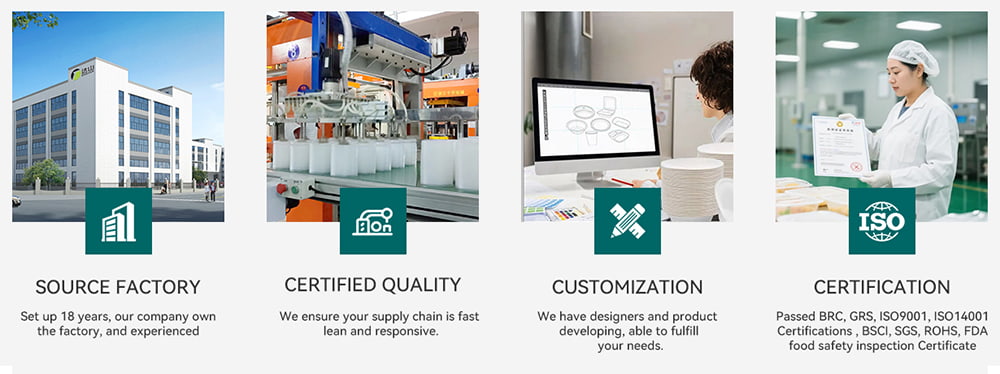
Selecting the right manufacturing partner is just as important as choosing between OEM and ODM.
A reliable supplier should offer not only manufacturing capabilities but also technical support, quality assurance, and long-term partnership value.
DASHAN specializes in food packaging solutions designed for global markets.
Our product portfolio includes:
- PP food containers
- PET fruit packaging
- Airline meal trays
- Reusable PP cups
- Food bowls and lids
- Takeaway packaging solutions
- Customized food service packaging
For businesses seeking rapid market entry, DASHAN offers a wide range of ODM packaging options that are ready for production.
For brands requiring differentiation and exclusivity, our OEM development capabilities support custom packaging projects from concept to mass production.
Our team works closely with customers throughout the development process, helping transform packaging ideas into scalable commercial solutions.
Whether you need a standard packaging format or a fully customized design, DASHAN provides the manufacturing expertise, quality consistency, and production capacity required for long-term success.
Which Packaging Model Is Right for Your Business?
The best choice depends on your priorities.
Choose ODM if you want:
- Faster market entry
- Lower initial investment
- Reduced development risk
- Market testing flexibility
Choose OEM if you want:
- Unique packaging designs
- Strong brand differentiation
- Product exclusivity
- Long-term competitive advantages
Many successful companies actually use both approaches.
They begin with ODM packaging to validate demand and enter the market quickly. Once sales volumes become stable, they transition to OEM packaging to strengthen branding and create unique customer experiences.
FAQ
1. What is the main difference between OEM and ODM food packaging?
OEM food packaging is developed according to the customer’s unique design, specifications, and branding requirements. ODM food packaging uses existing designs created by the manufacturer, allowing customers to customize logos, colors, or labels without developing a new product from scratch.
2. Which option is more cost-effective, OEM or ODM?
ODM packaging typically has lower upfront costs because it does not require mold development or extensive product design work. OEM packaging requires a higher initial investment but may provide better long-term value through stronger brand differentiation and product exclusivity.
3. How long does OEM food packaging development take?
A typical OEM project can take between 2 and 5 months, depending on product complexity, mold development, sample approval, and production scheduling. The process usually includes design, tooling, sampling, mass production, and quality inspection.
4. Is ODM packaging suitable for startups?
Yes. ODM packaging is often the preferred choice for startups because it allows faster market entry, lower development costs, and reduced investment risk. Companies can test products and markets before investing in custom packaging.
5. When should a business choose OEM packaging?
OEM packaging is ideal when a company wants exclusive packaging designs, stronger brand recognition, unique product presentation, or specialized packaging structures that are not available through standard products.
6. Can I customize ODM food packaging with my logo?
Yes. Most ODM food packaging products can be customized with logos, labels, printed graphics, sleeves, colors, or other branding elements while using the manufacturer’s existing design and tooling.
Conclusion
OEM and ODM food packaging are not competing solutions. Rather, they represent different strategies designed to support businesses at different stages of growth.
ODM packaging offers speed, affordability, and flexibility, making it ideal for startups, market testing, and rapid expansion. OEM packaging provides exclusivity, customization, and stronger long-term branding opportunities, making it a preferred choice for established businesses and premium food brands.
As consumer expectations continue to evolve and competition intensifies, packaging will play an increasingly important role in product success. Businesses that understand when to use OEM and when to leverage ODM can make smarter sourcing decisions and build stronger market positions.
Whether you are launching a new product, expanding your packaging portfolio, or developing a completely customized food packaging solution, partnering with an experienced manufacturer is essential.
At DASHAN, we help food brands worldwide navigate both OEM and ODM packaging strategies, delivering reliable PP and PET packaging solutions that support growth, efficiency, and long-term business success.
References
- Food Packaging Forum – Food Packaging Materials and Industry Trends
https://www.foodpackagingforum.org - PMMI (The Association for Packaging and Processing Technologies) – Packaging Industry Insights
https://www.pmmi.org - Flexible Packaging Association (FPA) – Packaging Market Resources
https://www.flexpack.org - Institute of Packaging Professionals (IoPP) – Packaging Education and Standards
https://www.iopp.org - Smithers – The Future of Global Packaging Market Reports
https://www.smithers.com - World Packaging Organisation (WPO) – Global Packaging Industry Information
https://www.worldpackaging.org - Plastics Industry Association – Packaging and Plastics Manufacturing Resources
https://www.plasticsindustry.org - DASHAN Food Packaging Solutions
https://www.dashanpacking.com
Copyright Statement
© 2026 Dashan Packing. All rights reserved.
This article is an original publication by the Dashan Packing team based on industry research, market analysis, and packaging expertise. Unauthorized reproduction, distribution, or copying of this content is prohibited without prior written permission.
Dashan Packing is committed to delivering reliable, original, and professional information for the global food packaging industry.