


Quick Summary:
Anti-fog RPET lids are essential for keeping fresh food visually appealing and extending shelf life. Condensation can obscure product visibility and reduce consumer appeal. Proper mold design, tooling surface finish, and anti-fog coatings are critical to maintain high optical clarity. This article explores surface tension vs. anti-fog coatings, tooling impacts on clarity, troubleshooting tips for condensation, and microstructural analysis of anti-fog coatings.
What Are Anti-Fog RPET Lids?
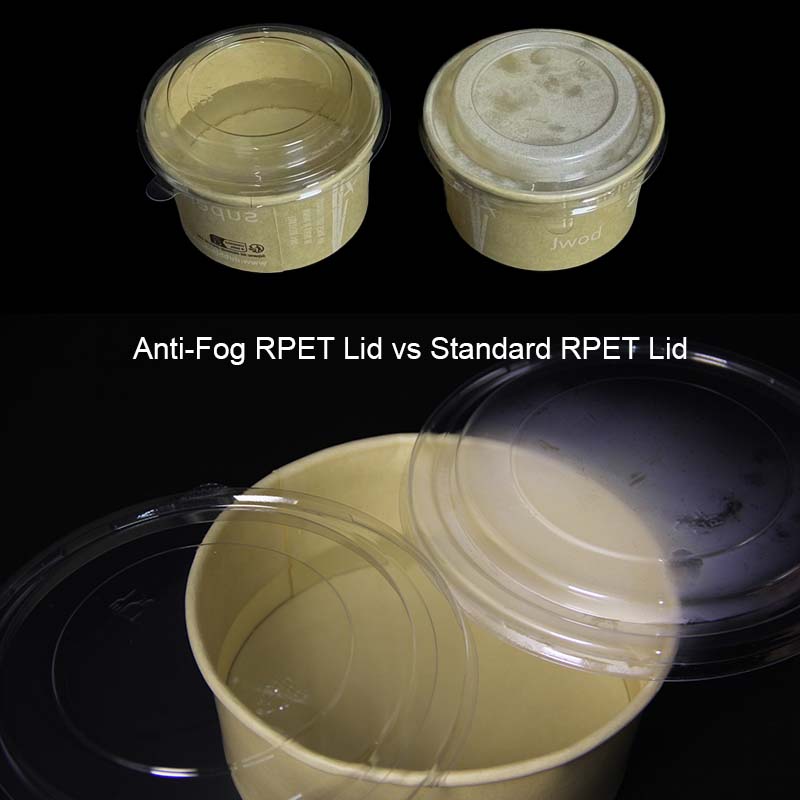
In the food packaging industry, RPET (Recycled Polyethylene Terephthalate) lids are widely used for salads, ready meals, and fresh produce containers. Anti-fog RPET lids are specially treated or coated to prevent water droplets from forming on the lid surface. These lids combine mechanical clarity with chemical coatings to maintain optical transparency, ensuring consumers can clearly see the product while preventing fogging caused by condensation during cold storage or temperature changes.
Check [our RPET Lid Design Optimization Guide] for in-depth insights on tooling and coating synergy. 😊
The Challenge of Condensation in Fresh Food Packaging
Condensation occurs when warm, humid air contacts a cold RPET surface. This creates micro-droplets that scatter light, reducing optical clarity and making products look unappealing.
Key issues caused by condensation:
- Reduced product visibility
- Shorter perceived freshness
- Negative consumer perception and lower sales
Surface Tension vs. Anti-Fog Coatings
Anti-fog coatings work by reducing the surface tension of water droplets, allowing them to spread as a thin, transparent film instead of forming visible beads.
| Property | Uncoated RPET Lid | Anti-Fog Coated RPET Lid |
|---|---|---|
| Water Droplet Formation | Large beads | Uniform thin film |
| Optical Transmittance (%) | 85 | 95 |
| Shelf-Life Clarity Maintenance | Low | High |
| Coating Thickness (μm) | N/A | 0.5–1 |
Observation: Applying a uniform anti-fog coating enhances both clarity and consumer appeal while maintaining the mechanical integrity of the RPET lid.
How Tooling Surface Finish Impacts RPET Clarity
Tooling plays a critical role in lid clarity. The smoother the mold surface, the higher the gloss, transparency, and anti-fog effectiveness.
Factors affecting clarity:
- Polishing grade: Finer polish reduces light scattering.
- Microstructure: Proper micro-texturing can enhance coating adhesion.
- Material flow: Even RPET distribution prevents stress lines that reduce transparency.
See [RPET Lid] 🛠️
“If Condensation Occurs, Then…” Troubleshooting Guide
Even with coatings and smooth tooling, condensation may occur due to environmental factors. Here’s a troubleshooting workflow:
- Check storage temperature – ensure lids are not exposed to rapid temperature swings.
- Examine coating uniformity – uneven coating can cause localized fogging.
- Verify mold surface finish – scratches or micro-imperfections scatter light.
- Adjust packaging process – sealing and cooling rates impact condensation.
- Test with cold chain simulations – ensure real-world performance matches lab results.
Micro Summary: Maximizing Shelf Appeal
Maximizing shelf appeal is the goal of every fresh food packaging designer. By combining:
- Anti-fog coatings
- Optimal mold surface finish
- Controlled temperature and packaging process
…you ensure the product remains visually appealing, clear, and safe for consumers.
Check [Shelf Appeal Optimization Techniques for Fresh Food Packaging]. 🥗✨

FAQ: Anti-Fog RPET Lids
1. What causes fogging on RPET lids?
Fogging occurs due to condensation when warm, humid air contacts a cooler RPET surface.
2. How does an anti-fog coating work?
It reduces surface tension, spreading water into a thin transparent film instead of forming droplets.
3. Does coating affect RPET mechanical strength?
No, properly applied coatings maintain the lid’s structural integrity.
4. Can uncoated RPET lids be polished to reduce fog?
Smoother molds help, but coatings are usually needed for long-term clarity.
5. What is optical transmittance?
A measure of how much light passes through the lid; higher percentages mean clearer visibility.
6. How thick should anti-fog coatings be?
Typically 0.5–1 μm to balance clarity and durability.
7. Can condensation happen during freezing?
Yes, temperature swings in cold storage can cause micro-droplets even on coated lids.
8. How to test anti-fog performance?
Lab testing with controlled humidity and temperature cycles simulates real-world conditions.
9. Does RPET color affect anti-fog efficiency?
Transparent or light-colored RPET performs best; dark colors reduce optical clarity.
10. How does tooling impact anti-fog effectiveness?
Smooth, polished molds improve both clarity and coating adhesion, ensuring consistent anti-fog performance.
11. Differences between coating materials?
Hydrophilic polymer coatings and surfactant-based coatings vary in durability and performance; polymer coatings are more long-lasting.
12. Can coatings be applied after molding?
Yes, post-molding coating application is possible, but in-process coatings usually achieve better adhesion.
13. Are coatings food-safe and FDA approved?
High-quality coatings comply with FDA and EU food-contact regulations.
14. Does lid geometry influence condensation?
Yes, thicker walls or uneven surfaces increase micro-droplet formation; proper design reduces fog risk.
15. Can anti-fog RPET lids be microwaved?
Some high-temperature RPET lids with stable coatings can be microwave-safe; check specifications.
Summary
Designing high-performance anti-fog RPET lids requires synergy between coating technology, mold surface finish, and proper packaging processes. By optimizing these factors:
- Lids maintain optical clarity and shelf appeal
- Consumers can see products clearly
- Food remains fresh longer, improving sales and brand perception
For companies looking for reliable anti-fog RPET solutions, Xiamen Dashan Packaging provides high-quality thermoformed RPET lids with optimized optical clarity, anti-fog coatings, and customizable designs, backed by rigorous quality control and global certifications.
References
- Harper, C.A. (2020). Handbook of Plastics, Elastomers, and Composites. McGraw-Hill.
- PlasticsEurope. (2022). PET and RPET Market Overview and Properties. Retrieved from https://www.plasticseurope.org
- ASTM International. (2021). ASTM D1003-21: Standard Test Method for Haze and Luminous Transmittance of Transparent Plastics.
- Food Packaging Forum. (2021). Anti-Fog Coatings for Food Packaging: Safety and Performance. Retrieved from https://www.foodpackagingforum.org
- Global Foodservice Packaging Market Report. (2022). Trends in Thermoformed PET and RPET Containers. Frost & Sullivan.
- Auras, R., Harte, B., & Selke, S. (2004). Polymers in Food Packaging: Material Properties and Applications. Macromolecular Bioscience, 4(9), 835–864.
Copyright Notice
© 2026 Xiamen Dashan Packaging Co., Ltd. All rights reserved.
This article, including text, tables, and data, is the intellectual property of Xiamen Dashan. No part of this article may be reproduced, distributed, or transmitted in any form without prior written permission. For permission requests, please contact [email protected].