

Introduction
Choosing the right food packaging material has become increasingly complex in today’s global marketplace. Beyond protecting food and enhancing product presentation, packaging materials must now comply with a growing number of food contact regulations, sustainability requirements, and customer expectations. For manufacturers and exporters, selecting an inappropriate material can lead to product redesigns, failed compliance reviews, delayed shipments, or even rejected imports.
At the same time, international buyers have become more knowledgeable about food contact compliance. Procurement teams no longer evaluate packaging based solely on price or appearance. Instead, they increasingly assess whether suppliers understand global regulations, provide appropriate technical documentation, and recommend materials that match specific food applications.
Although regulatory frameworks differ across regions such as the European Union, the United States, Australia, Japan, and China, the principles behind material selection remain remarkably similar. Packaging should be safe for its intended use, perform reliably throughout the product lifecycle, and be supported by evidence demonstrating regulatory compliance.
For packaging manufacturers, this means material selection should begin with understanding the application rather than choosing the lowest-cost option. A well-planned material strategy not only supports regulatory compliance but also improves product performance, simplifies customer approval, and strengthens long-term business relationships.
This article explores the key factors manufacturers should consider when selecting food packaging materials for global markets and explains how to balance compliance, functionality, and commercial success.
Start with the Intended Application
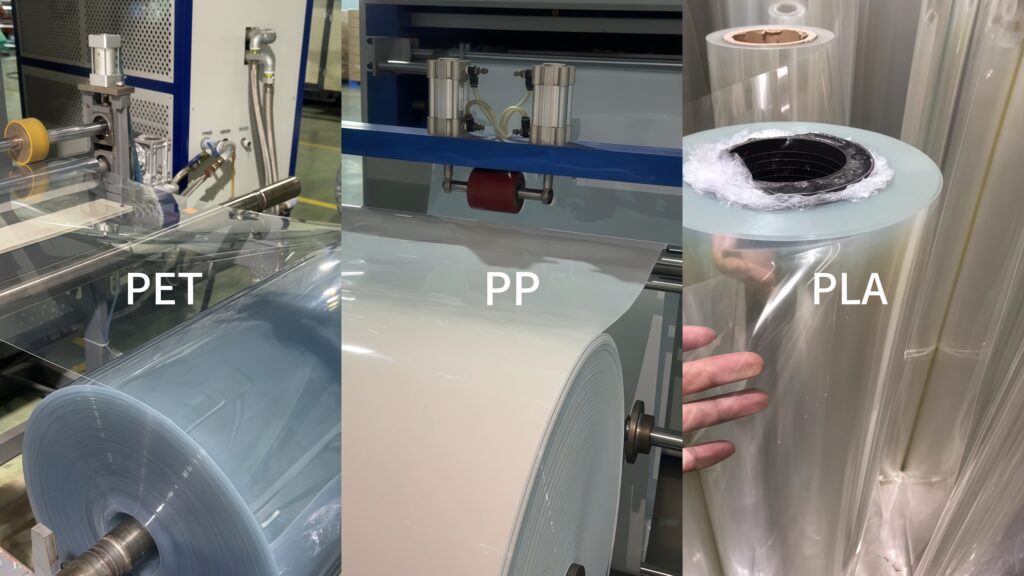
One of the biggest mistakes companies make when selecting food packaging materials is focusing on the material itself before fully understanding how the packaging will be used.
Food packaging is designed for a wide variety of applications, each with different performance requirements. A container for microwaveable ready meals faces entirely different conditions than a clamshell for fresh fruit or a cup for cold beverages. Even when two products are made from the same material, differences in temperature, food type, storage time, and handling conditions may require different design considerations.
For this reason, the intended application should always be the starting point of material selection.
Manufacturers should first consider questions such as:
- Will the packaging hold hot, cold, or frozen food?
- Will it be used in a microwave or under refrigeration?
- How long will the food remain in contact with the packaging?
- Is the product designed for single-use or repeated use?
- Will the packaging be displayed in retail environments or used for takeaway services?
Answering these questions helps narrow the range of suitable materials while ensuring that the packaging performs safely and effectively throughout its intended lifecycle.
Choosing Materials Based on Application
| Food Application | Key Material Requirements |
|---|---|
| Hot meals | Heat resistance and dimensional stability |
| Fresh produce | Transparency and ventilation |
| Frozen foods | Low-temperature durability |
| Ready-to-eat meals | Microwave compatibility |
| Bakery products | Product visibility and rigidity |
| Cold beverages | Clarity and impact resistance |
Rather than asking “Which material is the best?”, manufacturers should ask “Which material best suits this application?” This application-driven approach forms the foundation of both product performance and regulatory compliance.
Understand the Regulatory Requirements of Your Target Market
Once the intended application has been defined, the next step is understanding the regulatory expectations of the destination market.
Every major market has established its own food contact regulatory framework. Although these systems differ in legal structure, they all aim to ensure that packaging materials do not negatively affect food safety under normal conditions of use.
For exporters, compliance is not simply about selecting a food-grade material. Customers often expect suppliers to demonstrate that the chosen material has been evaluated according to the requirements of the destination market and is supported by appropriate technical documentation.
For example, European buyers frequently request a Declaration of Compliance together with migration testing results, while customers in North America may focus on whether the materials used are suitable for FDA food contact applications. Australian importers often review product specifications and supporting technical documents as part of their supplier qualification process.
Instead of memorizing every regulation, manufacturers should focus on several universal compliance principles:
- Selecting materials intended for food contact applications
- Understanding the product’s intended conditions of use
- Maintaining material traceability
- Supporting products with appropriate technical documentation
- Verifying compliance through recognized testing where required
By building material selection around these common principles, exporters can adapt more efficiently to different international markets while reducing compliance risks.
Balance Compliance with Product Performance

Regulatory compliance is essential, but it is only one part of selecting the right food packaging material.
A material that meets food contact requirements must also perform reliably throughout manufacturing, transportation, retail display, and consumer use. Poor material selection can lead to deformation during heating, cracking at low temperatures, inadequate sealing, or reduced product shelf life—even if the material itself complies with food contact regulations.
Manufacturers should therefore evaluate both compliance and performance when comparing materials.
Some of the most important performance factors include:
| Performance Factor | Why It Matters |
|---|---|
| Heat resistance | Supports hot-fill and microwave applications |
| Mechanical strength | Prevents damage during transport and handling |
| Transparency | Improves product visibility and retail presentation |
| Barrier performance | Helps maintain food freshness and quality |
| Sealability | Ensures secure packaging and reduces leakage |
| Recyclability | Supports sustainability objectives and future regulations |
In many cases, achieving the best packaging solution requires balancing multiple factors rather than optimizing a single characteristic.
For example, packaging designed for premium retail products may prioritize transparency and appearance, while takeaway meal containers may focus on heat resistance and structural strength. Export packaging may require additional consideration for transportation durability and varying environmental conditions.
By evaluating regulatory compliance alongside functional performance, manufacturers can develop packaging solutions that satisfy both legal requirements and customer expectations.
Material Selection Should Consider Future Market Trends
Food packaging regulations continue to evolve as governments place greater emphasis on food safety, sustainability, and circular economy initiatives. As a result, material selection should not focus only on today’s compliance requirements but also on future market expectations.
Many global brands are actively reviewing their packaging portfolios to improve recyclability, reduce unnecessary material usage, and increase the use of packaging designed for resource recovery. At the same time, customers continue to expect packaging that maintains product quality, protects food throughout distribution, and supports efficient manufacturing.
For packaging manufacturers, this means selecting materials that not only meet current regulatory requirements but also provide flexibility for future product development. Materials with established food contact performance, mature supply chains, and broad international acceptance are often better positioned to support long-term business growth.
A forward-looking material strategy allows manufacturers to respond more quickly to changing customer requirements while minimizing the need for repeated product redesigns.

References
- European Commission – Food Contact Materials
https://food.ec.europa.eu/plants-and-pesticides/food-contact-materials_en - U.S. Food & Drug Administration (FDA) – Packaging & Food Contact Substances
https://www.fda.gov/food/packaging-food-contact-substances-fcs - European Food Safety Authority (EFSA) – Food Contact Materials
https://www.efsa.europa.eu - Food Standards Australia New Zealand (FSANZ) – Food Contact Materials
https://www.foodstandards.gov.au - Food Packaging Forum
https://www.foodpackagingforum.org - World Packaging Organisation (WPO)
https://www.worldpackaging.org