

Quick Summary:
As global demand for sustainable packaging grows, sugarcane bagasse and corn starch-based materials are becoming popular eco-friendly alternatives to plastic. However, for these materials to be recognized as truly compostable, they must meet certain certifications. This article covers the key certifications required for compostable packaging, including OK Compost Home, BPI Certification, EU Ecolabel, ASTM D6400, and others. These certifications ensure that the materials meet compostability standards in both industrial and home composting environments. The article also discusses the environmental benefits of compostable packaging, such as reducing waste, lowering greenhouse gas emissions, and improving soil health. Despite their advantages, challenges like higher production costs and the need for industrial composting infrastructure remain. Ultimately, these certifications help d
Introduction
With growing global awareness of environmental issues, the demand for sustainable packaging solutions has increased significantly. Among the leading eco-friendly alternatives are sugarcane bagasse and corn starch-based packaging materials. These materials are derived from renewable resources, are compostable, and offer a viable alternative to plastic packaging. However, to ensure that these materials meet environmental standards, they must be certified as compostable. Certifications provide manufacturers and consumers with the assurance that these products meet specific environmental and biodegradability standards.
This article explores the various certifications required for sugarcane bagasse and corn starch compostable packaging, the processes involved in obtaining these certifications, and their importance in ensuring environmental sustainability.
1. Overview of Compostable Materials
1.1 Sugarcane Bagasse Packaging
Sugarcane bagasse is the fibrous material left over after extracting juice from sugarcane. This by-product is increasingly used as a sustainable alternative to plastic and paper-based packaging due to its excellent properties. Bagasse is biodegradable and compostable under the right conditions, making it a highly suitable material for packaging. It is strong, heat-resistant, and can be used for food packaging without compromising on strength or integrity.
1.2 Corn Starch Packaging
Corn starch packaging is another eco-friendly material derived from renewable resources. Corn starch is used to produce biodegradable plastics that break down into organic matter when exposed to composting conditions. These materials have been gaining popularity due to their biodegradability, compostability, and their ability to reduce reliance on petroleum-based plastics.
1.3 Benefits and Challenges of Compostable Materials
Compostable materials such as sugarcane bagasse and corn starch have numerous environmental benefits, including reducing plastic pollution, enhancing soil health through composting, and lowering carbon emissions. However, there are challenges to their widespread adoption, such as the need for industrial composting infrastructure, higher manufacturing costs, and consumer education on proper disposal methods.
2. Certifications for Compostable Packaging
2.1 Introduction to Compostable Certification Standards
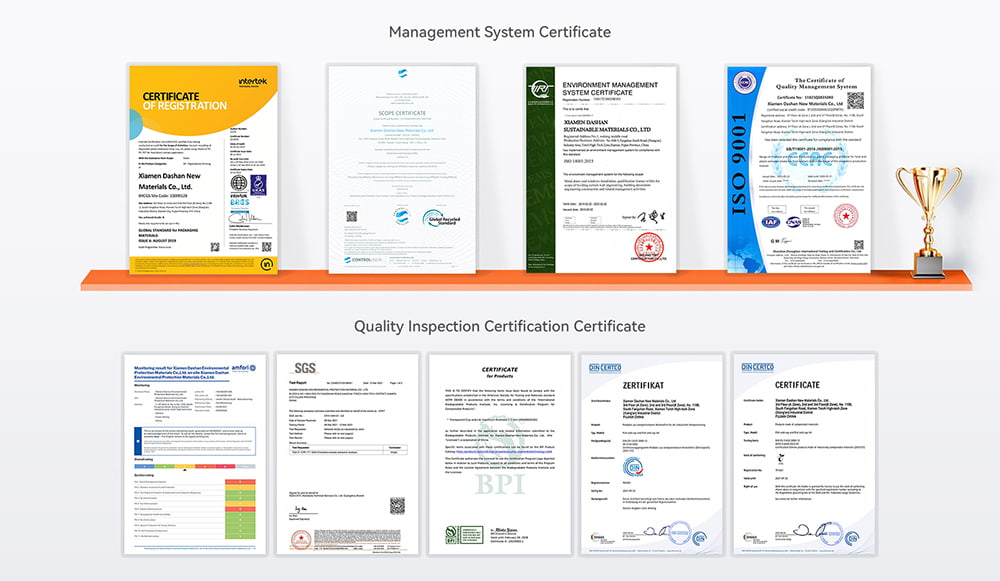
Compostable materials must meet specific standards to be classified as compostable. Certification guarantees that the material will break down into natural, non-toxic organic matter when subjected to composting conditions. It also ensures that the materials will not release harmful substances during their degradation and that they are safe for use in environmental systems.
2.2 Importance of Certifications for Sugarcane Bagasse and Corn Starch Packaging
Obtaining certification for compostability helps businesses demonstrate that their products are environmentally responsible. Certifications provide legal and market advantages, enabling manufacturers to market their products as eco-friendly and compostable. For consumers, certifications provide confidence that the packaging they are using is not only sustainable but will also degrade safely.
3. Key Certifications and Their Requirements
3.1 OK Compost Home
OK Compost Home is a certification provided by TÜV Austria, which is granted to products that can break down in home composting environments. For a product to receive this certification, it must degrade fully within 12 weeks under typical home composting conditions. The material must also meet specific criteria, such as not leaving behind harmful residues and being non-toxic to the compost environment.
3.2 OK Compost Industrial
The OK Compost Industrial certification is similar to the home compost certification but applies to materials that are intended for industrial composting facilities. These facilities provide a controlled environment with optimal temperature and moisture levels, which enables the compostable material to break down faster and more efficiently. Products with this certification must degrade fully within 12 weeks in industrial composting conditions.
3.3 BPI Certification
The Biodegradable Products Institute (BPI) is an organization that certifies compostable products in North America. BPI certification requires that products meet the ASTM D6400 standard, which ensures that the material can break down in industrial composting facilities. Products with this certification must be completely degraded within 180 days, leaving no toxic residues or pollutants behind.
3.4 EU Ecolabel
The EU Ecolabel is a certification awarded to products that meet the environmental criteria set by the European Union. For compostable packaging, the EU Ecolabel ensures that the product is biodegradable and meets specific requirements regarding the material’s environmental impact, such as using renewable resources and ensuring low emissions during production.
3.5 ASTM D6400 and ASTM D6868
ASTM D6400 is an American standard for compostable plastics. It sets requirements for the degradation of plastics in industrial composting facilities. ASTM D6400 ensures that a material breaks down into carbon dioxide, water, and organic matter within 180 days. ASTM D6868 applies to food packaging materials and ensures that they are compostable and safe for food contact.
3.6 ISO 17088
ISO 17088 is an international standard that provides criteria for compostable plastics. This certification ensures that a product will decompose into harmless organic matter in composting environments. It is recognized globally, making it an important certification for manufacturers seeking to enter international markets.
3.7 TÜV Austria Certifications
TÜV Austria offers various certifications for compostable materials. They provide both industrial and home composting certifications, ensuring that materials meet the required standards for biodegradability. TÜV Austria’s rigorous testing and certification processes are widely recognized around the world.
3.8 Other Regional Certifications
In addition to the global certifications mentioned above, many regions have their own compostability certification standards. For example, Japan has the Green Purchasing Law, and Australia follows AS 4736-2006 for compostable packaging. These regional certifications ensure that products comply with local environmental regulations.
4. Understanding Compostability Testing
4.1 Testing Methods for Compostability
Compostability testing is an essential part of the certification process. The materials are subjected to composting conditions, and their degradation rates are monitored. The two primary standards used for testing are ASTM D6400 and EN 13432, both of which test the ability of materials to break down in composting environments. The tests measure the breakdown of the material into water, carbon dioxide, and organic matter, with no toxic residues left behind.
4.2 Environmental Impact and Degradation Rates
The degradation rates of sugarcane bagasse and corn starch packaging are crucial for determining their compostability. The ideal compostable material will break down quickly, returning valuable nutrients to the soil. Materials that degrade within 12 weeks are considered ideal for composting, as they can contribute to soil health without leaving behind harmful chemicals.
4.3 Comparing Certification Methods
Different certification methods vary in terms of testing protocols and degradation criteria. While ASTM and BPI certifications focus on industrial composting conditions, certifications such as OK Compost Home focus on home composting. Understanding these differences helps manufacturers choose the right certification based on their target market and the composting infrastructure available.
5. Environmental Benefits of Compostable Packaging
5.1 Reducing Waste and Greenhouse Gas Emissions
Compostable packaging materials reduce waste and lower greenhouse gas emissions compared to traditional plastic. By diverting organic waste from landfills, compostable materials help reduce methane emissions, a potent greenhouse gas. Composting also decreases the need for incineration, further reducing harmful emissions.
5.2 Improving Soil Health
Compostable materials, once broken down, enrich the soil by returning organic matter and nutrients. This enhances soil fertility, improves water retention, and promotes healthy plant growth. This is particularly important for sustainable agriculture, as composting reduces the need for chemical fertilizers.
5.3 Composting vs. Traditional Waste Disposal
Traditional waste disposal methods, such as landfilling and incineration, contribute to environmental pollution. Composting provides an eco-friendly alternative by converting waste into valuable organic material. The composting process also helps reduce the environmental impact of waste by returning nutrients to the ecosystem.
6. Challenges and Limitations of Compostable Materials
6.1 Industrial Composting Requirements
Industrial composting facilities are necessary for compostable materials to break down efficiently. However, many regions lack the infrastructure needed for industrial composting. Without adequate composting facilities, the benefits of compostable materials cannot be fully realized.
6.2 Consumer Awareness and Participation
While compostable packaging offers significant environmental benefits, consumer awareness of proper disposal methods is often limited. Many consumers are unaware of how to compost correctly, which can lead to improper disposal and reduce the effectiveness of compostable packaging.
6.3 Market Adoption Barriers
Despite the environmental advantages, compostable materials face barriers to adoption. These include higher production costs, limited availability of composting facilities, and the need for more consumer education. Overcoming these barriers is key to widespread adoption.
7. Case Studies: Adoption of Compostable Packaging in Different Industries
7.1 Foodservice Industry
The foodservice industry is one of the largest adopters of compostable packaging, especially for take-out and delivery services. Many restaurants and food outlets are shifting to sugarcane bagasse and corn starch-based packaging due to the growing demand for sustainable solutions.
7.2 Retail and Consumer Goods
Retailers are also increasingly adopting compostable packaging, particularly for fresh produce and take-away meals. As consumers become more eco-conscious, retailers are responding by offering sustainable packaging alternatives.
7.3 Local Government Initiatives
Governments around the world are promoting the use of compostable materials through regulations and incentives. Local government initiatives are helping to create awareness and provide the infrastructure needed to support the widespread adoption of compostable packaging.
8. Certification for Global Trade and Export
8.1 International Trade Considerations
For businesses aiming to trade globally, it is essential to ensure that their compostable packaging meets international certification standards. This enables them to enter markets that require compliance with specific compostability standards.
8.2 Import/Export Compliance with Certifications
Obtaining the necessary certifications ensures that products can be legally imported and exported across international borders. Manufacturers must understand the regulatory requirements of different regions to avoid compliance issues.
8.3 Navigating Global Standards
Different regions have different compostability certification standards. Understanding these differences allows manufacturers to navigate global markets more effectively and avoid potential trade barriers.
9. Conclusion
As demand for sustainable packaging increases, certifications for sugarcane bagasse and corn starch-based materials will continue to play an essential role in promoting environmentally responsible practices. These certifications not only validate the compostability and biodegradability of the materials but also provide confidence to consumers, manufacturers, and regulators. The adoption of certified compostable packaging will contribute to a more sustainable future, reducing plastic waste and improving environmental health.
FAQs
1. What are the main certifications for compostable packaging?
The primary certifications include OK Compost Home, OK Compost Industrial, BPI Certification, EU Ecolabel, ASTM D6400, ASTM D6868, ISO 17088, and TÜV Austria certifications.
2. How long does it take to get compostable certification?
The process of obtaining compostable certification can take several weeks to months, depending on the testing requirements and certification body.
3. Is sugarcane bagasse compostable in home composting environments?
Yes, sugarcane bagasse is compostable in home composting systems, especially when it meets the OK Compost Home certification.
4. What is the ASTM D6400 standard?
ASTM D6400 is a standard for compostable plastics, ensuring that the material will break down into non-toxic components within 180 days in industrial composting facilities.
5. Can compostable packaging be used in foodservice?
Yes, compostable packaging made from materials like sugarcane bagasse and corn starch is widely used in the foodservice industry, especially for take-out packaging.
6. How do compostable materials impact the environment compared to plastic?
Compostable materials reduce plastic waste, lower greenhouse gas emissions, and enhance soil health through composting. Unlike plastics, they do not persist in the environment for hundreds of years.
7. Are compostable packaging materials more expensive than plastic alternatives?
Compostable materials tend to be more expensive to produce than plastic alternatives due to raw material costs and manufacturing processes. However, the environmental benefits often justify the higher cost.
References
-
BPI Certification Website: https://www.bpiworld.org
-
TÜV Austria Certification: https://www.tuv.at
-
EU Ecolabel: https://ec.europa.eu/environment/ecolabel
-
ASTM Standards for Compostable Packaging: https://www.astm.org
-
ISO 17088: https://www.iso.org
Copyright Statement
© 2026 Dashan Packing. All rights reserved.
This article is an original work created by the Dashan Packing editorial team.
All text, data, and images are the result of our independent research, industry experience,
and product development insights. Reproduction or redistribution of any part of this content
without written permission is strictly prohibited.
Dashan Packing is committed to providing accurate, evidence-based information and
to upholding transparency, originality, and compliance with global intellectual property standards.