

Quick Summary
CPET trays are widely used in airline catering, ready meals, and institutional food service due to their excellent heat resistance and structural stability. Unlike standard PET or PP trays, CPET trays maintain shape and strength during freezing, microwave reheating, and oven heating. Through controlled crystallization, CPET provides reliable performance in high-temperature food packaging applications. At DASHAN, CPET trays are designed to meet strict operational, safety, and consistency requirements for large-scale food service systems.
A Practical Guide for Airline Catering, Ready Meals, and High-Temperature Food Packaging
Introduction: Why CPET Trays Matter in High-Temperature Food Packaging
In food service sectors where meals must withstand freezing, reheating, and direct oven use, packaging performance is not optional—it is critical. Airline catering, ready meals, railway dining, and central kitchens all require trays that maintain shape, safety, and functionality under high temperatures.
Standard plastic trays such as PET or PP often fall short in these environments, leading to deformation, leakage, or structural failure. This is where CPET trays have become the preferred solution. Known for their exceptional heat resistance and dimensional stability, CPET trays are widely used in applications where thermal performance and operational reliability are essential.
What Is CPET?
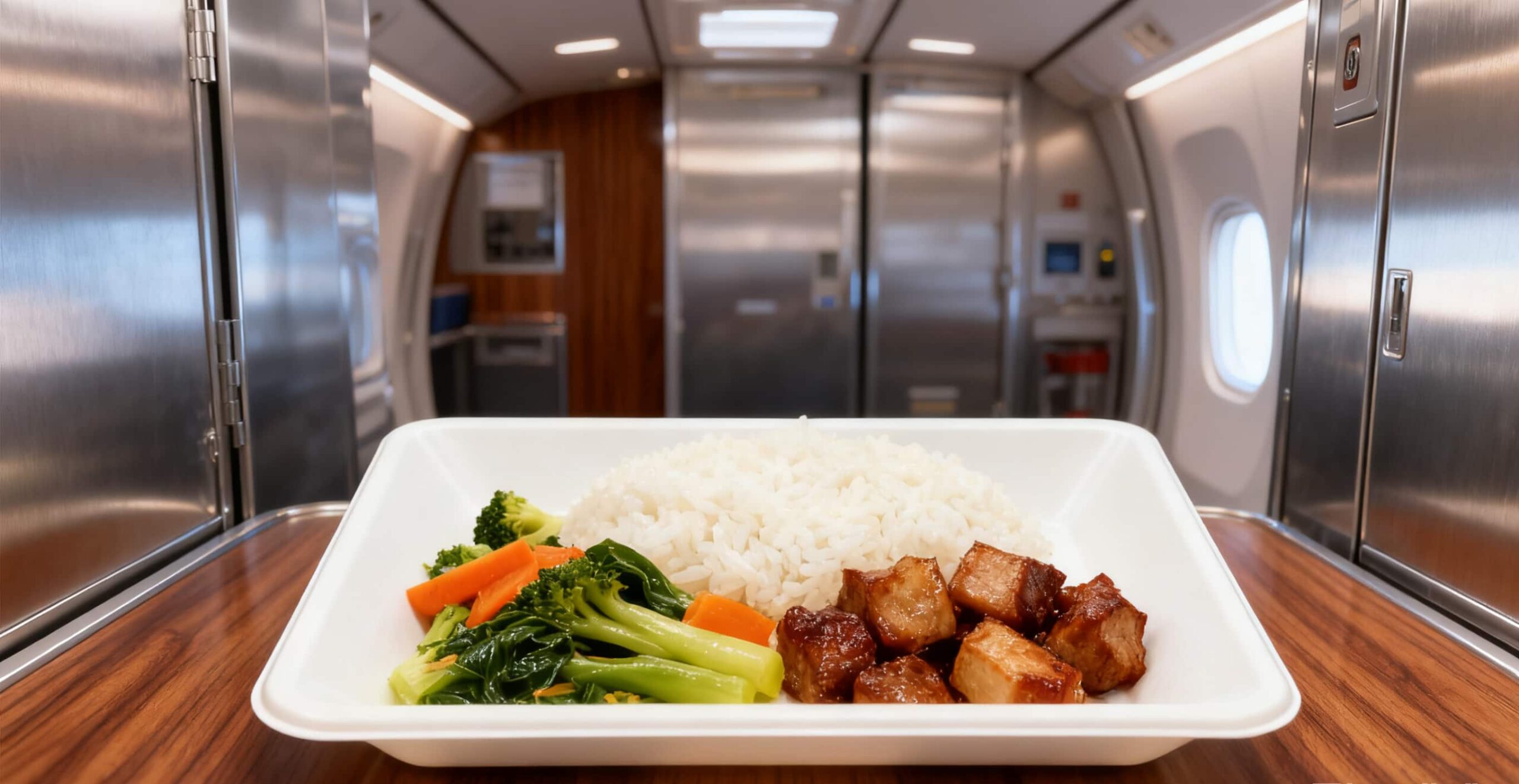
Definition of CPET (Crystallized Polyethylene Terephthalate)
CPET stands for Crystallized Polyethylene Terephthalate. Unlike standard PET, which is largely amorphous, CPET undergoes a controlled crystallization process during manufacturing. This crystallized structure significantly improves the material’s resistance to heat.
While PET begins to soften at relatively low temperatures, CPET maintains its rigidity and shape even when exposed to oven or microwave heat, making it suitable for demanding food service environments.
Key Characteristics of CPET Material
-
High crystallinity for thermal stability
-
Excellent dimensional integrity under heat
-
Strong mechanical strength for handling and transport
-
Suitable for both freezing and reheating cycles
At DASHAN, CPET is selected specifically for applications where thermal performance and consistency are non-negotiable, such as airline meal trays and ready-to-eat food packaging.
Heat Resistance: Why CPET Performs Under High Temperatures
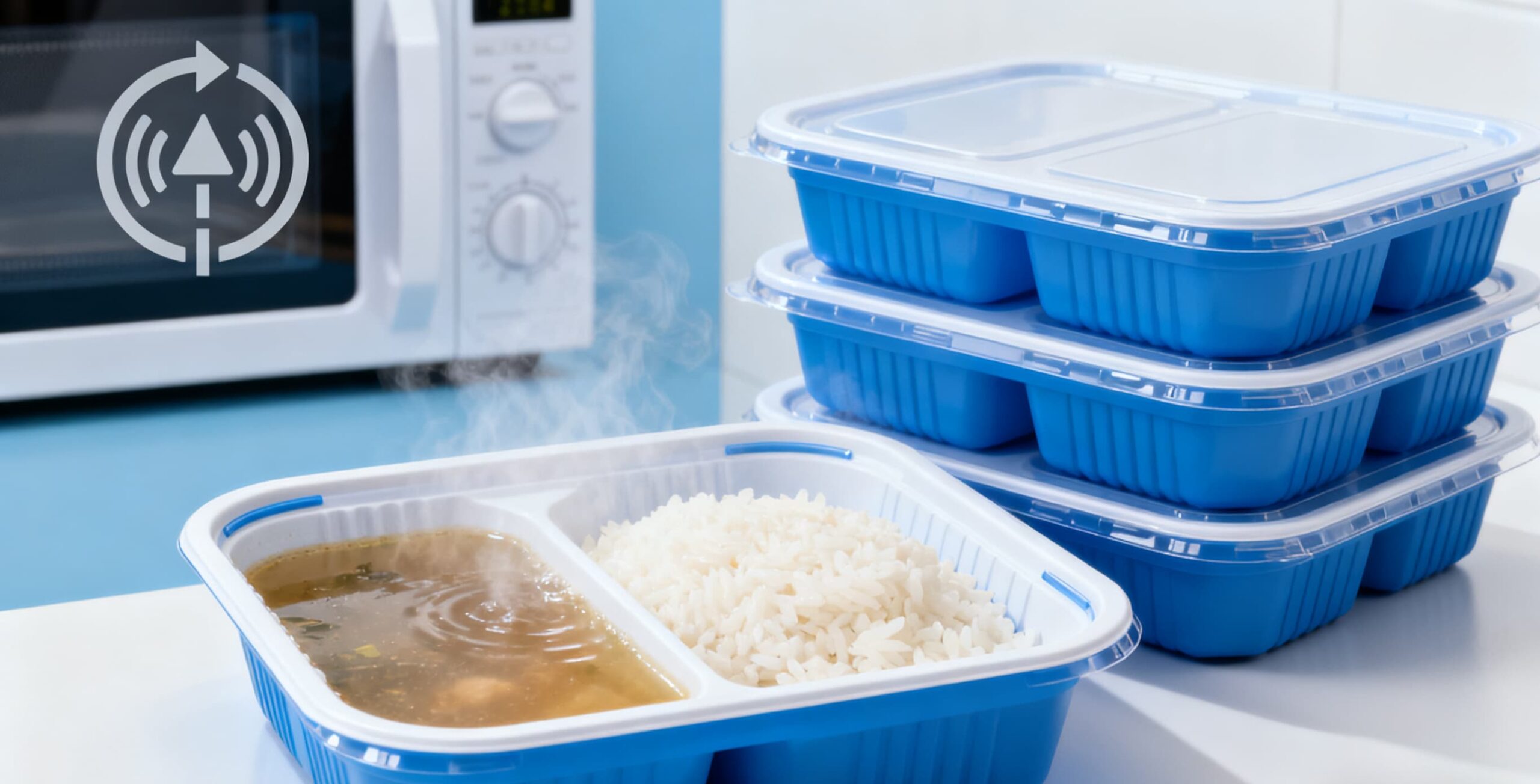
Typical Temperature Performance of CPET Trays
CPET trays are designed to handle a wide temperature range, including:
-
Freezer storage
-
Microwave reheating
-
Conventional oven heating
This versatility allows meals to move seamlessly from cold storage to reheating without repackaging, improving operational efficiency for food service providers.
Why Standard PET or PP Trays Fail at High Heat
Standard PET trays soften quickly under heat, while PP trays may warp or lose rigidity. CPET trays, by contrast, retain their structure due to their crystallized molecular arrangement.
Real-World Performance Benefits
-
No tray collapse during heating
-
No unpleasant odors during reheating
-
Stable compartment separation for multi-course meals
These properties make CPET trays especially valuable in controlled food service systems.
Structure & Design of CPET Trays
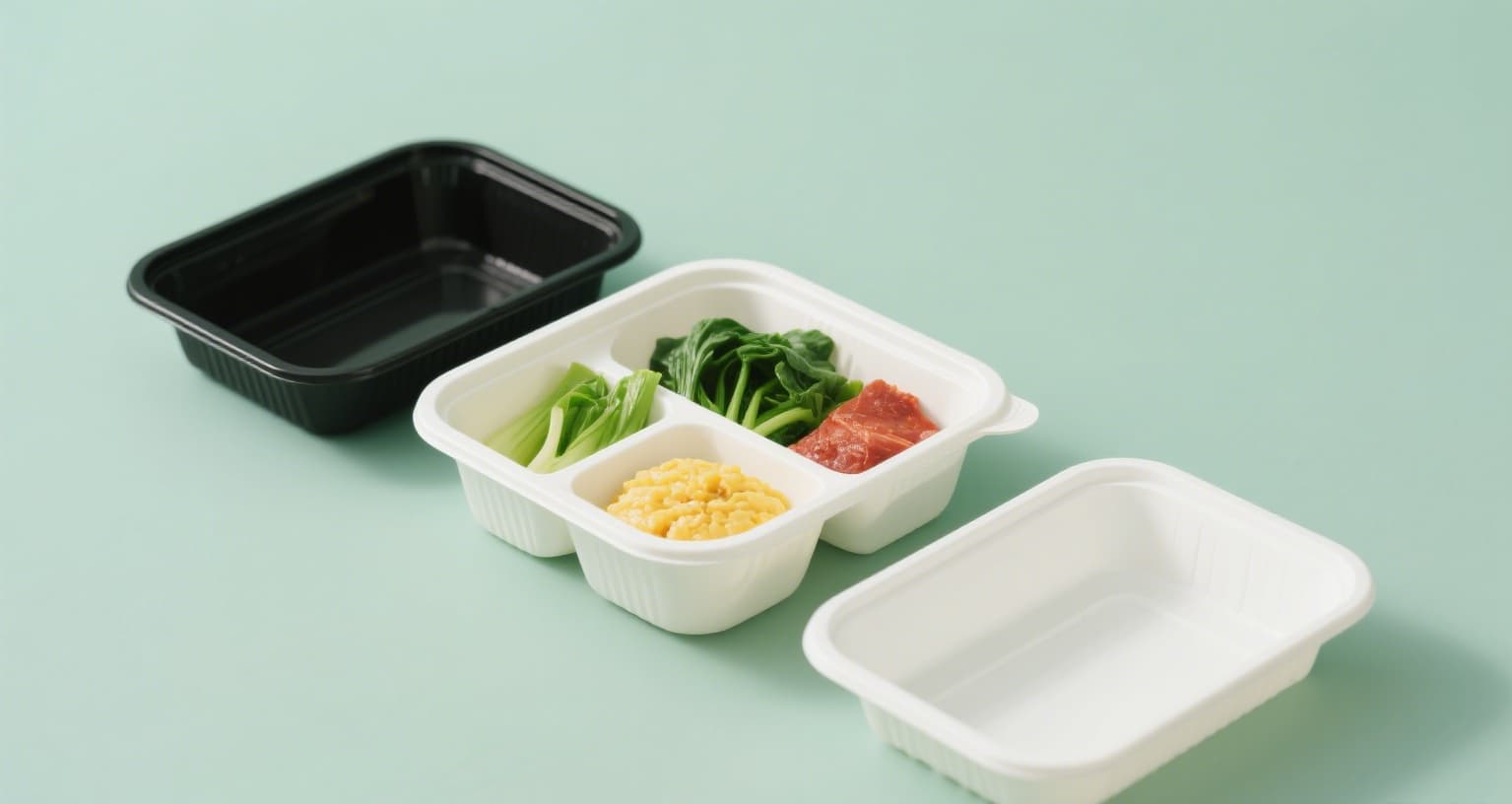
Tray Structure and Compartment Design
CPET trays are available in a variety of structural designs:
-
Single-compartment trays
-
Multi-compartment meal trays
-
Airline-specific formats with precise portion control
Compartment design plays a critical role in thermal distribution and meal presentation, particularly in airline catering.
Thickness, Weight, and Rigidity
Tray performance is closely linked to material thickness and weight tolerance. Lighter trays reduce logistics costs, but excessive lightweighting can compromise rigidity.
At DASHAN, CPET trays are engineered to balance:
-
Structural strength
-
Heat resistance
-
Weight efficiency
This balance is especially important for large-scale airline and institutional catering orders.
Lid and Sealing Compatibility
CPET trays are commonly used with:
-
Heat-sealable films
-
Specialized plastic lids (where applicable)
Proper sealing ensures:
-
Leak prevention during transport
-
Safe reheating
-
Food hygiene compliance
CPET Manufacturing Process Explained
Material Preparation and Crystallization Control
The defining feature of CPET lies in its controlled crystallization process. Precise temperature management during thermoforming ensures consistent crystallinity across each tray.
Thermoforming vs Injection Molding
| Process | Suitability for CPET Trays | Key Advantage |
|---|---|---|
| Thermoforming | High | Cost-efficient for large volumes |
| Injection Molding | Limited | Higher tooling cost |
Thermoforming is the preferred process for CPET trays due to its efficiency, scalability, and flexibility in tray design.
Quality Control in CPET Tray Production
Reliable CPET trays require strict control over:
-
Dimensional tolerances
-
Weight consistency
-
Heat resistance testing
At DASHAN, multi-stage inspections and process controls are applied to ensure batch-to-batch stability, which is critical for long-term supply contracts.
CPET Trays vs Other Food Trays: Practical Comparison
| Feature | CPET | PET | PP | Aluminum |
|---|---|---|---|---|
| Heat Resistance | Excellent | Low | Medium | Excellent |
| Microwave Safe | Yes | No | Limited | No |
| Oven Safe | Yes | No | Limited | Yes |
| Weight | Light | Light | Light | Heavy |
| Food Visibility | No (opaque) | Yes | Yes | No |
| Cost Efficiency | High (large volume) | High | High | Medium |
| Common Applications | Airline, ready meals | Cold food | Takeaway | Oven meals |
This comparison explains why CPET remains the preferred choice for high-temperature food applications, despite the availability of alternative materials.
Key Applications of CPET Trays
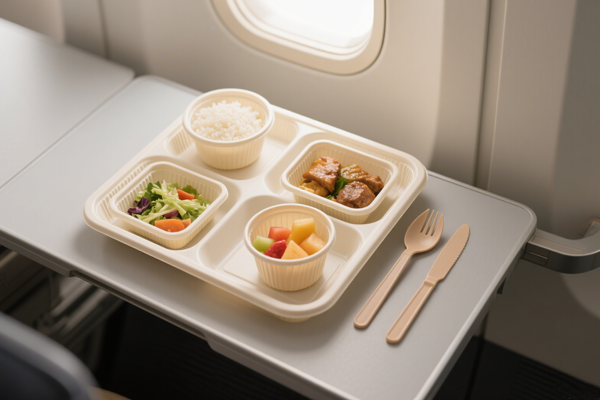
Airline Catering & Railway Meals
CPET trays are widely used in airline catering due to:
-
High heat tolerance
-
Stable structure under reheating
-
Compatibility with automated catering systems
DASHAN has extensive experience supplying CPET trays for airline meal service, where consistency and compliance are critical.
Ready Meals and Meal Prep
For frozen or chilled ready meals that require reheating, CPET trays offer:
-
One-container convenience
-
Reduced packaging waste
-
Reliable performance from freezer to oven
Institutional Catering and Central Kitchens
Hospitals, schools, and corporate dining facilities rely on CPET trays for:
-
Large-volume meal production
-
Safe reheating
-
Efficient portion control
Compliance & Food Safety Considerations
CPET trays must comply with international food contact regulations, including:
-
FDA food contact standards
-
EU food contact material requirements
In regulated environments such as aviation, additional documentation and traceability may be required. DASHAN ensures CPET tray production aligns with global compliance expectations for professional food service buyers.
Sustainability & Recycling of CPET Trays
CPET is technically recyclable, though challenges exist—particularly with black CPET, which is harder to sort in recycling streams.
Current industry trends include:
-
Development of recyclable CPET formulations
-
Improved sorting technologies
-
Exploration of recycled CPET (rCPET) for non-critical applications
Sustainability considerations are increasingly influencing CPET tray design and material selection.
What Buyers Should Consider When Sourcing CPET Trays
When selecting a CPET tray supplier, buyers should evaluate:
-
Required heat resistance and application scenario
-
Tray structure and compartment design
-
Manufacturing consistency and quality control
-
Supplier experience with regulated industries
At DASHAN, CPET tray recommendations are typically based on application-specific performance requirements, rather than one-size-fits-all solutions.
FAQ
1. What is a CPET tray?
A CPET tray is made from crystallized polyethylene terephthalate. The crystallization process gives the tray high heat resistance, allowing it to withstand oven and microwave temperatures without deformation.
2. Why are CPET trays used instead of PET or PP trays?
Standard PET trays soften at relatively low temperatures, and PP trays may warp under high heat. CPET trays maintain dimensional stability, making them suitable for high-temperature food applications such as airline meals and ready-to-eat foods.
3. Are CPET trays oven and microwave safe?
Yes. CPET trays are designed to be both oven-safe and microwave-safe, allowing food to be reheated directly in the tray.
4. What industries commonly use CPET trays?
CPET trays are commonly used in airline catering, railway meals, ready meals, frozen foods, central kitchens, hospitals, and institutional catering.
5. Can CPET trays be used for frozen food?
Yes. CPET trays perform well across a wide temperature range, from freezer storage to high-temperature reheating.
6. Are CPET trays food safe?
When produced correctly, CPET trays comply with FDA and EU food contact regulations. DASHAN manufactures CPET trays in accordance with international food safety standards.
7. Are CPET trays recyclable?
CPET is technically recyclable. However, recycling efficiency can be affected by factors such as tray color and local recycling infrastructure, particularly for black CPET trays.
8. What should buyers consider when sourcing CPET trays?
Buyers should evaluate heat resistance requirements, tray structure, weight tolerance, sealing compatibility, compliance documentation, and supplier manufacturing consistency.
Conclusion: Why CPET Remains the Preferred Solution for High-Heat Food Packaging
Despite increasing pressure for alternative materials, CPET trays continue to play a vital role in high-temperature food packaging. Their unmatched heat resistance, structural stability, and operational reliability make them indispensable in airline catering, ready meals, and institutional food service.
For buyers seeking packaging that performs reliably across freezing, reheating, and transport stages, CPET trays remain a proven and practical choice. Backed by controlled manufacturing processes and application-driven design, CPET trays—such as those produced by DASHAN—continue to support safe, efficient, and scalable food service operations worldwide.
References
-
U.S. Food & Drug Administration (FDA)
Food Contact Substances (FCS) Program
https://www.fda.gov/food/packaging-food-contact-substances-fcs -
European Commission
Food Contact Materials – Legislation Overview
https://food.ec.europa.eu/safety/chemical-safety/food-contact-materials_en -
PlasticsEurope
PET and Crystallized PET (CPET): Properties and Applications
https://plasticseurope.org/knowledge-hub/pet-polyethylene-terephthalate/ -
Smithers
The Future of Rigid Plastic Food Packaging
https://www.smithers.com/services/market-reports/packaging/rigid-plastic-packaging -
Packaging Europe
CPET Trays and High-Temperature Food Packaging Explained
https://packagingeurope.com/ -
ScienceDirect
Crystallization and Thermal Properties of PET Materials
https://www.sciencedirect.com/topics/materials-science/polyethylene-terephthalate -
Journal of Food Packaging and Shelf Life
Performance of Plastic Food Trays Under Thermal Stress
https://www.sciencedirect.com/journal/food-packaging-and-shelf-life -
ASTM International
Standards for Plastic Packaging Materials
https://www.astm.org/industry/plastics
Copyright Statement
© 2026 Dashan Packing. All rights reserved.
This article is an original work created by the Dashan Packing editorial team.
All text, data, and images are the result of our independent research, industry experience,
and product development insights. Reproduction or redistribution of any part of this content
without written permission is strictly prohibited.
Dashan Packing is committed to providing accurate, evidence-based information and
to upholding transparency, originality, and compliance with global intellectual property standards.