

Quick Summary:
Polypropylene (PP) is widely used in food packaging due to its chemical resistance, lightweight nature, and cost-effectiveness. However, not all PP is created equal. Copolymer and homopolymer PP differ in molecular structure, heat resistance, and mechanical properties, which affects their suitability for applications involving freezing, hot-filling, or high-temperature storage. This article explores molecular structures, thermal deflection temperature (TDT) differences, mechanical performance matrices, and provides guidance for selecting the appropriate PP type for specific food packaging scenarios.
What Are Copolymer and Homopolymer PP in Food Packaging?
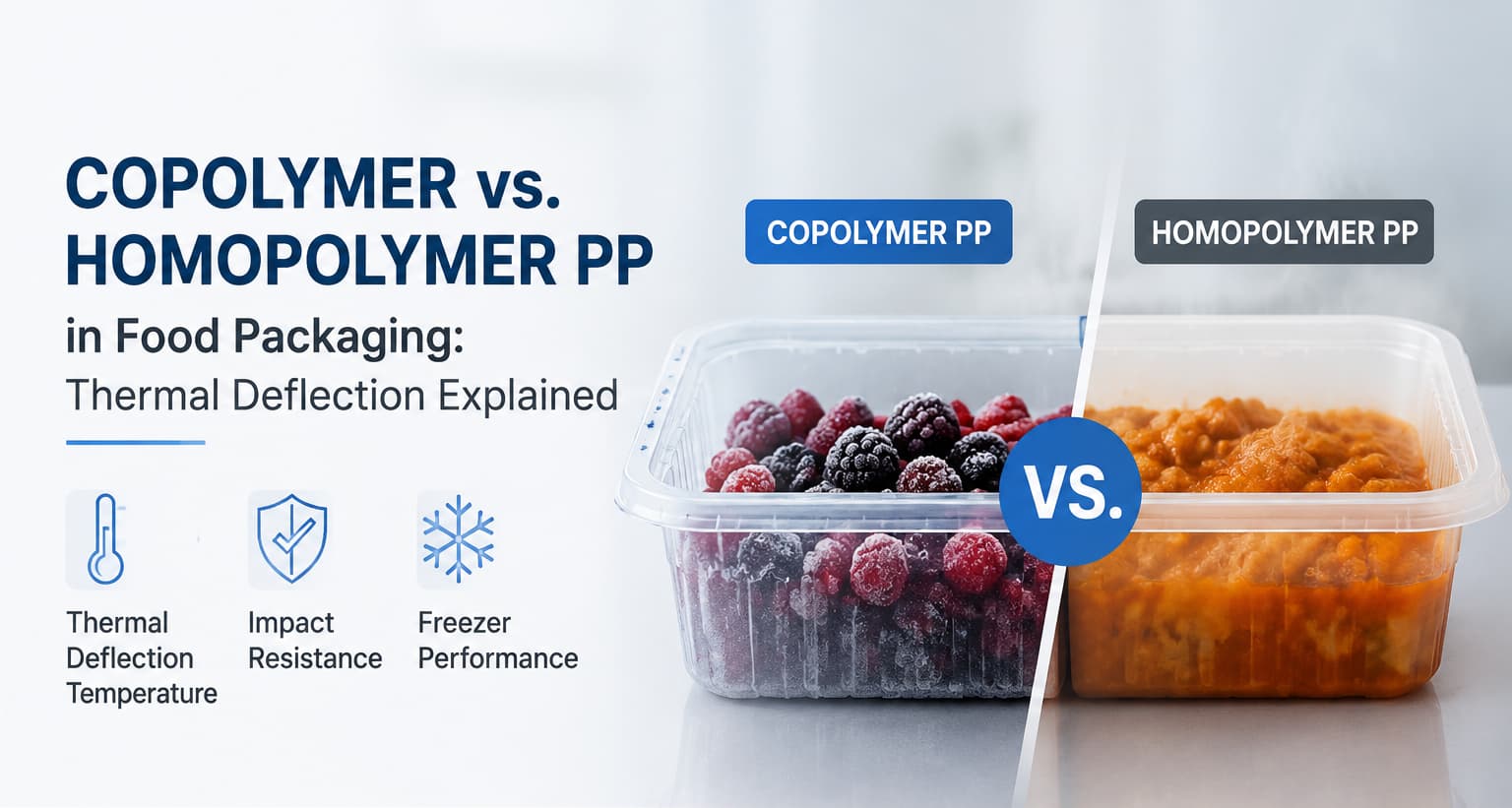
In food packaging, homopolymer PP is made exclusively from propylene monomers. Its highly crystalline structure gives it high stiffness and excellent heat resistance, making it ideal for hot meal trays, ovenable containers, and rigid packaging. On the other hand, copolymer PP is created by polymerizing propylene with a small percentage of ethylene. This reduces crystallinity, making the material less brittle at low temperatures and improving impact resistance, which is perfect for freezer trays, chilled meal packaging, or containers that undergo repeated freeze-thaw cycles.
Understanding these fundamental differences is crucial for designers and manufacturers to select the right material that balances stiffness, thermal stability, and toughness based on the intended food packaging application.

Molecular Structures of Polypropylene Variants
Polypropylene comes mainly in two forms: homopolymer PP and copolymer PP. Understanding their molecular structure is key to predicting performance.
- Homopolymer PP:
- Made from only propylene monomers.
- Crystalline structure gives high stiffness and heat resistance.
- Common in rigid containers, hot meal trays, and items requiring dimensional stability.
- Copolymer PP:
- Made by polymerizing propylene with a small percentage of ethylene monomers.
- Reduced crystallinity improves impact resistance at low temperatures.
- Ideal for applications involving freezing or repeated thermal cycling.
For a deep dive into PP manufacturing and material selection, see [our Comprehensive Guide to Thermoformed PP Packaging].
H3: Impact Resistance vs. Heat Resistance
The trade-off between impact resistance and heat resistance is a crucial factor for food packaging design.
| PP Type | Impact Resistance | Heat Resistance | Typical Applications |
|---|---|---|---|
| Homopolymer PP | Medium | High (>120°C) | Hot meal trays, ovenable containers |
| Copolymer PP | High | Medium (~100°C) | Freezer containers, cold food trays |
Observation: Homopolymer offers higher thermal deflection temperature, but copolymer is less brittle in sub-zero conditions, reducing the risk of cracking during freezing.
H2: Thermal Deflection Temperature (TDT) Data Analysis
Thermal Deflection Temperature (TDT) measures the temperature at which a material deforms under a specific load. It is critical for packaging applications where hot-filling or microwaving occurs.
| PP Type | Load (MPa) | TDT (°C) |
|---|---|---|
| Homopolymer PP | 0.45 | 160 |
| Homopolymer PP | 1.80 | 135 |
| Copolymer PP | 0.45 | 120 |
| Copolymer PP | 1.80 | 100 |
Key Insights:
- Homopolymer PP retains stiffness at higher temperatures, suitable for hot meal packaging.
- Copolymer PP maintains toughness at lower temperatures, ideal for freezer or chilled applications.
- Designers must balance stiffness, impact resistance, and thermal performance for optimal food packaging.
H2: If Freezing is Required, Then Choose Copolymer
For frozen or cold-chain food applications, copolymer PP is preferred due to:
- Low-temperature toughness: Resists cracking when exposed to -20°C or lower.
- Safe for repeated thaw-freeze cycles: Maintains integrity over multiple cold chain transitions.
- Flexible wall design: Easier to form thin-walled freezer trays without sacrificing durability.
Scenario Example: A frozen meal tray for airline catering or retail ready meals benefits from copolymer PP, whereas a microwavable hot lunch tray benefits from homopolymer PP.
Check [our Freezer-Safe PP Packaging Solutions] for practical product recommendations.
H2: Semantic Closure: Specifying the Right PP Resin
Choosing between copolymer and homopolymer PP depends on:
- Temperature requirements: Hot vs. cold or frozen storage.
- Mechanical requirements: Impact resistance vs. stiffness.
- Forming process: Wall thickness and tray geometry can influence resin choice.
- End-user experience: Packaging must survive handling without deformation or cracking.
By combining molecular knowledge, TDT data, and application scenarios, manufacturers and designers can specify the right PP resin to optimize performance, cost, and consumer satisfaction.
For a complete overview of selecting PP resins for food packaging, see [PP food containers].
FAQ: Copolymer vs. Homopolymer PP
1. What is the main difference between copolymer and homopolymer PP?
Copolymer PP contains ethylene monomers, improving impact resistance at low temperatures, while homopolymer PP is stiffer and more heat resistant.
2. Which PP type is better for hot meals?
Homopolymer PP is preferred due to higher thermal deflection temperature and dimensional stability at elevated temperatures.
3. Can copolymer PP be used in microwaves?
Copolymer PP can be used for moderate heat, but its maximum TDT is lower than homopolymer, so caution is needed for high-temperature microwaving.
4. Why is impact resistance important in frozen food trays?
Freezing can make plastics brittle. Copolymer PP maintains toughness at low temperatures, preventing cracks during handling.
5. How do I calculate TDT for a specific tray design?
TDT depends on load, wall thickness, and material grade. Standard lab testing or material datasheets provide precise values.
6. Are there hybrid solutions combining copolymer and homopolymer benefits?
Yes, some blends or multilayer designs can balance heat resistance and low-temperature toughness, but they require careful processing.
Summary
Understanding the differences between copolymer and homopolymer PP is critical for designing durable and reliable food packaging. Key takeaways:
- Homopolymer PP: High TDT, stiff, best for hot meals and ovenable trays.
- Copolymer PP: Low-temperature toughness, impact-resistant, best for freezer or chilled applications.
- TDT and mechanical properties should guide material selection, not just cost.
- Scenario-based selection ensures packaging survives the cold chain, microwave use, or hot-filling without compromising quality.
For manufacturers and foodservice brands seeking high-quality, reliable PP packaging, Xiamen Dashan Packaging provides a wide range of thermoformed solutions, including hot meal trays, freezer trays, and customizable PP containers, backed by rigorous quality control and global certifications. Leveraging Dashan’s expertise ensures packaging performs under diverse temperature conditions while maximizing efficiency and ROI.
References
- Harper, C.A. (2020). Handbook of Plastics, Elastomers, and Composites. McGraw-Hill.
- PlasticsEurope. (2022). Polypropylene (PP) Market and Properties Overview. Retrieved from https://www.plasticseurope.org
- ASTM International. (2021). ASTM D790-21: Standard Test Methods for Flexural Properties of Plastics.
- Food Packaging Forum. (2021). Polypropylene in Food Packaging: Safety, Properties, and Applications. Retrieved from https://www.foodpackagingforum.org
- Global Foodservice Packaging Market Report. (2022). Trends in Thermoformed Polypropylene Containers. Frost & Sullivan.
- Auras, R., Harte, B., & Selke, S. (2004). An Overview of Polylactides as Packaging Materials. Macromolecular Bioscience, 4(9), 835–864.
Copyright Notice
© 2026 Xiamen Dashan Packaging Co., Ltd. All rights reserved.
This article, including text, tables, and data, is the intellectual property of Xiamen Dashan. No part may be reproduced, distributed, or transmitted in any form without prior written permission. For permission requests, please contact [email protected].