

Introduction
Airline catering is one of the most demanding sectors of the food service industry. Every meal served onboard must maintain its quality from production to consumption while meeting strict food safety standards, limited aircraft space, and highly coordinated logistics. Unlike restaurants or takeaway businesses, airline caterers prepare thousands of meals every day, transport them through complex cold-chain systems, and often reheat them before serving passengers at cruising altitude.
Because of these unique operating conditions, packaging plays a much more significant role than simply holding food. It protects meal quality during transportation, supports efficient production, withstands temperature changes, and helps airlines deliver a consistent dining experience.
In recent years, airline catering has also faced new challenges. Airlines are seeking lighter packaging to improve fuel efficiency, more sustainable materials to support environmental commitments, and packaging solutions that comply with food contact regulations across international markets. At the same time, passenger expectations for meal presentation and convenience continue to increase.
Choosing the right airline catering packaging therefore requires balancing several factors, including food safety, operational efficiency, material performance, sustainability, and regulatory compliance.
This article explores the key considerations for selecting airline catering packaging and explains how different packaging materials can help airlines, catering companies, and food service suppliers improve both operational performance and passenger satisfaction.
Why Airline Catering Requires Specialized Packaging
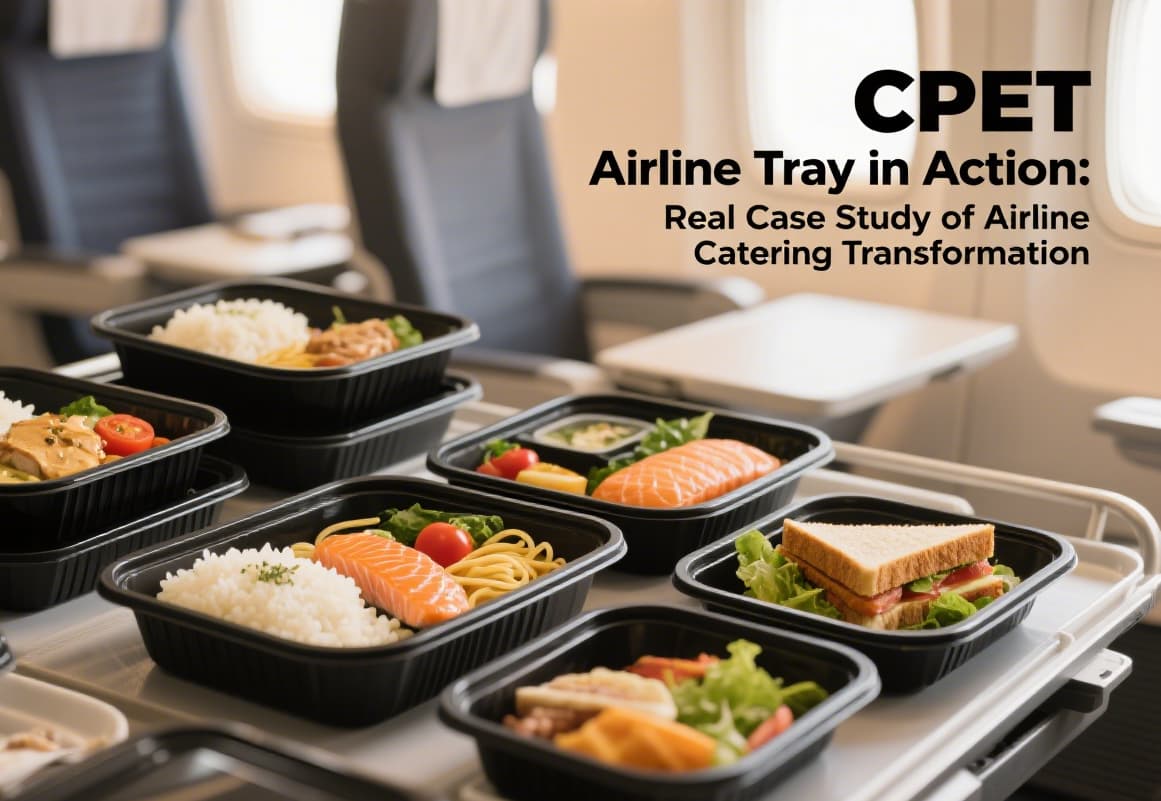
Packaging used for airline meals operates under conditions that are very different from those in restaurants or retail food service.
A typical airline meal is prepared several hours before departure, stored under refrigerated conditions, transported to the airport, loaded onto aircraft, reheated if necessary, and finally served to passengers. Throughout this process, the packaging must maintain food quality while protecting the meal from contamination and physical damage.
Aircraft cabins also introduce practical limitations. Storage space is limited, cabin crews work within narrow service aisles, and meal carts must accommodate hundreds of individual meals in an organized and efficient manner. Packaging that is too bulky, unstable, or difficult to stack can reduce operational efficiency and increase handling time.
Weight is another important consideration. Every kilogram loaded onto an aircraft contributes to fuel consumption. Although a single container may weigh only a few grams, airlines serve millions of meals annually. Even small reductions in packaging weight can contribute to significant operational savings over time.
At the same time, airline packaging must comply with food contact regulations and perform reliably under changing temperatures. Depending on the route and catering process, meals may be refrigerated, frozen, reheated in convection ovens, or warmed in microwave systems before being served.
For these reasons, airline catering requires packaging specifically designed for demanding transportation, storage, and food service environments.
Key Requirements for Airline Catering Packaging
| Requirement | Why It Matters |
|---|---|
| Food safety | Protects meals throughout production and transportation |
| Heat resistance | Supports reheating before serving |
| Lightweight construction | Helps reduce aircraft operating weight |
| Stackability | Maximizes storage efficiency in meal carts |
| Leak resistance | Prevents spills during transport and service |
| Structural strength | Maintains packaging integrity throughout handling |
Meeting these requirements allows airlines to improve operational efficiency while delivering meals that arrive in good condition and maintain their intended appearance.
Key Factors When Choosing Airline Catering Packaging
Selecting airline catering packaging involves much more than choosing a suitable container. Every packaging solution should support the entire catering process—from meal preparation to passenger service.
Food Safety and Regulatory Compliance
Food safety is the highest priority in airline catering. Packaging materials must be suitable for food contact and manufactured under controlled production conditions.
International airline catering suppliers often serve multiple countries and regions, meaning packaging may need to comply with different food contact regulations depending on the destination market. Customers also increasingly request supporting technical documentation such as migration test reports and Declarations of Compliance (DoC) to verify product safety.
Choosing packaging from suppliers with established compliance systems helps reduce approval time and provides greater confidence throughout the supply chain.
Temperature Performance
Airline meals experience a wide range of temperatures before reaching passengers.
Some meals remain refrigerated until service, while others are frozen for extended storage before reheating. Hot meals may be heated in convection ovens or microwave systems shortly before serving, requiring packaging that can maintain its shape and performance under elevated temperatures.
Selecting materials that match the intended temperature conditions helps ensure food quality while minimizing the risk of deformation or leakage during service.
Strength and Stackability
Airline catering operations rely heavily on efficient logistics.
Thousands of meal trays are transported every day using standardized carts, pallets, and storage systems. Packaging must therefore be strong enough to withstand repeated handling while remaining easy to stack without collapsing or shifting.
Well-designed containers also improve warehouse efficiency and simplify loading and unloading during flight preparation.
Lightweight Design
Reducing packaging weight has become an important objective for many airlines.
Lighter packaging contributes to lower fuel consumption without compromising food protection. Modern packaging materials allow manufacturers to reduce weight while maintaining sufficient rigidity for transportation and onboard service.
For large airline catering operations, even modest weight reductions can translate into measurable savings over time.
Operational Efficiency
Packaging should also support efficient meal preparation and onboard service.
Features such as secure lid fit, consistent dimensions, smooth sealing surfaces, and compatibility with automated filling equipment help improve production efficiency and reduce handling time.
From the cabin crew’s perspective, packaging should be easy to open, stable during serving, and capable of presenting meals attractively to passengers.
Comparing Common Packaging Materials for Airline Catering
Different meal types require different packaging materials. Rather than relying on a single solution, airline caterers often use multiple materials depending on how the food will be prepared, transported, and served.
The table below summarizes some of the most commonly used materials in airline catering.
| Material | Typical Applications | Main Advantages |
|---|---|---|
| CPET | Oven-ready meals, frozen meals | Excellent heat resistance and dimensional stability |
| PP | Microwaveable meals, hot food containers | Lightweight, durable, microwave-safe |
| PET | Salads, desserts, fresh fruit, cold meals | High clarity, attractive presentation |
| Aluminum | Premium hot meals, long-haul catering | Excellent heat conductivity and oven performance |
CPET for Oven-Ready Meals
CPET is widely used for premium airline meals that require heating in convection ovens. It performs well across both frozen and high-temperature conditions, making it suitable for international and long-haul flights where meals are prepared well in advance and reheated before serving.
PP for Everyday Hot Meal Service
Polypropylene (PP) is a popular choice for many airline catering applications because it combines good heat resistance with low weight. It is commonly used for microwaveable meal containers, side dishes, soup bowls, and other hot food packaging where durability and cost efficiency are important.
Its versatility also makes PP suitable for a wide range of domestic and regional flight catering programs.
PET for Cold Food Presentation
PET is frequently selected for cold meal applications such as fresh salads, fruit portions, sandwiches, desserts, and bakery products.
Its excellent transparency allows passengers to see the food clearly, creating a fresher and more premium presentation. PET also offers good rigidity, helping protect delicate foods during transportation and handling.
Rather than competing with one another, CPET, PP, and PET each serve different roles within airline catering. Selecting the right material depends on the meal type, heating method, operational process, and passenger experience the airline wants to deliver.