

Quick Summary
The EU Single-Use Plastics Directive is reshaping global food packaging standards by restricting certain plastic products and promoting sustainable alternatives. For businesses, compliance with EU single-use plastics packaging regulations now requires adopting materials like PLA and bagasse, meeting labeling and EPR requirements, and working with reliable suppliers. While costs may increase initially, long-term benefits include regulatory compliance, improved brand perception, and stronger market competitiveness in Europe.
Introduction: Why the EU Single-Use Plastics Directive Matters Globally
Plastic pollution has evolved from an environmental concern into a structural global challenge. Each year, over 11 million metric tons of plastic waste enter the oceans, and a significant portion originates from single-use food packaging systems.
In response, the European Union has positioned itself at the forefront of regulatory action by introducing the EU Single-Use Plastics Directive. Unlike isolated environmental policies, this directive is designed to reshape how packaging is produced, used, and disposed of across an entire economic system.
What makes this particularly important is its global reach. Even companies operating outside Europe must comply if they wish to access the EU market. As a result, EU single-use plastics packaging has become a benchmark standard influencing global supply chains.
For manufacturers, exporters, and procurement teams, understanding EU single-use plastics packaging regulations is no longer a compliance exercise—it is a strategic requirement.
What Is the EU Single-Use Plastics Directive (SUP Directive)?
Overview of Directive (EU) 2019/904
The directive did not emerge as a sudden regulatory shift. Instead, it was developed through a structured and data-driven process aimed at targeting the most problematic sources of marine plastic waste.
This evolution can be understood as a three-stage progression.
Initially, the EU conducted extensive environmental assessments to identify the most common plastic items found in marine ecosystems, with a clear focus on foodservice-related products. Based on these findings, Directive (EU) 2019/904 was formally adopted in 2019 as a legal framework designed to reduce environmental impact at scale.
Implementation began in 2021, with phased enforcement across member states. This phased rollout allowed industries time to adapt while ensuring that compliance would eventually become mandatory across all markets.
Today, these measures collectively define the foundation of EU SUP directive packaging rules.
Key Products Covered by the Directive
The directive focuses on products that combine high usage frequency with low reuse potential. These are typically items designed for immediate disposal after a single use.
Among the most affected categories are plastic cutlery, takeaway food containers, beverage cups, straws, and expanded polystyrene packaging. These products represent a substantial share of single-use waste in the foodservice industry.
What is critical to understand is that the regulation is not only about banning specific items—it is about transforming usage patterns. Businesses involved in single-use plastic food packaging EU ban categories must therefore rethink both materials and product design strategies.
Which Food Packaging Materials Are Affected?
Traditional Plastics (PP, PET, PS)
The EU does not apply a uniform ban across all plastics. Instead, it uses a layered regulatory approach that differentiates between materials based on environmental impact and recyclability.
At the base level, materials such as polypropylene (PP) and polyethylene terephthalate (PET) are still permitted, but they are subject to increasing regulatory pressure. This includes stricter recycling targets, labeling requirements, and sustainability expectations.
At a higher level of restriction, expanded polystyrene (EPS) has effectively been eliminated under the PS foam packaging ban EU, due to its poor recyclability and high environmental impact.
This tiered framework reflects the broader tightening of plastic food packaging restrictions EU, where the goal is not just reduction, but systematic replacement.
Biodegradable Alternatives (PLA, Bagasse, Paper)
As traditional plastics face increasing limitations, alternative materials are moving from optional solutions to strategic necessities.
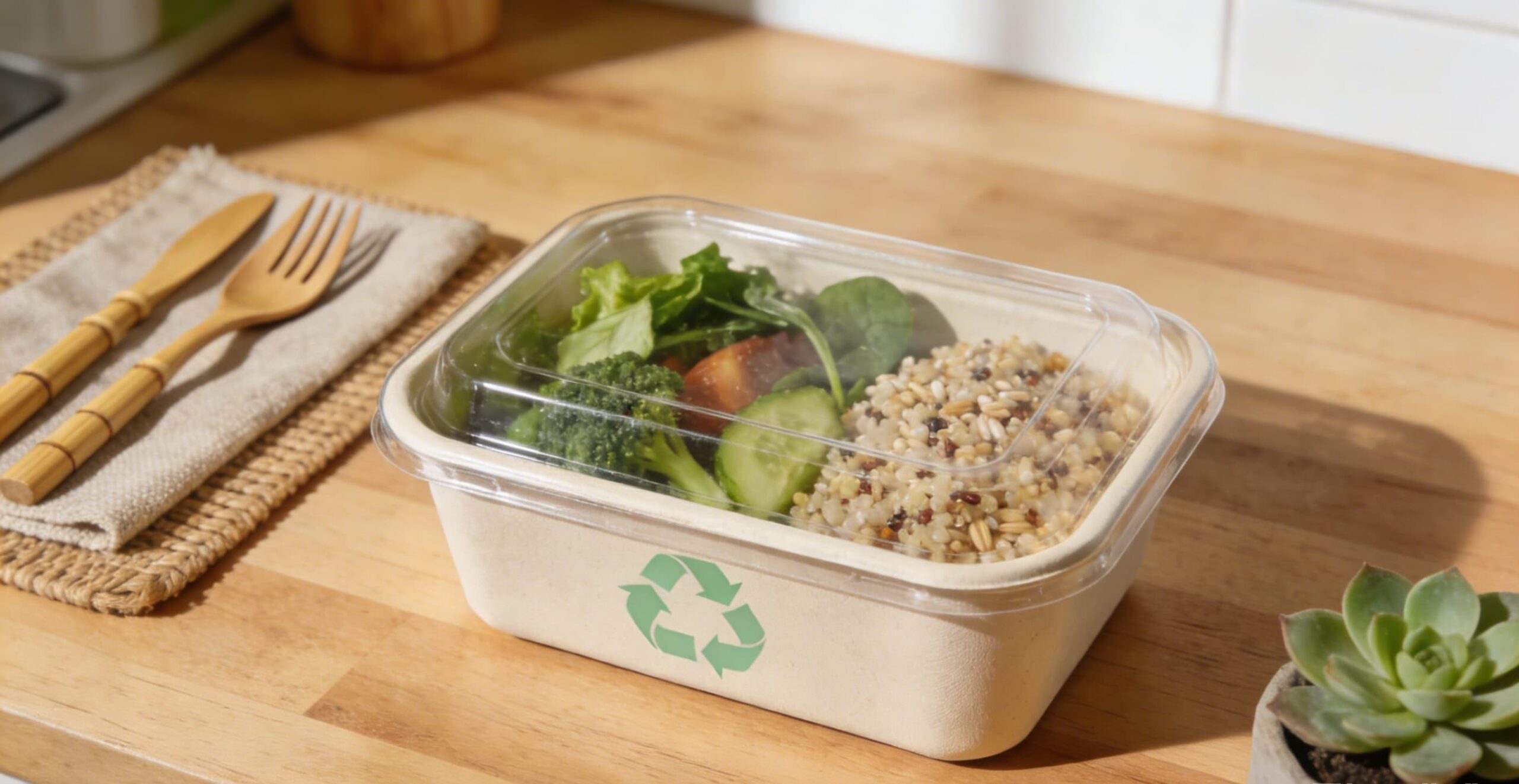
Among these, three materials have emerged as dominant options in the EU market:
- PLA: a bio-based polymer derived from renewable resources, suitable for cold applications but dependent on industrial composting infrastructure
- Bagasse: a natural fiber material produced from sugarcane residue, offering strong heat resistance and rapid biodegradability
- Paper-based packaging: widely accepted across EU markets, particularly when combined with sustainable coatings
These materials are increasingly recognized as biodegradable food packaging EU compliant, particularly when supported by proper certification systems.
Key Compliance Requirements for Food Packaging Suppliers
Labeling and Marking Requirements
Compliance under the directive extends beyond material selection into product communication. Packaging must clearly inform consumers about its composition and disposal method.
This requirement follows a structured logic. First, products must indicate whether they contain plastic. Second, they must provide clear disposal instructions. Finally, they must include environmental warnings where applicable.
These rules form the basis of EU plastic packaging labeling requirements, ensuring that consumers are actively involved in the waste reduction process.
Extended Producer Responsibility (EPR)
One of the most transformative elements of the directive is the implementation of EPR requirements EU packaging, which fundamentally redefines accountability within the packaging lifecycle.
Historically, waste management responsibilities were largely handled by public systems. Under EPR, this responsibility shifts toward producers and importers, requiring them to finance the collection, sorting, and recycling of their products.
This shift introduces a new cost structure, where the environmental impact of packaging directly influences financial obligations. As a result, material selection is no longer just a technical decision—it becomes a financial strategy.
Recycling Targets and Material Restrictions
The directive also establishes measurable targets to ensure long-term impact.
Rather than relying solely on restrictions, the EU has introduced a progressive system. Collection systems are first standardized, followed by the introduction of specific targets such as a 90% collection rate for plastic bottles by 2029. Over time, these targets are reinforced by requirements for recycled content in new packaging.
These measures define the trajectory of EU packaging recycling targets, pushing the industry toward circular economy models.
Real Impact on Food Packaging Manufacturers and Buyers
Impact on Manufacturers
For manufacturers, compliance represents a structural transformation rather than a simple adjustment.
The transition typically begins with material substitution, followed by investment in new production technologies and certification processes. These changes require both capital investment and operational restructuring.
As a result, many companies experience cost increases in the range of 10–30%, particularly during the initial transition phase. However, these costs are often offset over time through improved efficiency and market access.
For any food packaging manufacturer EU compliance is now a fundamental requirement rather than a competitive advantage.
Impact on Importers and Brands
For importers and brand owners, the impact is primarily reflected in procurement complexity.
Supplier selection now involves not only price and quality, but also compliance verification. This includes certification checks, material validation, and supply chain transparency.
As a result, companies are increasingly prioritizing food packaging suppliers for EU market that can demonstrate both regulatory compliance and production reliability.
Cost Comparison: Plastic vs Biodegradable Packaging
Cost evaluation in the EU context must go beyond unit pricing. It must incorporate regulatory costs, lifecycle impact, and long-term operational efficiency.
To illustrate this, the following comparison outlines typical cost structures and compliance levels across common materials:
| Material | Cost Index | Compliance Level | Sustainability |
|---|---|---|---|
| PP | 1.0 | Medium | Low |
| PET | 1.2 | Medium | Medium |
| PLA | 1.5–1.8 | High | High |
| Bagasse | 1.3–1.6 | High | Very High |
Cost Index:
A comparative pricing reference used in procurement to evaluate material cost differences against a baseline (typically 1.0). It reflects relative cost levels rather than exact prices, taking into account factors such as raw materials, production complexity, and regulatory compliance costs in the EU market.
From this data, it becomes clear that while biodegradable materials have higher upfront costs, they often reduce long-term expenses associated with compliance and environmental impact.
This shift is driving a more strategic approach to eco packaging cost comparison, where lifecycle efficiency becomes the key metric.
How to Choose EU-Compliant Food Packaging
Certifications to Look For
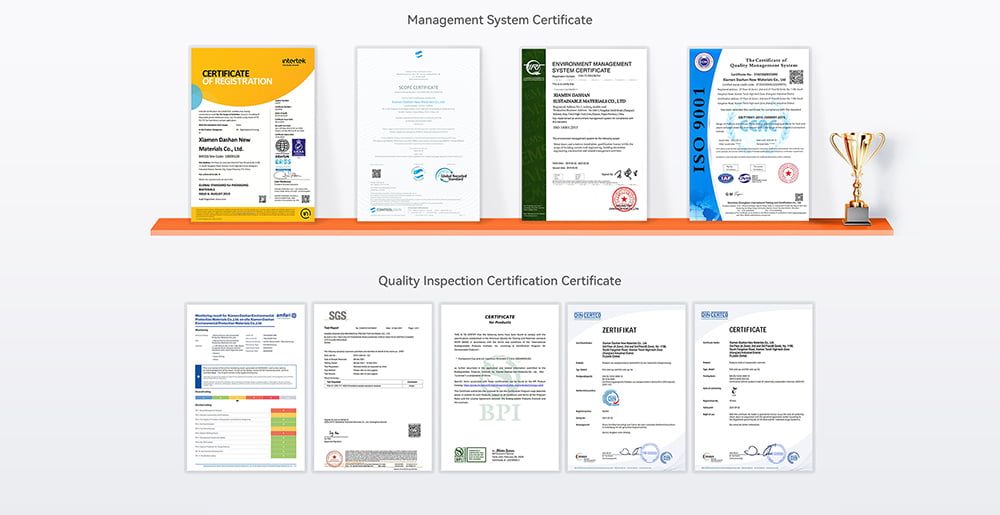
Certification serves as the foundation of compliance in the EU market.
The process follows a logical sequence. Materials must first meet compostability standards such as EN13432. They must then comply with food safety regulations such as LFGB. Additional certifications may be required depending on the export market and application.
Together, these requirements define the framework of EU compostable packaging certification.
Supplier Selection Criteria
Choosing the right supplier has become a strategic decision that directly affects compliance, cost, and operational flexibility.
Buyers typically evaluate suppliers based on several key factors:
- Material capabilities, including access to PLA, bagasse, and paper solutions
- Production consistency and scalability
- Certification and compliance experience
- Flexibility in MOQ and customization
This is why procurement teams increasingly search for partners such as biodegradable food packaging manufacturer, eco packaging factory China, and low MOQ packaging supplier, all of which combine compliance with practical supply chain advantages.
In practice, many buyers prefer working with suppliers that combine compliance expertise with flexible production capabilities.
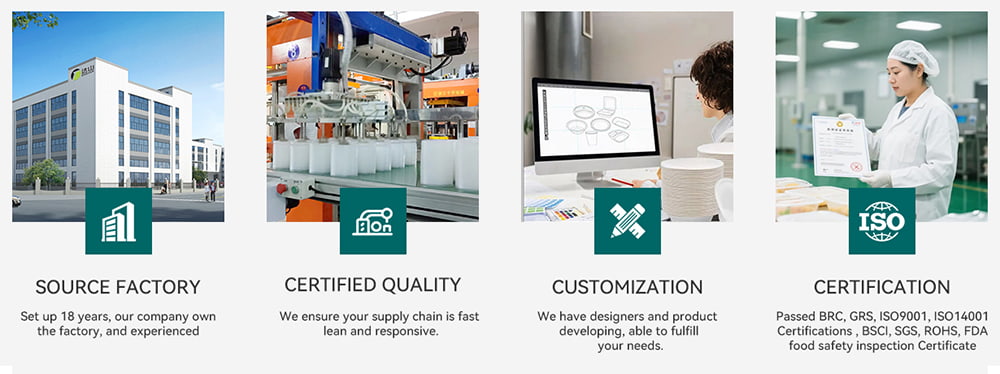
For example, companies like DASHAN, as a biodegradable food packaging manufacturer and eco packaging factory China, focus on providing EU-compliant materials such as PLA and bagasse, while supporting low MOQ orders and customized solutions for international buyers.
This type of flexibility is particularly valuable for businesses testing new markets or adapting to regulatory changes.
Industry Trends: Where EU Packaging Regulations Are Heading
The EU regulatory framework continues to evolve, and its direction is becoming increasingly clear.
In the short term, enforcement is becoming stricter, with greater scrutiny on non-compliant products. In the medium term, requirements for recycled content and material restrictions will become more widespread. In the long term, the system is expected to shift toward reusable packaging models.
These developments collectively define the future of sustainable food packaging trends Europe, where compliance and sustainability will be fully integrated.
Scientific Perspective: Environmental Impact Comparison
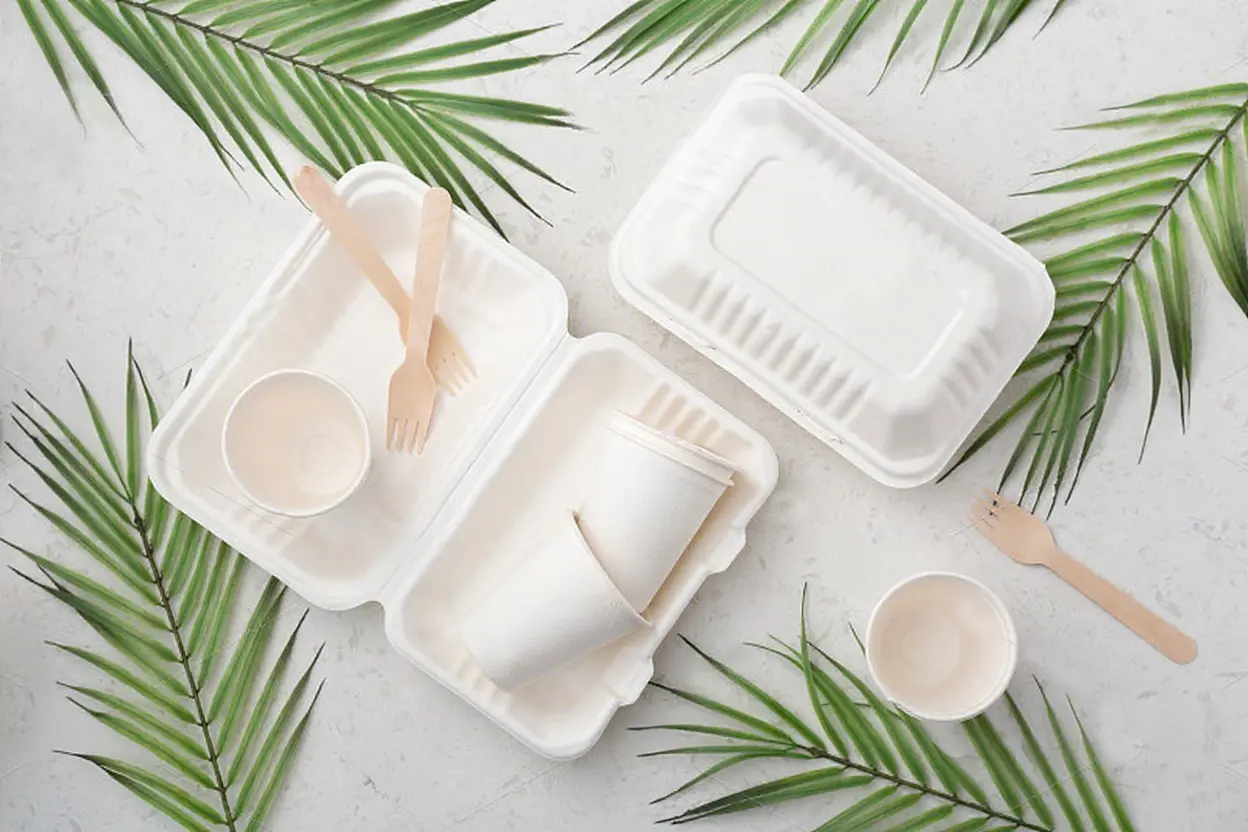
Understanding material selection requires a scientific perspective on environmental impact.
The following data compares lifecycle emissions and degradation timelines across common materials:
| Material | CO₂ Emissions (kg/ton) | Decomposition Time |
|---|---|---|
| Aluminum | 9,000–12,000 | Not biodegradable |
| PET | 2,500–3,500 | 400–500 years |
| PLA | 500–1,000 | 6–12 months |
| Bagasse | 200–500 | 60–120 days |
This comparison highlights a clear trend: materials with lower emissions and faster degradation are becoming increasingly important in regulatory and commercial decision-making.
Opportunities for Global Suppliers (Especially China)
While the directive introduces constraints, it simultaneously creates new opportunities for global suppliers.
The EU market is undergoing a transition toward compliant and sustainable packaging, driven by both regulation and consumer demand. This has resulted in increased demand for certified products, particularly in high-volume sectors such as food delivery and retail packaging.
China, with its advanced manufacturing ecosystem and material diversity, is well positioned to meet this demand. Suppliers that can offer compliant materials, scalable production, and flexible customization are gaining significant traction.
This explains the growing demand for China biodegradable packaging manufacturer, food packaging factory for EU market, and wholesale eco food packaging supplier, all of which play a critical role in supporting the EU’s transition.
Real-World Scenario: Transition to Compliance
A typical business transition under the directive follows a predictable pattern.
Companies initially rely on traditional plastic packaging due to its low cost and availability. As regulations tighten, compliance risks increase, prompting a shift toward alternative materials such as bagasse or PLA.
Although this transition often results in short-term cost increases, these are gradually offset by reduced regulatory risk, improved brand perception, and greater market access.
Over time, compliance evolves from a cost burden into a strategic advantage.
FAQ
1. What is the EU Single-Use Plastics Directive?
It is an EU regulation designed to reduce plastic waste by banning or restricting certain single-use plastic products and promoting sustainable alternatives.
2. Which food packaging products are banned in the EU?
Products such as plastic cutlery, straws, and expanded polystyrene food containers are banned under the directive.
3. Is biodegradable packaging required in the EU?
Biodegradable packaging is not fully mandatory, but regulations strongly encourage its use and restrict traditional plastics.
4. What materials are EU-compliant for food packaging?
Common compliant materials include PLA, bagasse, and paper-based packaging, especially when certified under EU standards.
5. What is EPR in EU packaging regulations?
Extended Producer Responsibility requires producers to finance the collection, recycling, and disposal of packaging waste.
6. How can companies find EU compliant packaging suppliers?
Businesses should look for certified suppliers with experience in EU exports, offering materials like PLA and bagasse and flexible production capabilities.
Conclusion: Compliance Is Becoming a Competitive Advantage
The transformation of EU single-use plastics packaging represents a fundamental shift in how the food packaging industry operates.
Compliance is no longer optional. Sustainable materials are becoming the standard. Cost structures are shifting toward lifecycle efficiency. And supplier selection is increasingly tied to regulatory capability.
Businesses that respond proactively—by aligning with compliant, flexible, and forward-thinking suppliers—will not only meet regulatory requirements but also position themselves for long-term success in a rapidly evolving global market.
As the market evolves, working with experienced and flexible suppliers—such as DASHAN—can help businesses navigate regulatory complexity more efficiently while maintaining cost control and supply stability.
References
- European Commission
Directive (EU) 2019/904 on single-use plastics
👉 https://environment.ec.europa.eu/topics/plastics/single-use-plastics_en - European Environment Agency
Plastic waste and recycling data in Europe
👉 https://www.eea.europa.eu/themes/waste/plastic-waste - European Bioplastics
Bioplastics and compostable materials standards
👉 https://www.european-bioplastics.org - WRAP UK
Packaging sustainability and recycling systems
👉 https://wrap.org.uk - U.S. Food and Drug Administration
Food contact material safety guidelines
👉 https://www.fda.gov/food/food-ingredients-packaging - Plastics Europe
Plastics material data and lifecycle insights
👉 https://plasticseurope.org
Copyright Statement
© 2026 Dashan Packing. All rights reserved.
This content has been carefully developed by Dashan Packing, combining product innovation, material science expertise, and industry insights.
All text, data, and images are proprietary and represent our commitment to authenticity and quality.
Unauthorized reproduction or commercial use is strictly prohibited.
Dashan Packing values transparency, credibility, and long-term trust with our global clients.