Quick Summary
Food-grade packaging is not defined by appearance or marketing claims but by material safety, manufacturing control, and regulatory compliance. This article explains how to identify food-grade packaging by checking materials, food-contact symbols, applicable regulations, intended use conditions, and supplier documentation, helping buyers and users avoid safety and compliance risks.
Introduction
Food packaging comes into direct contact with what people eat every day, yet many buyers, restaurant operators, and even consumers are unsure how to tell whether packaging is truly food grade. Labels such as “food safe,” “eco-friendly,” or “BPA-free” are often used interchangeably, creating confusion and sometimes a false sense of security.
Using non–food-grade packaging can pose health risks, lead to regulatory non-compliance, and damage brand credibility. This article explains, in practical terms, how to identify food-grade packaging, what standards actually matter, and which warning signs to watch for—without requiring technical expertise.
What Does “Food Grade” Packaging Mean?
Food-grade packaging refers to materials and finished products that are approved for direct contact with food under defined conditions of use. This approval is based on scientific testing and regulatory frameworks designed to ensure that packaging does not release harmful substances into food.
It is important to distinguish between related but different terms:
-
Food grade: Suitable for direct food contact under specific conditions.
-
Food safe: Often a marketing term; not always legally defined.
-
Food-contact approved: Indicates compliance with official regulations.
Crucially, food grade status depends not only on the material itself, but also on additives, manufacturing processes, and intended use.
Why Food-Grade Packaging Matters
Health and Safety
Non–food-grade materials may contain substances such as plasticizers, heavy metals, or residual solvents that can migrate into food. Migration risk increases with heat, fat content, acidity, and prolonged contact time.
Legal and Compliance Risks
Many countries regulate food-contact materials. Using packaging that does not meet local requirements can result in product recalls, fines, or import rejections—especially for cross-border trade.
Brand Trust
Consumers increasingly scrutinize packaging. A single safety incident related to packaging can cause lasting reputational damage, even if the food itself is safe.
Look for Official Food-Contact Symbols and Markings
One of the easiest first checks is to examine whether the packaging carries recognized food-contact symbols.
Common Symbols
-
Fork and glass symbol: Indicates suitability for food contact in many regions.
-
Resin Identification Codes (RIC): Numbers inside a recycling triangle (e.g., PP 5, PET 1).
Missing or Misleading Markings
Some food-grade packaging may lack symbols due to regional labeling practices, while some non-food-grade items may display vague or non-standard icons. Markings should always be verified against documentation.
Check the Material Type
Understanding common food packaging materials helps eliminate obvious risks.
Plastics Commonly Used for Food Packaging
-
PP (Polypropylene): Widely used for hot and cold foods; good chemical resistance.
-
PET (Polyethylene Terephthalate): Common for cold foods and beverages.
-
CPET (Crystallized PET): Designed for high-temperature applications.
-
RPET: Recycled PET; food grade only when processed and certified for food contact.
Fiber-Based and Molded Pulp Packaging
-
Sugarcane bagasse and molded fiber products can be food grade when produced without harmful additives and under controlled conditions.
Materials to Avoid for Direct Food Contact
-
General-purpose PVC
-
Industrial plastics not designed for food use
-
Uncoated paper made with recycled fibers of unknown origin
Verify Compliance With Food Safety Regulations
Food-grade status is ultimately defined by compliance with specific regulations, not marketing claims.
Major Regulatory Frameworks
-
United States: FDA food-contact regulations
-
European Union: Framework Regulation (EC) No. 1935/2004
-
Other markets: Often align with EU or FDA standards
Each regulation defines permitted substances, migration limits, and testing requirements.
Why “Compliant” Matters More Than “Certified”
Food-contact materials are often self-declared compliant based on testing, rather than “certified” by authorities. What matters is whether the supplier can provide evidence of compliance.
Evaluate Manufacturing and Processing Standards
Even approved raw materials can become unsafe if processed incorrectly.
Key Factors
-
Clean and dedicated production lines
-
Controlled use of colorants and additives
-
Traceability of raw materials and batches
Food-grade packaging requires process control, not just approved materials.
Assess Intended Use Conditions
Food-grade approval is use-specific.
Temperature
-
Some materials are safe for cold food but not hot food.
-
Microwave or oven use requires specific approval.
Food Type
-
Fatty, acidic, or alcoholic foods increase migration risk.
-
Long-term storage differs from short-term contact.
Always confirm that packaging is approved for the actual use scenario, not just general food contact.
Ask the Right Questions Before Buying or Using Packaging
Whether sourcing packaging or selecting it for daily use, asking the right questions is critical.
Key Questions
-
Which food-contact regulations does this product comply with?
-
Is it suitable for hot food, oily food, or microwave use?
-
Can you provide compliance declarations or test reports?
Red Flags
-
Vague claims without documentation
-
Overreliance on terms like “eco-friendly” or “natural”
-
Inconsistent answers from suppliers
Common Myths About Food-Grade Packaging
“Clear Plastic Is Always Food Safe”
Transparency has no relation to food safety. Many non-food-grade plastics are clear.
“Recyclable Means Food Grade”
Recyclability refers to waste management, not food safety.
“Eco-Friendly Packaging Is Automatically Safe”
Sustainable materials still require food-contact approval and proper processing.
Practical Checklist: How to Identify Food-Grade Packaging
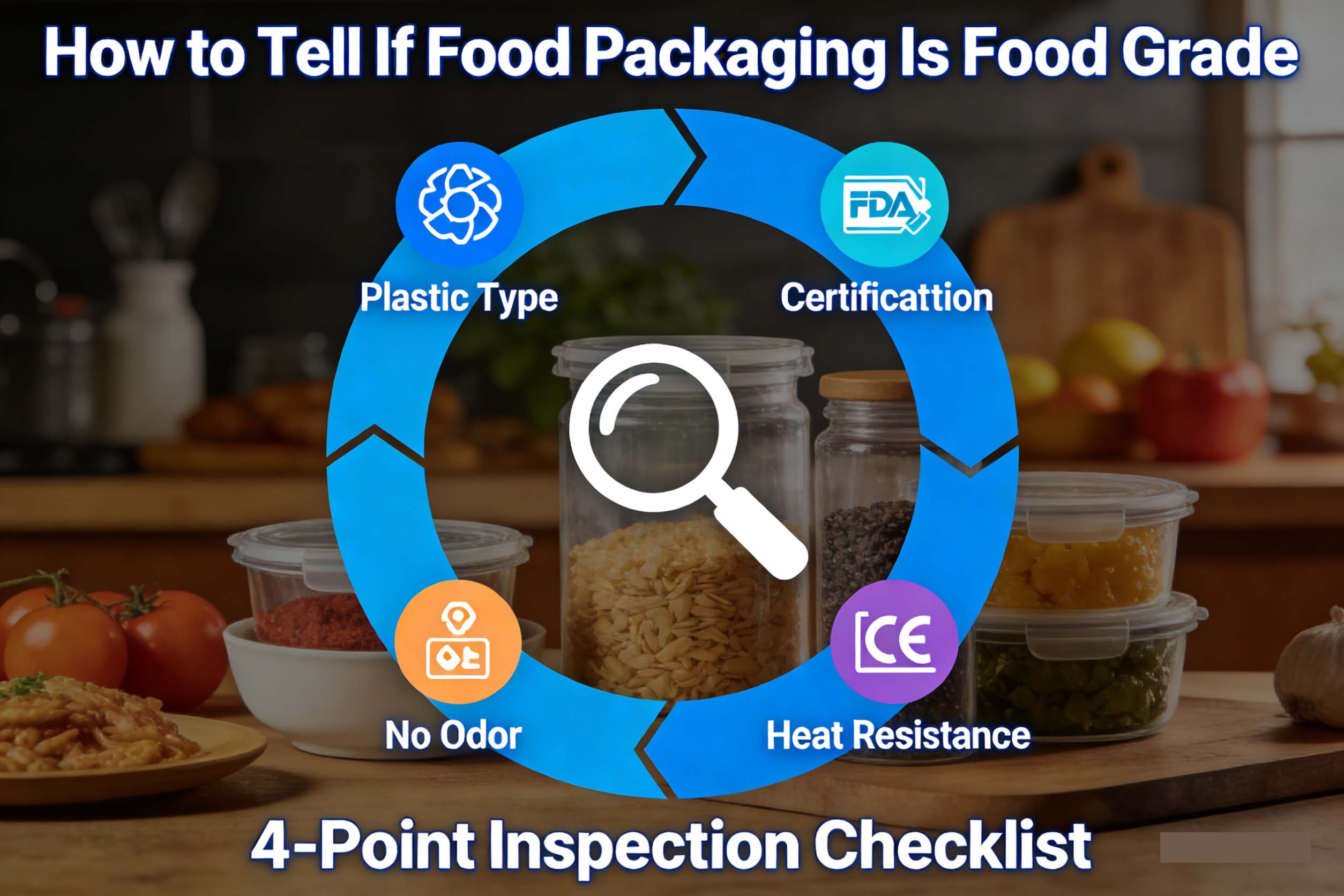
Use the checklist below to quickly assess whether food packaging is suitable for direct food contact. While no single factor is decisive on its own, a combination of these indicators provides a reliable evaluation.
1. Food-Contact Markings and Labeling
☐ Displays a recognized food-contact symbol (such as the fork and glass icon)
☐ Clearly states suitability for food contact on the product or packaging
☐ Includes material identification (e.g., PP, PET, CPET)
Why it matters:
Official markings indicate intended food contact use, but they should be treated as an initial screening step rather than final proof.
2. Material Suitability for Food Contact
☐ Made from commonly accepted food-grade materials
☐ Free from industrial-grade plastics or unknown composites
☐ For fiber-based packaging, produced from virgin or controlled raw materials
Why it matters:
Not all plastics or paper-based materials are inherently food safe. Material origin and formulation play a critical role in food-contact safety.
3. Regulatory Compliance Declaration
☐ Complies with relevant food-contact regulations (e.g., FDA, EU FCM)
☐ Supplier can provide a Declaration of Compliance (DoC) or equivalent
☐ Supporting test reports are available upon request
Why it matters:
Legal compliance is the strongest indicator of food-grade status. Marketing terms alone are insufficient.
4. Manufacturing and Process Control
☐ Produced in facilities following food-contact manufacturing standards
☐ Uses controlled additives, colorants, and processing aids
☐ Offers batch traceability and consistent production records
Why it matters:
Even approved materials can become unsafe if contamination occurs during manufacturing or handling.
5. Intended Use Compatibility
☐ Approved for the actual temperature range of use (hot, cold, reheating)
☐ Suitable for contact with oily, acidic, or moist foods if applicable
☐ Appropriate for short-term or long-term food contact as intended
Why it matters:
Food-grade approval is use-specific. Packaging safe for cold foods may not be safe for hot or fatty foods.
6. Supplier Transparency and Documentation
☐ Supplier provides clear, consistent technical information
☐ Safety claims are supported by documents, not just descriptions
☐ No vague or contradictory answers to compliance questions
Why it matters:
Transparent suppliers reduce compliance risk and are more likely to meet food safety requirements consistently.
7. Final Risk Assessment
☐ All critical safety indicators are met
☐ No unresolved compliance gaps remain
☐ Packaging use aligns with regulatory and practical requirements
If several boxes cannot be checked, the packaging should not be used for direct food contact without further verification.
Optional One-Line Summary (for snippet placement)
Food-grade packaging can be identified by verified food-contact materials, regulatory compliance documentation, controlled manufacturing processes, and suitability for the intended food and temperature conditions.
Frequently Asked Questions (FAQ)
Can packaging be food grade without visible symbols?
Yes. Symbols help, but documentation is more reliable.
Is recycled plastic safe for food contact?
Only when processed under approved food-grade recycling systems and properly tested.
Does food-grade packaging expire?
Materials themselves do not “expire,” but storage conditions and degradation over time can affect safety.
Is food-grade packaging safe for all foods?
No. Approval depends on temperature, contact time, and food composition.
Conclusion
Determining whether food packaging is food grade requires more than reading labels or trusting marketing claims. By understanding materials, verifying regulatory compliance, evaluating manufacturing standards, and matching packaging to its intended use, buyers and users can make informed, safe choices.
Food-grade packaging is not just a regulatory requirement—it is a fundamental part of food safety and consumer trust.
References
-
U.S. Food & Drug Administration (FDA) – Food Contact Substances
https://www.fda.gov/food/food-ingredients-packaging/food-contact-substances -
European Commission – Food Contact Materials (FCM)
https://food.ec.europa.eu/safety/chemical-safety/food-contact-materials_en -
European Commission – Regulation (EC) No 1935/2004
https://eur-lex.europa.eu/eli/reg/2004/1935/oj -
European Food Safety Authority (EFSA) – Food Contact Materials
https://www.efsa.europa.eu/en/topics/topic/food-contact-materials -
PlasticsEurope – Plastics and Food Contact
https://plasticseurope.org/knowledge-hub/plastics-and-food-contact/
Copyright Statement
© 2025 Dashan Packing. All rights reserved.
This article is an original work created by the Dashan Packing editorial team.
All text, data, and images are the result of our independent research, industry experience,
and product development insights. Reproduction or redistribution of any part of this content
without written permission is strictly prohibited.
Dashan Packing is committed to providing accurate, evidence-based information and
to upholding transparency, originality, and compliance with global intellectual property standards.