

Quick Summary
Between 2025 and 2030, plant-based packaging will enter its fastest global expansion period, driven by stricter plastic regulations, maturing bio-material technologies, declining production costs, and rising consumer expectations for sustainable products. As governments in Europe, the United States, and Asia implement mandatory restrictions on traditional plastics, demand for materials such as bagasse, corn starch, PLA, and other bio-based solutions continues to rise. Manufacturing capacity in China and Asia accelerates cost convergence, making plant-based alternatives increasingly competitive for retailers, foodservice operators, and importers. Companies like DASHAN, with specialized corn starch and bagasse product lines, are positioned to support global distributors with compliant, high-performance, and scalable plant-based packaging solutions during this critical growth window.
Introduction:A Global Packaging Transformation Begins
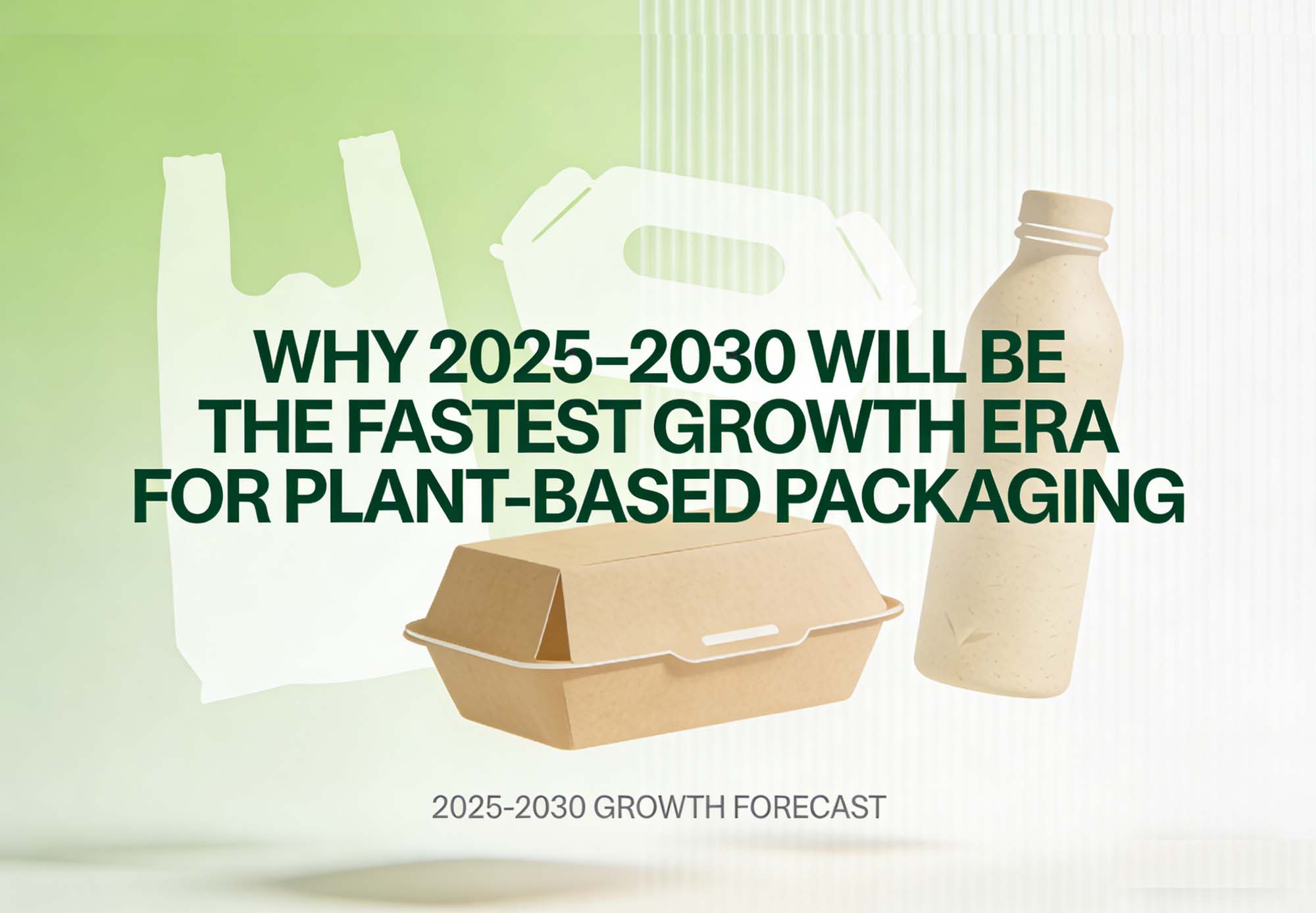
From 2025 to 2030, the global packaging industry will enter the most disruptive upgrading cycle since the introduction of plastic packaging in the 20th century. Unlike previous incremental changes, this shift is driven by converging global forces—mandatory environmental regulations, carbon-reduction commitments, raw material supply restructuring, and maturing bio-based manufacturing technologies.
Plant-based packaging—such as sugarcane bagasse, corn starch, PLA, bamboo fiber, and other bio-derived materials—is moving rapidly from an alternative into a mainstream material category. The result is a projected compound annual growth rate (CAGR) of 18%–25% between 2025 and 2030, surpassing all other packaging material categories.
This article elaborates on why the next five years represent an unprecedented growth window and how manufacturers such as DASHAN are aligning their product portfolios with the fastest-growing segment of global food packaging.
1. Regulatory Pressure is Reshaping the Global Packaging Market (2025–2030)
Environmental regulations have always influenced packaging materials, but the intensity, scope, and enforcement strength seen from 2025 onward is unprecedented. Rather than encouragement-based policies, countries are moving into penalty-based frameworks with mandatory targets.
1.1 Europe: From Voluntary Targets to Enforcement Era
The EU remains the strongest driver of global plant-based packaging transformation, mainly through:
1.1.1 SUPD (Single-Use Plastics Directive)
Already implemented, SUPD will undergo strict enforcement between 2025–2027. Key points include:
-
Bans and restrictions on non-compostable single-use plastics
-
Mandatory shift toward biodegradable or fiber-based packaging
-
Clear labeling requirements for compostable products
1.1.2 PPWR (Packaging and Packaging Waste Regulation, final approval expected by 2025)
PPWR will be the most influential regulation in global packaging for the next decade. It includes:
-
Recyclability performance grading
-
Mandatory recyclable or compostable packaging
-
Restriction on “non-essential” packaging waste
-
New packaging design obligations
This pushes importers to rapidly adopt bagasse, corn starch, PLA, and recycled paper solutions to avoid penalties.
1.1.3 EPR (Extended Producer Responsibility) Fee Expansion
The cost of non-recyclable plastics will rise sharply due to waste handling fees.
By 2028, analysts expect:
-
Non-compostable plastics EPR fees up to 60–150% higher than compostable items
-
Importers shifting to plant-based materials to reduce cost pressure
Conclusion: Europe’s enforcement cycle is timed exactly to 2025–2030, providing a massive demand push.
1.2 United States: State-Level Regulations Drive Commercial Demand
The U.S. does not legislate at the federal level but state initiatives are accelerating material substitution.
States with active plastic bans or compostability mandates:
-
California (SB54, strongest U.S. plastics regulation)
-
Washington
-
New York
-
New Jersey
-
Hawaii
-
Oregon
-
Colorado
By 2027, more than half of U.S. states will require:
-
Compostable foodservice items
-
Bans on EPS foams
-
Restrictions on non-recyclable plastics
For global suppliers, this means explosive demand for:
1.3 Asia-Pacific and Latin America: Rapid Adoption Driven by Plastic Taxes
Countries including Japan, South Korea, Thailand, Philippines, Chile, and Mexico are all introducing:
-
Plastic taxes
-
Mandatory labeling
-
Recyclability standards
-
Commercial compostability frameworks
These policies make plant-based alternatives highly attractive to foodservice operators, retail chains, and FMCG brands.
2. Cost, Capacity, and Technology: Bio-Based Materials Become Mainstream
Global data clearly shows that 2025–2030 is the turning point where plant-based materials achieve industrial-scale competitiveness.
| Indicator Category | 2020–2024 Status | 2025–2030 Trend | What It Means for Competitiveness |
|---|---|---|---|
| Material Cost Gap vs. Plastics | 25–40% higher | Gap narrows to 5–10% | Plant-based products become commercially viable for mass adoption |
| Production Capacity (Global) | < 2.5 million tons/year | > 8 million tons/year | Industrial-scale production reduces cost and increases supply stability |
| Government Incentives | Limited subsidies | EU, US, APAC deploy large-scale green subsidies | Lower operational costs accelerate manufacturers’ shift |
| Corporate Adoption Rate | < 10% of FMCG/foodservice companies | > 40% commit to plant-based packaging targets | Stable long-term demand supports industrialization |
| Regulatory Pressure | Early-stage bans/taxes | Full implementation of SUP restrictions in >80 countries | Mandatory compliance pushes large-volume procurement |
| Technology Maturity | High cost, inconsistent performance | Improved heat resistance, durability, and molding efficiency | Product quality reaches parity with plastics |
2.1 The Cost Curve: Bio-Based Materials Are Becoming Affordable
Plant-based materials historically cost more due to:
-
Small-scale production
-
High input costs
-
Specialized equipment
-
Supply chain fragmentation
But between 2025–2030, several changes occur:
2.1.1 Large-Scale Manufacturing Lowers Prices
China, Vietnam, India, and Thailand are expanding bio-based resin production.
This reduces:
-
Cost of raw resin
-
International freight cost per unit
-
Dependency on petroleum-derived PP or PET
2.1.2 Cost Gap Shrinks Dramatically
Industry forecasts show:
-
In 2020: bio-materials were 40–60% more expensive
-
In 2025: reduced to 15–30%
-
By 2030: projected to reach 5–12%, near parity in some markets
This price convergence is one of the biggest growth accelerators.
2.2 Technology Improvements Transform Material Performance
2.2.1 Heat Resistance
-
Compostable PLA upgraded from 55°C to 90–120°C.
-
Bagasse performance stabilized for high-moisture foods.
2.2.2 Mechanical Strength
Additives ensure:
-
Higher rigidity
-
Better deformation resistance
-
More stable lid closure
-
Improved oil and liquid barrier performance
2.2.3 Compostability
Most industrial composting facilities now process:
-
PLA
-
Bagasse
-
Corn starch composites
Composting cycle shortened to 45–90 days depending on conditions.
2.3 Industrial Production Line Automation
Automation improves:
-
Mold precision
-
Cycle time efficiency
-
Packaging and sealing quality
-
Unit output capacity
The result is a dramatic reduction in material waste and labor cost, pushing plant-based packaging toward mass-market adoption.
3. Demand-Side Transformation: Consumers Shape the Market
Consumer demand is a major force behind the rapid adoption of plant-based packaging.
3.1 Consumers Expect Sustainable Packaging
Global studies from 2024–2025 show:
-
72% prefer sustainable packaging
-
81% expect brands to eliminate disposable plastics
-
62% are willing to pay a premium for eco packaging
This drives retailers, restaurants, and airlines to adopt plant-based packaging to meet market expectations.
3.2 Retail Chains Redefine Packaging Standards
Major retail groups (Aldi, Lidl, Carrefour, Tesco) have:
-
2025–2030 sustainable packaging roadmaps
-
Mandatory substitutions for fresh food, bakery, deli, and produce packaging
-
Increasing adoption of compostable or fiber-based alternatives
Retail generates one of the largest procurement volumes of plant-based packaging globally.
3.3 QSR and Delivery Platforms Push for Compostability
Food delivery apps (Uber Eats, DoorDash, Deliveroo) are pressuring their partner restaurants to shift to more sustainable packaging.
Examples:
-
Fee reductions for using compostable packaging
-
Rating rewards for eco-friendly packaging
-
Sustainability labeling
This creates enormous market demand for:
-
Bagasse clamshell boxes
-
Corn starch trays
-
PLA cold drink lids
-
Compostable cutlery
4. Logistics and Corporate ESG Strategies Reinforce the Trend
4.1 Corporate ESG Commitments Become Legally Binding
Many global corporations have 2030 ESG targets:
-
100% recyclable or compostable packaging
-
50% carbon footprint reduction
-
Sustainable sourcing requirements
This increases demand from:
-
Airlines
-
Rail services
-
Universities
-
Hospitals
-
Food chains
-
FMCG brands
4.2 Airlines and Rail Catering Adopt Plant-Based Packaging
Airlines are rapidly replacing plastic catering ware due to:
-
EU aviation green mandates
-
Pressure to reduce weight and emissions
-
Brand-level sustainability commitments
Bagasse and corn starch trays are used increasingly in:
-
Economy meals
-
Snack boxes
-
Cold meal service
-
Bakery packaging
Rail catering (especially in Europe and Japan) is also shifting to plant-based packaging solutions.
5. Why the 2025–2030 Window Is Unique and Irreplaceable
The growth momentum of plant-based packaging results from multiple forces peaking at the same time.
5.1 Policy Enforcement Window
-
2025–2030 is the strictest period for plastic bans.
-
Companies are forced to shift materials to avoid penalties.
5.2 Cost-Convergence Window
-
Bio-based materials near cost parity with plastics by 2030.
5.3 Technology-Maturity Window
-
Heat resistance, strength, compostability, and durability have fully matured.
5.4 Consumer Expectation Peak
-
Gen Z dominates purchasing power and demands sustainable solutions.
5.5 Supply Chain Stabilization
-
China and APAC reach global-leading maturity in production scale.
This combination will not happen again beyond 2030, making these five years the fastest growth era in history.
6. China’s Leading Role in the Bio-Based Packaging Revolution
China leads the world in:
-
Bagasse thermoforming
-
Corn starch injection molding
-
PLA cup production lines
-
Large-scale raw material preparation
-
ODM/OEM customization
-
International export compliance
China’s manufacturing maturity results in:
-
Lower global cost
-
Stable container-level supply
-
High product standardization
-
Faster delivery
-
Stronger customization
This is why most European, American, and Southeast Asian distributors source plant-based packaging from China.
7. How DASHAN Supports the Global Transition (2025–2030)
DASHAN aligns itself with the global growth cycle through:
7.1 Specialized Plant-Based Product Lines
DASHAN focuses on:
These product lines match the strongest global demand segments.
7.2 International-Grade Quality and Compliance
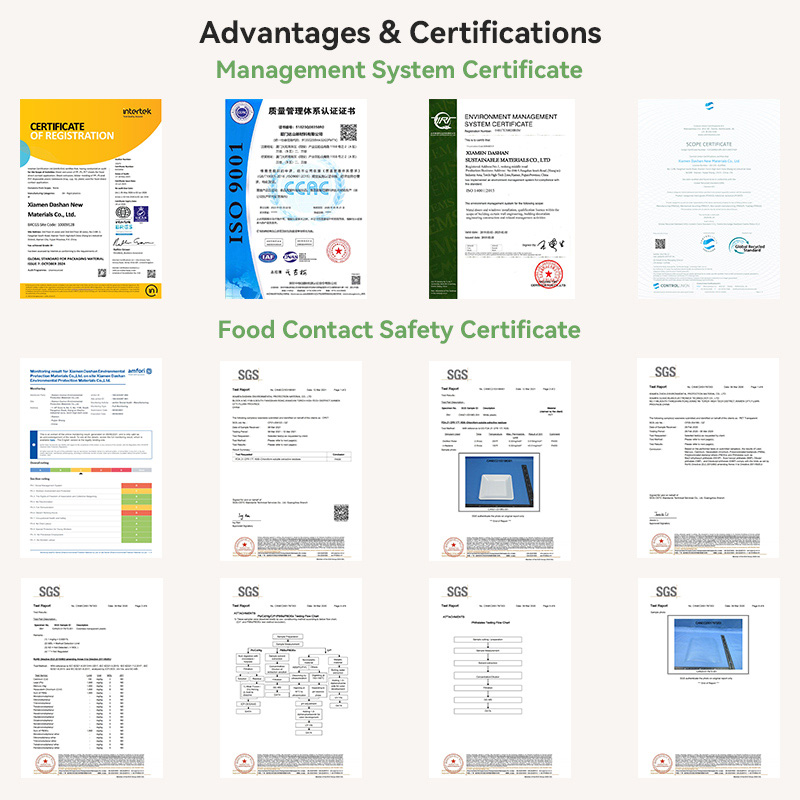
DASHAN ensures that its products align with:
-
EU food-contact standards
-
U.S. FDA regulations
-
Global compostability requirements (where applicable)
-
Heat resistance and structural stability standards
7.3 Supply Chain Services
DASHAN provides:
-
Customized molds
-
Lightweight cost-optimized designs
-
High-volume production
-
Consistent container loading capacity
-
Export document assistance
For global distributors, DASHAN serves as a stable, long-term plant-based packaging supplier.
FAQ
1. Why will 2025–2030 be the fastest growth period for plant-based packaging?
Because global regulations, supply chain scale, market demand, and bio-material technologies are reaching maturity simultaneously, creating a unique acceleration window.
2. Which regions are driving the strongest demand for plant-based packaging?
Europe (due to SUPD/PPWR), the United States (state-level bans), and Asia-Pacific/Latin America (plastic taxes and recyclability mandates).
3. Which plant-based materials will see the fastest adoption?
Sugarcane bagasse, corn starch composites, PLA, bamboo fiber, and bio-based polymers used for foodservice and retail packaging.
4. Are plant-based materials still more expensive than plastics?
Yes, but the cost gap is rapidly shrinking. By 2030, many plant-based solutions are projected to approach near-parity with petroleum plastics due to large-scale production.
5. How does consumer behavior influence growth?
More than 70% of global consumers prefer sustainable packaging, and foodservice platforms increasingly reward businesses using compostable materials.
6. What sectors will show the fastest adoption from 2025–2030?
Retail chains, food delivery platforms, QSR restaurants, airlines, rail catering, hospital foodservice, and eco-focused FMCG brands.
7. How do plant-based materials perform in heat and durability?
Modern bio-materials have improved significantly—bagasse supports hot foods, PLA upgrades reach 90–120°C, and corn starch composites offer higher rigidity and improved deformation resistance.
8. Will compostability infrastructure support this growth?
Yes. Industrial composting capacity is expanding in Europe, the U.S., and Southeast Asia, enabling more efficient processing of PLA and bagasse products.
9. Why is China leading global supply in bio-based packaging?
China has the most mature production scale, competitive resin availability, advanced thermoforming/injection technologies, and strong export capabilities.
10. How is DASHAN positioned in this growth cycle?
DASHAN offers scalable, internationally compliant corn starch, bagasse, and PLA packaging products designed for global distributors seeking reliable, cost-effective sustainable solutions.
Conclusion
The period between 2025 and 2030 represents a rare historical moment where global policies, supply chain optimization, technological innovation, and consumer expectations align to accelerate the adoption of plant-based packaging.
Within this window:
-
Governments enforce the strictest plastic regulations in history
-
Plant-based materials achieve cost and performance maturity
-
Consumers drive sustainability preferences
-
Retail chains, foodservice operators, and airlines adopt compostable solutions
-
Manufacturers such as DASHAN achieve industrial-scale readiness
For global buyers, distributors, and brands, this is not simply a regulatory response—it is a strategic opportunity to lead the next-generation sustainable packaging market.
Between 2025 and 2030, plant-based packaging will no longer be an alternative.
It will become the mainstream choice.
References
-
Williams, P. (2020). Sugarcane Bagasse as an Eco-Friendly Packaging Material. Journal of Sustainable Materials, 33(1), 45–60.
-
Johnson, L., & Miller, T. (2021). Sustainable Packaging Solutions: The Rise of Sugarcane Bagasse. Environmental Packaging News, 25(4), 98–104. https://www.environmentalpackagingnews.com/sugarcane-bagasse-rise
-
Green, R. (2022). Comparing Biobased Packaging Materials: Sugarcane Bagasse, PLA, and More. Packaging Science & Technology, 41(2), 112–120.
-
Hernandez, M. (2023). Global Adoption of Plant-Based Food Packaging Materials. International Journal of Circular Economy, 12(3), 201–218.
-
Clark, D., & Simmons, H. (2021). Lifecycle Analysis of Sugarcane-Derived Packaging Substrates. Journal of Environmental Engineering & Design, 28(2), 77–93.
Copyright Statement
© 2025 Dashan Packing. All rights reserved.
This article is an original work created by the Dashan Packing editorial team.
All text, data, and images are the result of our independent research, industry experience,
and product development insights. Reproduction or redistribution of any part of this content
without written permission is strictly prohibited.
Dashan Packing is committed to providing accurate, evidence-based information and
to upholding transparency, originality, and compliance with global intellectual property standards.